Who does what in UL Lafayette nursing clinicals
A UL Lafayette practicum passes through several hands: course faculty who approve preceptors and guide the course, a graduate coordinator who reviews them, DNP advisors and mentors, the Graduate School and a handful of offices in V.L. Wharton Hall. This guide names each one by title, says what it handles and tells you who to ask for what. Names and contact details change; the university directory and your course pages carry the current ones.
Get your placement plan
Tell us your UL Lafayette program and where you live. A placement advisor replies with the preceptor and site options that fit your UL Lafayette course.
Graduate program titles
Course faculty are the title you will deal with most. Louisiana's Board rules keep nurse faculty responsible for guiding and evaluating every learning experience, and the consortium handbook gives course faculty the approval of each preceptor, with a graduate coordinator review to follow. MSN courses taught at a partner ICMSN school still appear in your UL Lafayette Moodle, so the faculty member for a given course may be based at McNeese, Nicholls or Southeastern; the ICMSN guide explains how that works.
| Title | What they handle | When you deal with them |
|---|---|---|
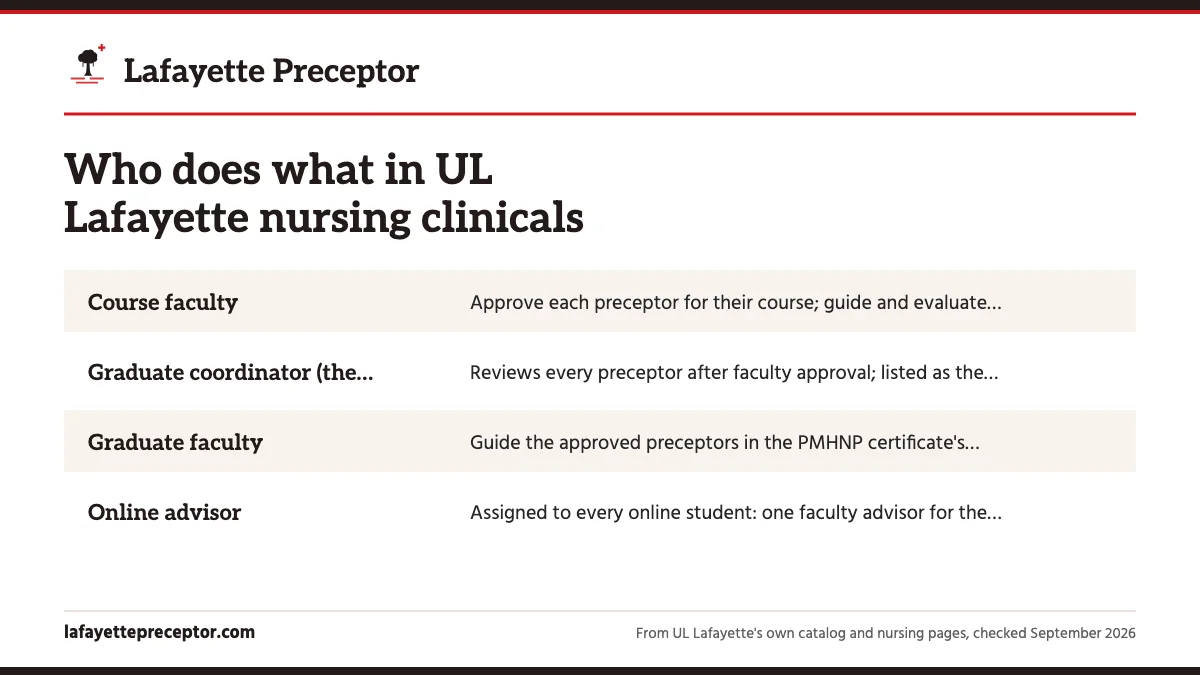
| Course faculty | Approve each preceptor for their course; guide and evaluate your clinical work with preceptor input; confer weekly with you and your preceptor | Before and throughout every practicum |
| Graduate coordinator (the Graduate Nursing Program Coordinator) | Reviews every preceptor after faculty approval; listed as the contact for the MSN concentrations | When a preceptor is proposed, and for program-level MSN questions |
| Graduate faculty | Guide the approved preceptors in the PMHNP certificate's clinical courses | NURS 591, NURS 592 and NURS 597 |
| Online advisor | Assigned to every online student: one faculty advisor for the MSN and the PMHNP certificate, a separate advisor for the DNP | Course planning each advising period |
DNP titles
The Doctor of Nursing Practice has its own cast, most of it tied to the residency courses and the Synthesis Project.
- DNP Coordinator: holds the virtual admission interview with DNP Faculty, approves the statistics prerequisite, plans each student's program and gives permission for NURS 809 to 812, the courses for students who need extra residency hours.
- DNP Faculty: the doctoral faculty who join the DNP Coordinator for the admission interview.
- Faculty advisor / Synthesis Project Committee chairperson: formally approves your project topic, which is identified on the DNP Progress Report Form, and works with you and your residency mentor in
NURS 822. - Synthesis Project Committee: faculty plus a mentor, approved by the program, from the agency that will host your project.
- Residency mentor: your partner, with the faculty advisor, as you implement an evidence-based intervention in
NURS 822. - Graduate School Dean: approves admission to candidacy, using a form available from the Graduate School, and approves transfer credit.
The DNP office shares its Wharton Hall room with the graduate nursing office. The DNP residency and Synthesis Project guides show how these roles meet across NURS 821, NURS 822 and NURS 823.
Drug screening and compliance roles
The School of Nursing's drug and alcohol policy covers entry to the first clinical course in any program, graduate or undergraduate, and it names who touches your results. The test is ordered through the school's clinical health requirement compliance tracker software and run by a laboratory holding SAMHSA and/or CAP-FUDT certification, at the student's expense.
A Medical Review Officer reviews the laboratory results. The Department Head of the School of Nursing receives them and reports confirmed positives to the Louisiana State Board of Nursing. The policy also provides for random and for-cause testing while you are enrolled.
DNP students have a second checkpoint: before the residency courses they arrange background checks, drug and alcohol tests and the DNP's health items, again at their own expense. Timing and testing types are in the background check and drug screen guide.
Offices and where to find them
| Office | Where | What it handles |
|---|---|---|
| Nursing student services | V.L. Wharton Hall, Room 254 | The LHC Group · Myers School of Nursing's student services desk |
| Graduate nursing office | V.L. Wharton Hall, Room 307 | Keeps the clinical documents the consortium requires before any clinical day; shares the room with the DNP office |
| Graduate School | Martin Hall, Room 332 | Admission, candidacy, withdrawals and resignations, leave of absence, and appeals to its Dean |
| Online advising | Online | Your assigned advisor for course planning |
| IT Service Desk | Stephens Hall, Room 110, plus online chat | ULID accounts, ULink, Moodle, Banner, email and software |
The clinical tracking system does some of this work for you: it shows students whether a facility already has a contract with the university, and it holds the approved clinical schedule. For ULID, ULink and Moodle, see student systems.
BSN semester coordinators
Pre-licensure students meet a different title. In the traditional BSN, the semester coordinators set each student's lab day, and students do not pick it themselves. NURS 208 Fundamentals of Caregiving opens the clinical sequence and meets one day a week on the student's Tuesday, Wednesday or Thursday lab day. Questions about that day go to the semester coordinators, and health documents for BSN clinical courses are due August 1 before Fall and January 5 before Spring.
Accelerated BSN students rotate through Ochsner Lafayette General or another agency affiliated with Ochsner as part of the UL Lafayette · Ochsner program, starting with NURS 208A in the Summer 8-week term that follows the May intersession. The traditional BSN guide walks through entry to NURS 208, from the application to the health documents.
Who to ask for what
Most questions have an obvious first stop once you know the titles. Use this list before you send a message to three offices at once.
- Is this preceptor acceptable for my course? Course faculty, followed by the graduate coordinator's review.
- Does the university have a contract with this facility? The clinical tracking system first, then the graduate nursing office.
- Which courses do I take next term? Your assigned online advisor.
- How do I get into a course taught at a partner school? The consortium's Online Enrollment Form, submitted each advising period.
- Can I take an incomplete? Your course faculty, who grant one at their discretion.
- How do I withdraw from a course or resign from all of them? The Graduate School.
- My DNP topic or mentor is changing. Your faculty advisor and the DNP Coordinator.
- Moodle or ULink will not let me in. The IT Service Desk.
Where we fit
Knowing the titles is half the work; giving each of them what they need is the other half. Your placement advisor at Lafayette Preceptor works on your side of that chain. We find a preceptor and site in Louisiana that fit your course, gather the license, certification and CV course faculty look for, and prepare what the graduate nursing office holds before day one, so everyone approving your practicum sees a complete file. When a question belongs to one of the titles above, we tell you which one and what to bring.
Whatever part UL Lafayette plays in arranging your placement, we make sure it meets the rules these titles apply, and we stay on call through the semester if a preceptor changes. Start with how it works, or send your details through the form below.
Questions UL Lafayette students ask
Who approves my preceptor at UL Lafayette?
Under the consortium handbook, approval starts with your course faculty and ends with a review by the graduate coordinator, all before your first clinical day. Louisiana's rules add a standard of their own: written selection criteria, drawn up jointly by faculty and the facility's nursing leadership. The PMHNP certificate describes its preceptors as approved and guided by graduate faculty.
Where is the graduate nursing office?
Room 307 in V.L. Wharton Hall, in Lafayette. It is where the consortium's pre-clinical file lives: the agency contract, the preceptor CV and the signed letter of agreement, along with your health, OSHA and HIPAA items. The DNP office uses the same room, and nursing student services works out of Room 254 in that building.
Who should a DNP student contact about residency hours?
The DNP Coordinator plans each student's program and gives permission for NURS 809 to 812, the directed-study courses for students who need extra residency hours. Inside the residency itself, your faculty advisor (the committee chair) and your residency mentor are the people you work with week to week.
Who sees my drug screen results?
Under the School of Nursing's drug policy, results pass through a Medical Review Officer and on to the School of Nursing's Department Head. Any confirmed positive goes to the Louisiana State Board of Nursing. The test is ordered through the school's compliance tracker software and paid for by the student.
Who handles withdrawing from a clinical course?
Graduate students start a withdrawal, which drops some classes, or a resignation, which drops all of them, at the Graduate School, using an electronic form open until 11:59 PM on the calendar deadline. Talk with your course faculty first, since the consortium allows no more than two W grades across the MSN.
Related pages
Last checked 2026-09-27
We check these pages against UL Lafayette's 2026-27 catalog, its online program and state authorization pages, the ICMSN student handbook and Louisiana's nursing rules. Your course faculty and your plan of study have the final word.
Whether UL Lafayette helps or you start alone, we find the preceptor.
Tell us your UL Lafayette program, the practicum coming up and the Louisiana town you train near. We look for preceptors and sites that fit the course and gather the license, CV and agency details that must be on file before your first clinical day.
- Preceptors who meet Louisiana's rules: an active Louisiana license, most hours with an APRN in your population focus
- The preceptor's CV, the agency details and your letter of agreement items gathered early
- Across Acadiana and the rest of Louisiana, plus DNP residencies in your home state
Start your placement plan
Your program, your town and your next clinical semester is all we need to begin.