UL Lafayette's Doctor of Nursing Practice, post-MSN
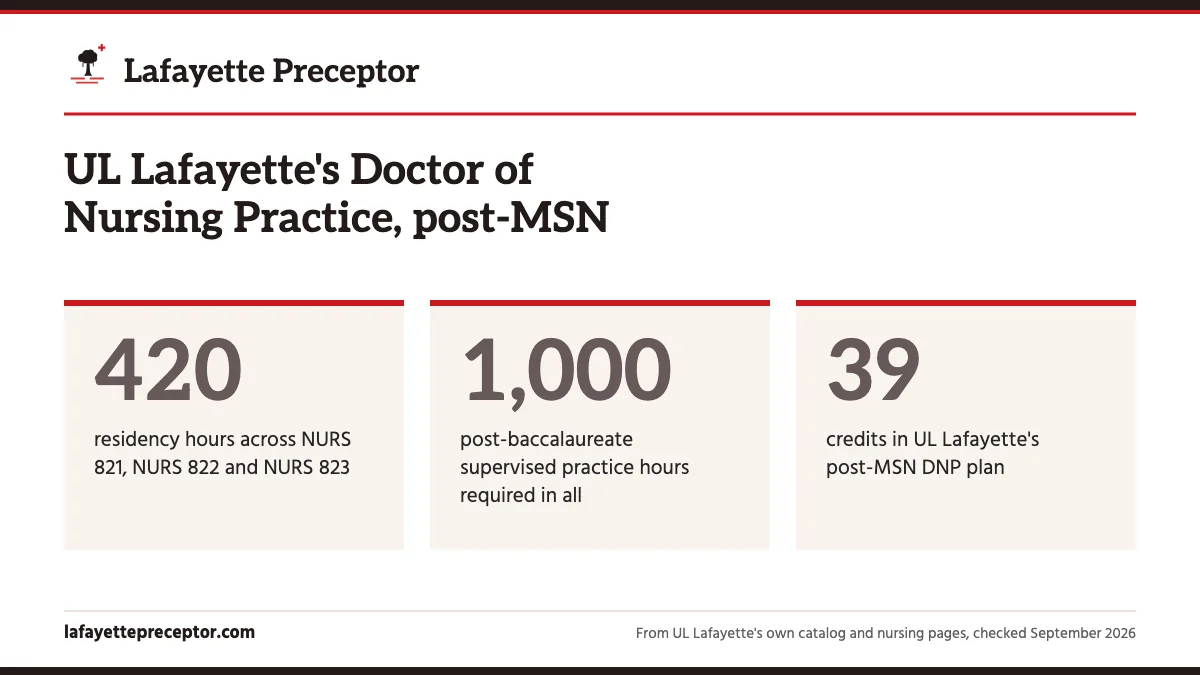
UL Lafayette's DNP is a 39-credit post-master's program that admits one cohort a year, each Fall, with applications due May 1. Coursework is online, two campus events bookend it, and three residency courses add 420 practice hours toward the 1,000 post-baccalaureate hours every graduate must show.
Find your residency site and mentor
Tell us your specialty, your project idea and where you live.
The DNP in brief
UL Lafayette's Doctor of Nursing Practice is a post-master's program. The 2026-27 catalog carries only the post-MSN curriculum, and the nursing school describes its MSN-to-DNP students beginning each fall. The plan totals 39 credits, and the DNP holds its own CCNE accreditation, separate from the consortium MSN and current through December 31, 2033.
One cohort starts each Fall, and applications close May 1. Didactic courses run online, with two required campus events: an opening DNP Orientation Intensive held just ahead of the first term, and a formal Synthesis Project presentation to close the program. The Synthesis Project guide covers both, along with the project committee.
Three eligibility notes sit outside the admission list. The online program may not be available to applicants in every state, F-1 students are excluded, and the Graduate School section of the catalog states that UL Lafayette nursing faculty may not be admitted to the DNP.
The 39-credit plan: catalog and web versions
The catalog and the nursing school's curriculum page agree on the totals, 39 credits and 420 residency hours, but not on every course. The table follows the catalog and notes where the web plan differs.
| Semester | Course | Credits | Web plan |
|---|---|---|---|
| 1 | NURS 800 Scholarly Foundations for Advanced Practice | 3 | Same |
| 1 | NURS 802 Epidemiology | 3 | Same |
| 1 | NURS 805 Preventive Care for Populations | 3 | Placed in semester 3 |
| 2 | NURS 801 Biostatistics | 3 | Same |
| 2 | NURS 804 Clinical Scholarship and Analytic Methods for Evidence-Based Practice | 3 | Same |
| 3 | NURS 803 Project Planning | 3 | Same |
| 3 | NURS 806 Health Care Informatics | 3 | Titled Health Informatics |
| 4 | NURS 821 Residency I (120 hours) | 3 | Same |
| 4 | NURS 808 Ethics and Health Care Policy | 4 | 3 credits |
| 5 | NURS 807 Organizational and Systems Leadership | 4 | Same |
| 5 | NURS 822 Residency II (180 hours) | 4 | Same |
| 6 | NURS 823 Residency III (120 hours) | 3 | 4 credits |
Semesters one to three build the tools a Synthesis Project needs: epidemiology, biostatistics, evidence methods, informatics and project planning. The residency courses take over from semester four.
Six semesters, or as little as two years
The catalog plan runs six semesters. UL Lafayette's online DNP page says the program can be finished in "as little as two years," and the same page says courses are offered online in the Fall and Spring semesters. If courses run only in those two terms, six semesters would span three academic years. That is our reading of the two statements, not a UL Lafayette figure, so ask the DNP Coordinator to map your own timeline at the start.
The outer limit is firm: every DNP requirement must be finished within five years of admission. Most of the timing risk sits in the residency, because NURS 821, NURS 822 and NURS 823 fall in consecutive semesters and each needs its site and mentor settled before the term opens. A residency site that falls through in semester five can push back the finish, not just one course.
Admission, and where UL Lafayette's pages differ
The catalog's DNP program page sets the core entry rules.
- An active, unencumbered RN license from any U.S. state; post-MSN applicants also need an unencumbered U.S. APRN license as a nurse practitioner
- A master's as a nurse practitioner, CRNA or CNM, or in nursing administration, leadership or nursing education
- A 3.3 GPA on master's coursework
- Three recommendations
- A virtual interview with the DNP Coordinator and DNP faculty
- A graduate statistics course before
NURS 801Biostatistics - Ahead of residency: background checks, drug and alcohol tests and program health clearance, paid by you (the screening guide has details)
Other UL Lafayette pages word this differently. The Graduate School section of the catalog names nurse practitioner, CRNA, CNM and nurse administration or executive backgrounds, leaves out nurse educators, and asks only for U.S. nursing licensure. The nursing school's requirements page accepts a 3.0 cumulative GPA on all undergraduate work or 3.3 on graduate work, and its How to Apply page calls the interview a telephone interview. The catalog program page comes first; the DNP Coordinator settles any gap.
UL Lafayette has also used a form titled Verification of Post-Baccalaureate Practicum Hours, on which your MSN program director reports the supervised advanced practice hours you completed; an institution-specific form may be substituted. Those hours matter for the 1,000-hour total below.
420 residency hours toward 1,000 in all
UL Lafayette asks each DNP graduate to show 1,000 or more supervised practice hours earned after the bachelor's, with the residency hours counted inside that figure: 120 in NURS 821 Residency I, 180 in NURS 822 Residency II and 120 in NURS 823 Residency III. Verified supervised hours from your MSN supply the rest, which is why the practicum verification matters at admission.
If your MSN hours plus 420 come to less than 1,000, you register for extra directed study to close the gap. NURS 809 through NURS 812 are Advanced Directed Studies I to IV, worth 3, 1, 2 and 4 credits, and each needs the DNP Coordinator's permission.
The residency is where your Synthesis Project comes to life. The catalog describes NURS 822 as implementing "an evidence-based intervention in collaboration with residency mentor and faculty advisor," and UL Lafayette's online page places practica in your specialty area of practice. The DNP residency guide goes course by course.
Louisiana or your home state
Unlike the MSN, the DNP is not tied to Louisiana. UL Lafayette's post-master's DNP page places the clinical hours in "Louisiana or your home state," and the admission rules ask for U.S. licenses rather than Louisiana ones. That opens the residency to DNP students living outside Louisiana, within the state limits below.
Which home states qualify is less settled. The program list on UL Lafayette's state authorization page accepts DNP students from 44 states and the District of Columbia. Six states are missing from it: Wyoming, Washington, Tennessee, Oklahoma, Maryland and Kansas. Yet the same page's state-by-state section lists the DNP under every state. If you live in one of those six, get a clear answer from UL Lafayette's online programs office before you apply; the state authorization page tracks each program's list.
Wherever the residency takes place, the agency still supplies an approved mentor for your project committee, and the screenings listed above still come before the first residency course.
Grades and time limits: two rules on record
Two catalog passages govern DNP grades. The program page uses a retake rule: a course that ends below B has to be taken again, with a single retake allowed. The Graduate School's DNP section sets a ceiling instead: one course with a C can stand, and a second C ends a student's eligibility for the program.
The two rules can lead to different outcomes for a student with a second C, so ask the DNP Coordinator how they apply to your cohort before it matters. The nursing school's requirements page adds a 3.0 cumulative GPA held "at all times," and the five-year completion clock runs from admission. More detail is on the grades and progression page.
Why DNP students choose us for the residency
The residency rests on two things that must be in place before NURS 821: a practice site in your specialty and a mentor there. UL Lafayette's project committee includes an approved mentor from the agency where you plan to carry out the project, and NURS 822 is completed alongside that residency mentor and your faculty advisor.
Whatever role UL Lafayette plays in setting up your residency, we find an agency and a mentor that fit its rules and your project, in Louisiana or your home state, early enough for mentor approval and your screenings to clear before the term. We assemble the mentor's credentials and practice details and the agency's information so your faculty advisor and committee receive a complete file. They approve the mentor and the project topic; we make sure what reaches them is ready on the first pass.
If a mentor changes jobs or an agency pulls back mid-residency, your placement advisor goes straight to work on a new site and mentor so your hours and project keep moving. Read how it works, then send your specialty and target residency term through the form below.
Questions UL Lafayette students ask
Can a nurse educator apply to UL Lafayette's DNP?
The catalog program page lists a nurse educator master's among accepted backgrounds, yet it also asks post-MSN applicants for a U.S. APRN nurse practitioner license, and the Graduate School section leaves educators out. Because the pages disagree, ask the DNP Coordinator before applying; the answer decides whether your master's qualifies.
Is there a BSN-to-DNP option at UL Lafayette?
Not in the 2026-27 catalog, which lists only the post-MSN curriculum for the DNP. For a nurse holding a BSN, the current path at UL Lafayette runs through an MSN first, such as the online FNP or PMHNP concentration, and then into the post-MSN DNP once the master's is complete.
How many times do DNP students come to campus?
Twice, going by UL Lafayette's pages: once for the Orientation Intensive at the very start, and once to present the finished Synthesis Project. The catalog describes the admission interview as virtual, and all didactic courses are online, so the rest of the program happens remotely or at your residency site.
Do I need a Louisiana nursing license for the DNP?
No specific Louisiana license is listed. The catalog asks for U.S. licensure: an unencumbered RN license and, for post-MSN applicants, an unencumbered APRN license as a nurse practitioner, issued by any state. That sets the DNP apart from the MSN and the PMHNP certificate, which tie admission and clinicals to Louisiana licensure.
Do my MSN clinical hours count toward the DNP's 1,000?
Yes. The 1,000-hour requirement covers post-baccalaureate supervised practice, and the 420 residency hours sit inside it, so verified supervised hours from your MSN make up the balance. If the combined total falls short, the DNP Coordinator can approve NURS 809 through NURS 812 for the missing hours.
Related pages
Last checked 2026-09-27
We check these pages against UL Lafayette's 2026-27 catalog, its online program and state authorization pages, the ICMSN student handbook and Louisiana's nursing rules. Your course faculty and your plan of study have the final word.
- UL Lafayette 2026-27 catalog: Doctor of Nursing Practice, DNP
- UL Lafayette 2026-27 catalog: Graduate School, Doctor of Nursing Practice requirements
- UL Lafayette Online: Doctor of Nursing Practice
- UL Lafayette LHC Group · Myers School of Nursing: Post-Masters DNP
- UL Lafayette Online: state authorization for online programs
Whether UL Lafayette helps or you start alone, we find the preceptor.
Tell us your UL Lafayette program, the practicum coming up and the Louisiana town you train near. We look for preceptors and sites that fit the course and gather the license, CV and agency details that must be on file before your first clinical day.
- Preceptors who meet Louisiana's rules: an active Louisiana license, most hours with an APRN in your population focus
- The preceptor's CV, the agency details and your letter of agreement items gathered early
- Across Acadiana and the rest of Louisiana, plus DNP residencies in your home state
Start your placement plan
Your program, your town and your next clinical semester is all we need to begin.