UL Lafayette's traditional BSN: NURS 208 entry and assigned clinical days
UL Lafayette's traditional BSN is a 120-credit, face-to-face program laid out over eight semesters, and its clinical side begins with NURS 208 in the sophomore year. The BSN is the one place where UL Lafayette states plainly that it assigns clinical days, so this guide covers the entry rules, the course sequence, the paperwork deadlines and the grade rules, then looks ahead to graduate study.
Planning past your BSN?
Tell us which graduate program you have in mind and when you expect to start.
The program in brief
The catalog lists the Nursing, BSN at 120 credits and describes the traditional track as face-to-face, eight semesters long and possible to finish in four years. The School of Nursing says the program prepares students for licensure within Louisiana, and the BSN is CCNE-accredited through Dec 31, 2033 and carries full approval from the state nursing board.
Two early gates shape the timeline. Before NURS 104 you need ACT scores of at least 18 in English and 21 in Math, or SAT scores of at least 450 in English and 500 in Math. Later, the nursing courses themselves follow a strict order: the catalog says all nursing courses must be taken in numerical order, so a delay in one course pushes every course after it.
The first clinical course is NURS 208, Fundamentals of Caregiving, taken with its co-requisite NURS 209, Health Assessment Skills. The first clinical course guide compares where that point falls in every UL Lafayette program.
Getting into NURS 208
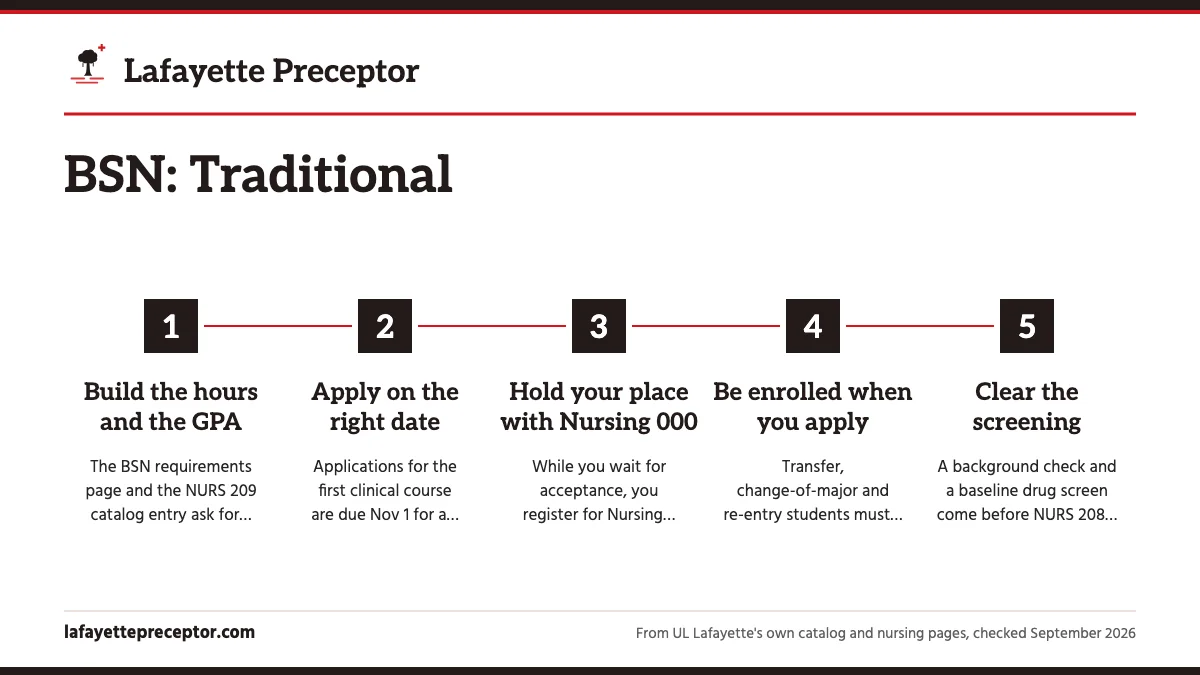
- Build the hours and the GPAThe BSN requirements page and the NURS 209 catalog entry ask for 45 credit hours, each course passed with a C or better, and a 2.8 cumulative GPA.
- Apply on the right dateApplications for the first clinical course are due Nov 1 for a Spring start and Apr 1 for a Fall start.
- Hold your place with Nursing 000While you wait for acceptance, you register for Nursing 000, a 7-credit-hour holding course.
- Be enrolled when you applyTransfer, change-of-major and re-entry students must be enrolled at UL Lafayette in the semester they apply for NURS 208 and 209.
- Clear the screeningA background check and a baseline drug screen come before NURS 208; the section on documents below has the detail.
UL Lafayette's sources do not agree on every entry number. The NURS 208 catalog entry lists a 2.6 GPA, while its co-requisite's entry, the requirements page and the School of Nursing's policy text say 2.8. On hours, most sources say 45, but the policy text says a minimum of 42 semester hours. Your academic advisor and nursing student services in V.L. Wharton Hall, Room 254, can tell you which figure they apply to your application.
Plan for the stricter numbers, a 2.8 GPA and 45 hours, until UL Lafayette confirms otherwise.
Lab days: assigned by the semester coordinators
In the BSN, UL Lafayette sets your clinical schedule. The School of Nursing's clinical requirements page answers the question directly: "Do I get to choose my lab day? No, lab days are assigned by the semester coordinators." The BSN handbook likewise sends students to assigned healthcare agencies.
For NURS 208, clinical is one day a week, falling on your Tuesday, Wednesday or Thursday lab day. You learn which day when it is assigned, so hold those three weekdays loosely when you plan a job, childcare or a commute for that semester.
You are responsible for getting yourself to each clinical site, and you buy the school uniform before clinicals start. Neither the site nor the day is yours to pick, which is a real contrast with the graduate programs, where the clinical side runs under different rules. For BSN students the practical work is keeping your documents current, arriving ready on your assigned day and earning a Satisfactory in every lab and clinical component.
The clinical course sequence
Five courses carry the bulk of the clinical load, with a simulation capstone at the end. The catalog's course entries give each one a lab contact hour figure, shown below. That field is a catalog contact-hour measure, not a published clinical-hour total, and UL Lafayette publishes no total clinical hours for the BSN.
| Year | Course | Credits | Lab contact hours |
|---|---|---|---|
| Sophomore | NURS 208 Fundamentals of Caregiving | 4 | 4.5 |
| Junior | NURS 308 Adult Health and Illness I | 9 | 13.5 |
| Junior | NURS 340 Community and Psychiatric/Mental Health Nursing | 9 | 13.5 |
| Senior | NURS 403 Childbearing Family, Child and Adolescent Health Care | 9 | 13.5 |
| Senior | NURS 418 Adult Health and Illness II | 9 | 13.5 |
| Senior | NURS 420 Bridge to Professional Practice | 1 | 3 (simulation) |
NURS 420 pairs high-fidelity simulation with NCLEX preparation, and the HESI exam falls in your final semester. The figure triples from 4.5 in NURS 208 to 13.5 in the junior courses, so expect a heavier clinical schedule from the junior year on.
Before each clinical term: documents and screening
Health documents, due Aug 1 before Fall and Jan 5 before Spring clinical courses
- A physical exam
- Immunizations and TB screening
- BLS certification through the American Heart Association or the Red Cross
- Proof of health insurance
- A urine drug screen
Screening starts before NURS 208: a Level I background check (Level II if you already hold a license or work as a certified caregiver) and a baseline drug screen. If your record includes discipline, an arrest or impairment in any state, you need clearance from the Louisiana State Board of Nursing before a clinical course. Random and for-cause drug testing, both part of the School of Nursing's policy, are explained in our own guide to the background check and drug screen, and the full document list is on clinical health requirements.
One more rule from the BSN handbook is worth knowing. Should a clinical agency turn a student away over the background check, the university has discretion to attempt a placement at another agency when space exists; without one, that student sits out the clinical course for the semester.
Grades, repeats and progression
- A grade of C or higher in each nursing course, plus a Satisfactory in each lab or clinical component
- Grading scale: A 93-100, B 85-92, C 77-84, D 69-76, F 68 and below; unit exam grades are not rounded, so an 84.9 is a C
- Two attempts at most for any required nursing course, and a repeat allowed in only one of them; a second W, D or F in that course ends the nursing major, and failures from another school count the same way
- Only one required non-nursing course may be repeated after a D or F
- A 2.8 GPA to move into sophomore and junior nursing courses, and a 2.0 overall GPA in the junior and senior years to graduate
- A three-year break in nursing enrollment means repeating every NURS course; after six years you move to the current cohort's curriculum
When seats are limited, UL Lafayette selects students by overall GPA, and repeated courses are not honored in that ranking. The grades and progression guide sets these rules beside the graduate ones.
Where you study: Wharton Hall and the Health Sciences Campus
Your first stop for BSN questions, nursing student services, is Room 254 in V.L. Wharton Hall, on UL Lafayette's main campus. From the junior year on, much of your classroom time moves next door to the Health Sciences Campus, on land that once held Our Lady of Lourdes Regional Medical Center, which the College of Nursing and Health Sciences began moving into in August 2023.
UL Lafayette states that all junior and senior nursing courses are taught in the 501 Building, the former St. Francis Office Building, renovated with support from LHC Group. The next phase planned for the site is a Regional Simulation Center for undergraduate and graduate students in nursing and the health sciences.
Simulation already runs through eight labs, including high-fidelity, critical care, maternal child and health promotion rooms, and the simulation program carries Society for Simulation in Healthcare accreditation. Details are on the campus and simulation page.
Where we fit: planning past the BSN
UL Lafayette arranges BSN clinical days and agencies, so your four undergraduate years involve no preceptor search. Our part comes later, and it pays to know it now if a nurse practitioner or nurse educator program is in your plans.
UL Lafayette's online MSN asks at admission for a 2.75 undergraduate GPA, an undergraduate statistics course, a course in physical assessment across the lifespan, and an unencumbered RN license. Its clinical side runs on its own rules: clinical experiences in Louisiana, consortium paperwork on file before the first day, and preceptors who satisfy Louisiana Board of Nursing rules. See how that plays out in the MSN FNP guide.
When you reach a graduate practicum, with or without UL Lafayette's involvement in the placement, we line up a nearby placement whose preceptor matches that course, and we prepare the approval file so it is complete on first review. Start a conversation on our contact page whenever graduate study comes into view.
Questions UL Lafayette students ask
What is Nursing 000 at UL Lafayette?
Nursing 000 is a 7-credit-hour holding course. Students who have applied for the first clinical course, NURS 208, and are waiting to hear whether they are accepted register for it so they stay enrolled in nursing during the wait. It is a placeholder on your schedule, not a clinical course.
Do I need my own car for BSN clinicals?
You need reliable transportation. The catalog leaves travel to every clinical site up to you, and because the semester coordinators assign both your lab day and your agency, the site may not be the one closest to home. Build travel time into the Tuesday, Wednesday or Thursday that becomes your clinical day.
What happens if I fail a nursing course in the BSN?
You can repeat one required nursing course, and any required nursing course can be attempted only twice. A second W, D or F in the course you are repeating ends your place in the nursing major. Because courses run in numerical order, a repeat also delays the courses that follow it.
Do UL Lafayette BSN students need a preceptor service?
Not during the BSN. UL Lafayette assigns lab days and clinical agencies for its pre-licensure students. A preceptor service becomes useful at the graduate level, when practicum courses need an approved preceptor and site that meet the program's rules. That is the stage where our placement desk does its work.
Is UL Lafayette's BSN accredited?
Yes. The CCNE directory lists UL Lafayette's baccalaureate program as accredited, and CCNE's current term for it runs to Dec 31, 2033. On the state side, Louisiana's Board of Nursing shows the BSN at full approval. The university itself is accredited by SACSCOC.
Related pages
Last checked 2026-09-27
We check these pages against UL Lafayette's 2026-27 catalog, its online program and state authorization pages, the ICMSN student handbook and Louisiana's nursing rules. Your course faculty and your plan of study have the final word.
Whether UL Lafayette helps or you start alone, we find the preceptor.
Tell us your UL Lafayette program, the practicum coming up and the Louisiana town you train near. We look for preceptors and sites that fit the course and gather the license, CV and agency details that must be on file before your first clinical day.
- Preceptors who meet Louisiana's rules: an active Louisiana license, most hours with an APRN in your population focus
- The preceptor's CV, the agency details and your letter of agreement items gathered early
- Across Acadiana and the rest of Louisiana, plus DNP residencies in your home state
Start your placement plan
Your program, your town and your next clinical semester is all we need to begin.