The clinical file that must be complete before your first day
Before a UL Lafayette MSN student logs a single clinical hour, the ICMSN handbook requires four things in the graduate nursing office: a current contract with the agency, the preceptor's recent CV, a letter of agreement signed by student, faculty and preceptor, and your own health, OSHA and HIPAA records. The contract is usually the slow piece. We start the file early so it is whole when your term begins.
Get your placement plan
Tell us your UL Lafayette program and where you live. A placement advisor replies with the preceptor and site options that fit your UL Lafayette course.
The four items, and where they go
The ICMSN student handbook, revised Oct. 6, 2025, sets out the consortium's procedure for setting up NP and nurse educator clinical and practicum experiences. Its rule is simple to state: no clinical day happens until the file sits in the graduate nursing office. UL Lafayette's graduate nursing office is in V.L. Wharton Hall, Room 307.
| Item | Comes from | What it has to show |
|---|---|---|
| Agency contract | UL Lafayette and the clinical agency | A current agreement covering the site where you will train |
| Preceptor CV | Your preceptor | A record of the preceptor's background, dated within the last two years |
| Letter of agreement | Student, faculty member and preceptor | All three signatures on the student-faculty-preceptor agreement |
| Health, OSHA and HIPAA documents | You | Your home school's clinical health items plus the OSHA and HIPAA pieces, current for the term |
The handbook does not rank the four. A gap in any one of them holds up the first clinical day, so it helps to treat the file as one unit rather than four separate errands.
Why the agency contract sets the pace
The ICMSN handbook cautions that a new agency contract "may take several weeks to months" to secure. When a site already holds a current contract with UL Lafayette, that line of the file may be settled before you arrive; when it does not, the contract becomes the longest step by far.
The handbook points students to the clinical tracking system their home school requires to check whether the university holds a contract with a given facility. Doing that check early reshapes the timeline. A site with a live contract needs only the preceptor's CV, the signed letter and your own records, while a new site needs all of that plus an agreement worked out between two institutions.
Health systems publish their own lead times for every school. Ochsner Health asks schools to allow at least four months for any new affiliation agreement, and CHRISTUS Health and LCMC Health each require a signed school agreement before a student rotation begins. The clinical tracking system guide explains the contract check.
What Louisiana's Board adds
Louisiana's nursing education rules put two more requirements behind every clinical site. Under LAC 46:XLVII.3529 D, the agreement between a nursing program and an agency has to be in writing, spell out each party's rights and responsibilities including liability insurance coverage, carry a termination clause and be reviewed on the institution's own schedule.
Under 3529 B, Board approval for a clinical agency is secured with the clinical facility survey form a minimum of four weeks before the agency is first used for student clinical experience. Put beside the handbook's warning about contracts, a site new to the program carries two lead times at once: the contract's weeks to months and the survey's four weeks. Both can still be running after a preceptor has said yes, which is why the search and the paperwork belong on the same calendar.
Your own documents: health, OSHA and HIPAA
The student side of the file is the part you control. According to the handbook, a student who cannot show the home school's clinical health requirements will not be allowed to stay enrolled in any clinical nursing course, so a lapsed item can cost a seat, not just a day.
UL Lafayette's published requirements include evidence of immunization at MSN admission and a drug screen as a condition of enrolling in the first clinical course, graduate or undergraduate, with random and for-cause testing after that. DNP students add their own round before the residency courses: a background check, drug and alcohol testing and the program's health items, each paid by the student. The health requirements and background check and drug screen guides take each item in detail.
HIPAA weighs more than the form suggests. The handbook treats confidentiality and HIPAA violations as grounds for dismissal.
The letter of agreement and the CV
The letter of agreement is the one document needing three signatures: yours, your faculty member's and your preceptor's. It turns a spoken yes into a recorded commitment the graduate nursing office can file, and it is a natural moment to settle the schedule you will post in the tracking system. Keep your own copy of the signed letter once it is filed.
The preceptor's CV has a shelf life. The handbook wants one dated within the last two years, so a copy a preceptor sent another student three years ago falls short. Requesting a current version the day a preceptor agrees saves a round trip later, and that CV is what the graduate coordinator reads when checking the preceptor against the consortium's preceptor minimums.
What we prepare early
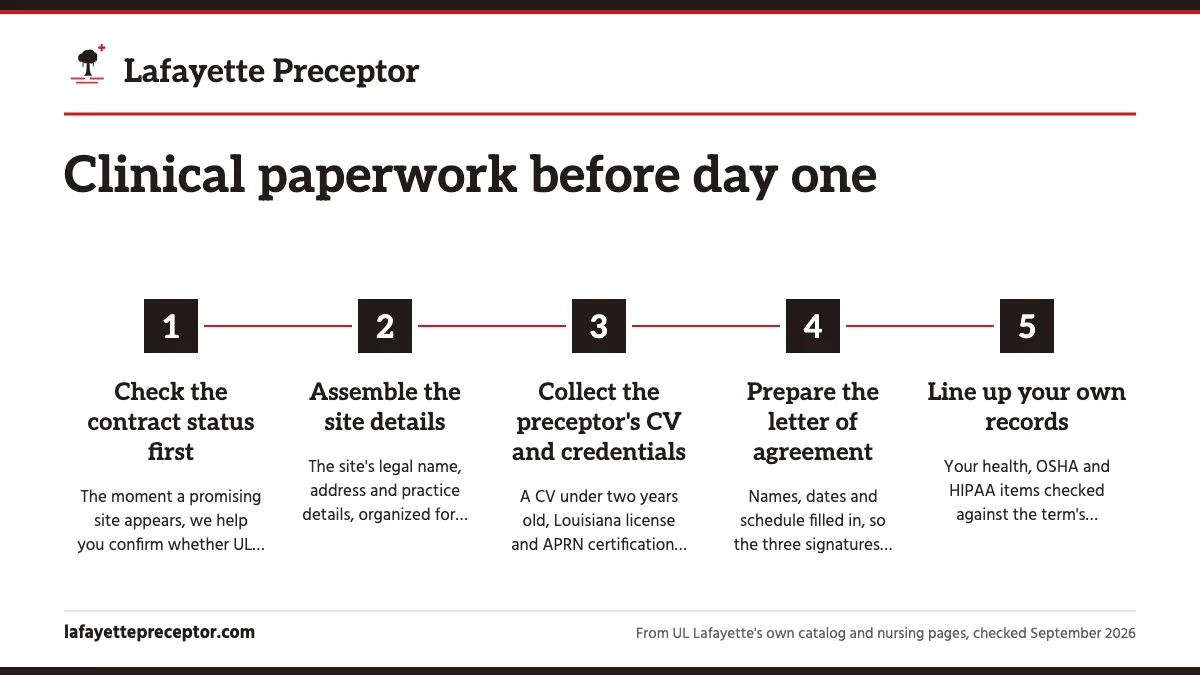
- Check the contract status firstThe moment a promising site appears, we help you confirm whether UL Lafayette already holds a contract with it, so any new agreement starts with the most lead time possible.
- Assemble the site detailsThe site's legal name, address and practice details, organized for the agency contract process.
- Collect the preceptor's CV and credentialsA CV under two years old, Louisiana license and APRN certification details, and practice information for the graduate coordinator's review.
- Prepare the letter of agreementNames, dates and schedule filled in, so the three signatures come together quickly.
- Line up your own recordsYour health, OSHA and HIPAA items checked against the term's dates, so nothing expires mid-practicum.
- Deliver a finished fileEverything ready well before the term, so the graduate nursing office receives it whole on the first pass.
UL Lafayette's graduate nursing office and course faculty decide when a file is complete, and ours arrive that way. Read how it works, or send your program and first practicum term through the form below.
The handbook sets the sequence: complete file first, first clinical day second. Build your dates backward from that.
Questions UL Lafayette students ask
Can I start clinical hours while an agency contract is pending?
The ICMSN handbook requires a current agency contract on file in the graduate nursing office before any clinical day, so a pending contract keeps the practicum from starting. Hours begun before the file is complete fall outside that procedure. If your contract is still in process, talk with your course faculty about timing rather than starting early.
Does UL Lafayette publish its clinical forms online?
No graduate preceptor agreement, site request or placement form appears on UL Lafayette's public pages. The one graduate form posted is a verification of post-baccalaureate practicum hours for DNP applicants, completed by the applicant's MSN program director. Ask your course faculty or the graduate nursing office for the current letter of agreement.
Does my own workplace need an agency contract?
Yes. The handbook's list applies to every site, your employer included, so a current agency contract has to be on file before any clinical day there. Clinical hours at your workplace must also stay separate from your job duties and unpaid. Our workplace clinicals guide explains how that separation works.
What is the Board's clinical facility survey?
It is the form Louisiana's Board of Nursing uses to approve an agency for student clinical experience. LAC 46:XLVII.3529 B requires the approval to be secured at least four weeks before the agency is first used. It is program-level paperwork, but it adds to the lead time for any site that has not hosted the program's students before.
Where is UL Lafayette's graduate nursing office?
It is in V.L. Wharton Hall, Room 307, in Lafayette, and the ICMSN handbook lists the same address. It is where the agency contract, preceptor CV, letter of agreement and your health, OSHA and HIPAA items must be on file. The DNP office shares Room 307.
Related pages
Last checked 2026-09-27
We check these pages against UL Lafayette's 2026-27 catalog, its online program and state authorization pages, the ICMSN student handbook and Louisiana's nursing rules. Your course faculty and your plan of study have the final word.
Whether UL Lafayette helps or you start alone, we find the preceptor.
Tell us your UL Lafayette program, the practicum coming up and the Louisiana town you train near. We look for preceptors and sites that fit the course and gather the license, CV and agency details that must be on file before your first clinical day.
- Preceptors who meet Louisiana's rules: an active Louisiana license, most hours with an APRN in your population focus
- The preceptor's CV, the agency details and your letter of agreement items gathered early
- Across Acadiana and the rest of Louisiana, plus DNP residencies in your home state
Start your placement plan
Your program, your town and your next clinical semester is all we need to begin.