Clinical hours in each UL Lafayette nursing program
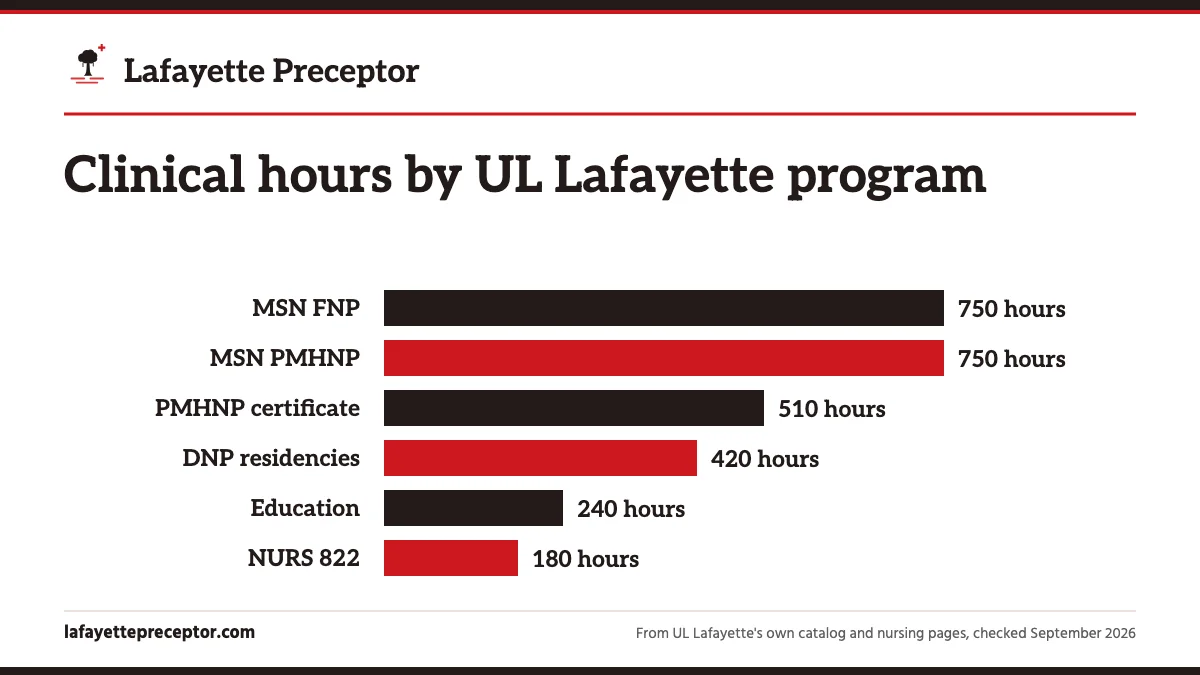
Under UL Lafayette's 2026-27 catalog, the FNP and the PMHNP each need at least 750 precepted hours, the PMHNP certificate needs 510 direct patient care hours (plus 60 observational hours in NURS 590), Nursing Education needs 240, and the DNP counts 420 residency hours inside a 1,000-hour post-baccalaureate total. The planner below splits each figure by course; the sections after it show where each number comes from and where older UL Lafayette pages print something else.
Get your placement plan
Tell us your UL Lafayette program and where you live. A placement advisor replies with the preceptor and site options that fit your UL Lafayette course.
Pick your UL Lafayette program
Your clinical courses and hours, who can precept you, where, and when to start looking. From UL Lafayette's own catalog and nursing pages.
- Who precepts
- Mostly APRNs certified in family practice, each with an active Louisiana license
- Where
- Louisiana primary care: children and women's health, then adults, then older adults
- Start looking
- NURS 582 falls in semester 3 of the 5-semester plan
- Who precepts
- Psychiatric mental health APRNs with an active Louisiana license
- Where
- Louisiana psychiatric and mental health practices, direct patient care
- Start looking
- NURS 591 falls in semester 4 of the 6-semester plan
- Who precepts
- An approved advanced practice preceptor, guided by graduate faculty
- Where
- Direct patient care in Louisiana, with an older-adult emphasis at the end
- Start looking
- NURS 591 falls in semester II of IV
- Who precepts
- An approved mentor from the agency where your project runs
- Where
- Your specialty area, in Louisiana or your home state
- Start looking
- NURS 821 falls in semester 4 of the 6-semester plan
- Who precepts
- Nurse educators and advanced clinicians who precept
- Where
- Clinical practice first, then precepted class, lab and clinical teaching
- Start looking
- NURS 544 falls in semester 3 of the 4-semester plan
Every program's total, side by side
Each figure in this table comes from the 2026-27 catalog unless the last column says otherwise. Where UL Lafayette prints a course's share of the total, the table gives it. Where it prints only a program minimum, the table says so instead of dividing the number by the count of courses, because an even split is not what UL Lafayette publishes.
| Program | Required hours | Clinical courses | Hours per course | Where sources differ |
|---|---|---|---|---|
| MSN Family Nurse Practitioner | At least 750 precepted | NURS 582, NURS 583, NURS 584 | Not published | The 2022-23, 2023-24 and 2025-26 catalogs said 600 |
| MSN Psychiatric/Mental Health NP | At least 750 precepted | NURS 591, NURS 592, NURS 593 | Not published | The nursing site's requirements page says 600 |
| PMHNP Post-Master's Certificate | 510 direct patient care, plus 60 observational | NURS 590, NURS 591, NURS 592, NURS 597 | 60 observational, then 180, 210 and 120 | The catalog prints 120 to 210 in each clinical course |
| MSN Nursing Education | 240 clinical/clock hours | NURS 544, NURS 557 | At least 60, then at least 180 | An older web page lists 300 |
| Doctor of Nursing Practice | 420 residency hours within 1,000 in all | NURS 821, NURS 822, NURS 823 | 120, 180 and 120 | NURS 809 to NURS 812 add hours when needed |
FNP and PMHNP: 750 hours each
Both nurse practitioner concentrations carry the same minimum in the current catalog, and UL Lafayette's online program page adds that the 750 hours are completed in Louisiana. For the FNP the number is new: catalogs from 2022-23, 2023-24 and 2025-26 printed 600, so it is a change over time. For the PMHNP the lower figure still sits on the nursing site's requirements page next to a catalog that says 750, which makes it a conflict between current sources.
Neither concentration breaks its 750 into per-course targets. FNP hours run through NURS 582 (pediatric, adolescent and childbearing women), NURS 583 (adults) and NURS 584 (older adults). PMHNP hours run through NURS 591, NURS 592 and NURS 593. How to read both figures, and why a catalog lab-hour field is no stand-in for a clinical total, is on NP clinical hours. Course by course detail lives on the FNP practicums and PMHNP practicums pages.
The PMHNP certificate: 510 hours after 60 observational
The Post-Master's Certificate is the one nurse practitioner route where UL Lafayette publishes hours per course. On its online page, NURS 590 (psychotherapy) carries 60 observational hours, and the direct care courses carry 180 (NURS 591), 210 (NURS 592) and 120 (NURS 597). The catalog's 510 is exactly the last three added together, so the observational hours are planned separately from it.
In the catalog, every certificate clinical course is direct patient care alongside an approved advanced practice preceptor, with graduate faculty guiding the arrangement. Watch one naming trap: NURS 597, with its older-adult emphasis, is a different course from the MSN's NURS 593, though each one closes its own program's psychiatric sequence. The certificate practicums page walks through all four.
Nursing Education: 240 practicum hours in two courses
Nursing Education has the smallest total and the clearest split. NURS 544, the Advanced Clinical Practicum, calls for a minimum of 60 clinical/clock hours in semester 3. NURS 557, the Nursing Education Practicum, calls for a minimum of 180 in semester 4, and the catalog frames it as teaching under a preceptor in classrooms, labs and clinical units, so teaching time counts there alongside time on a unit. With both minimums in print, you can pace each course against a known target from its first week.
A nursing site requirements page archived in 2025 lists 300 practicum hours instead of 240. The 2026-27 catalog is the newer source and comes first; if your plan of study shows another figure, the graduate coordinator settles it. Both courses are covered on Nursing Education practicums.
The DNP: 420 residency hours inside a 1,000-hour total
The post-MSN DNP works with two numbers. Its three residency courses carry 420 clinical clock hours between them, split 120, 180 and 120 from NURS 821 to NURS 823. Across the whole program you need 1,000 or more supervised practice hours after the bachelor's, and the 420 residency hours sit inside that 1,000 rather than on top of it.
Supervised hours from your MSN count toward the rest. DNP applicants hand in a Verification of Post-Baccalaureate Practicum Hours form, on which the MSN program director records supervised advanced practice hours; a form from your own school can replace it. Anyone still short registers for an Advanced Directed Studies course, NURS 809 through NURS 812, once the DNP Coordinator approves. The mentor and the project are covered on DNP residency.
Bachelor's programs: lab days instead of hour totals
UL Lafayette publishes no program-wide clinical hour total for its bachelor's programs. The catalog gives each clinical course a lab contact hour figure instead: 4.5 for NURS 208, the first clinical course of the Traditional BSN, and 13.5 apiece for NURS 308, NURS 340, NURS 403 and NURS 418. The Accelerated BSN mirrors that pattern with its A-suffixed courses.
Bachelor's clinical time is set by the school. Semester coordinators assign Traditional BSN lab days, and Accelerated BSN students rotate through Ochsner Lafayette General or another agency affiliated with Ochsner. The RN to BSN Online has no precepted clinical course in its 2026-27 plan, and the catalog entries for its main nursing courses, the NURS 499 capstone included, show zero lab contact hours.
Turning a total into a preceptor schedule
A total only becomes useful once it turns into weeks and clinic days. With 750 hours across three practicums and no published split, an FNP or PMHNP student needs Louisiana preceptors whose schedules can carry a steady weekly load, with most of the time spent beside an APRN certified in the student's population focus. That second point is a Louisiana Board of Nursing rule, and what counts as clinical hours shows how it shapes a log.
This planning is the heart of what we do for UL Lafayette students. However UL Lafayette handles graduate placement for your program, we search Louisiana for a preceptor and site that satisfy its rules, confirm the preceptor's calendar can actually hold your course's hours, and have the preceptor's license, certification and CV and the site's contract details ready well before the term. Share your program and start term in the form below and your placement advisor will map your hours with you.
Questions UL Lafayette students ask
How many clinical hours does the UL Lafayette FNP program require?
For the MSN Family Nurse Practitioner concentration, the floor in the 2026-27 catalog is 750 precepted clinical hours, all done in Louisiana according to UL Lafayette Online. Catalogs from 2022-23, 2023-24 and 2025-26 printed 600, which is why older material shows a lower figure. UL Lafayette gives no per-course split for the three FNP practicums, so confirm each course's target with course faculty.
Do the 60 observational hours count toward the PMHNP certificate's 510?
No. The catalog's 510 is the sum of the three direct care courses: NURS 591 at 180, NURS 592 at 210 and NURS 597 at 120. The online program page lists the 60 hours in NURS 590 separately and calls them observational. Plan for both sets of hours when you map out the certificate's four semesters.
Can hours from my master's program go toward the DNP's 1,000?
Yes. Supervised practicum hours from your MSN are part of how a DNP student reaches the 1,000-hour total. The director of your MSN program confirms the count on UL Lafayette's verification form, or on one your school uses. The DNP's own residency hours, 420 in all, then add to that tally.
Why does one UL Lafayette page say 300 hours for Nursing Education?
An older nursing site requirements page lists 300 practicum hours. The 2026-27 catalog gives 240: a minimum of 60 in NURS 544 and a minimum of 180 in NURS 557. A current catalog outranks an archived web page, and if your plan of study still shows 300, raise it with the graduate coordinator.
Does the RN to BSN Online include clinical hours?
Its 2026-27 plan has no precepted clinical course, and the catalog shows zero lab contact hours for its main nursing courses, including the NURS 499 capstone. UL Lafayette's web page mentions hands-on experiences without giving an hour count. If a course asks you for practice time, the course instructor is the person to ask about the details.
Related pages
Last checked 2026-09-27
We check these pages against UL Lafayette's 2026-27 catalog, its online program and state authorization pages, the ICMSN student handbook and Louisiana's nursing rules. Your course faculty and your plan of study have the final word.
- UL Lafayette 2026-27 catalog: MSN, Family Nurse Practitioner Concentration
- UL Lafayette 2026-27 catalog: MSN, Nursing Education Concentration
- UL Lafayette 2026-27 catalog: Psychiatric Mental Health Nurse Practitioner, PMC
- UL Lafayette 2026-27 catalog: Doctor of Nursing Practice
- UL Lafayette Online: Nursing, M.S.
Whether UL Lafayette helps or you start alone, we find the preceptor.
Tell us your UL Lafayette program, the practicum coming up and the Louisiana town you train near. We look for preceptors and sites that fit the course and gather the license, CV and agency details that must be on file before your first clinical day.
- Preceptors who meet Louisiana's rules: an active Louisiana license, most hours with an APRN in your population focus
- The preceptor's CV, the agency details and your letter of agreement items gathered early
- Across Acadiana and the rest of Louisiana, plus DNP residencies in your home state
Start your placement plan
Your program, your town and your next clinical semester is all we need to begin.