Background checks and drug screens for UL Lafayette nursing students
UL Lafayette's School of Nursing drug-tests students at entry to the first clinical course of a program, graduate or undergraduate, and can test again at random or for cause. DNP students also face background checks and drug and alcohol screening before residency, at their own expense. This guide sets out each rule, names the document it comes from, and shows how to keep screening from holding up a practicum.
Get your placement plan
Tell us your UL Lafayette program and where you live. A placement advisor replies with the preceptor and site options that fit your UL Lafayette course.
Which document the drug policy comes from
The fullest statement of the School of Nursing's drug policy sits in an unexpected place: the Fall 2022 Student Handbook, a BSN handbook posted on the nursing site. Its drug-testing section is not limited to BSN students. It applies at entry to "the first clinical course in the program of studies whether at the graduate or undergraduate level," which brings MSN, certificate and DNP students under the same policy.
Two cautions come with that source. It dates from 2022, and a newer handbook may have replaced it, so ask course faculty which version governs your first practicum. The consortium handbook adds no screening rules of its own: on background checks and drug screens it tells MSN students to refer to their home institution's requirements, which points straight back to UL Lafayette.
The 2022 text also explains why testing exists at all. It describes drug testing as "a contractual requirement of many clinical agencies which affiliate with the university as sponsors of clinical practicum experiences for nursing students." In other words, the hospitals and clinics that host students expect it.
How the School of Nursing's testing works
The handbook lays out a single path from order to report. Under the 2022 text, proof was due August 1 for entry into fall courses and January 5 for entry into spring courses.
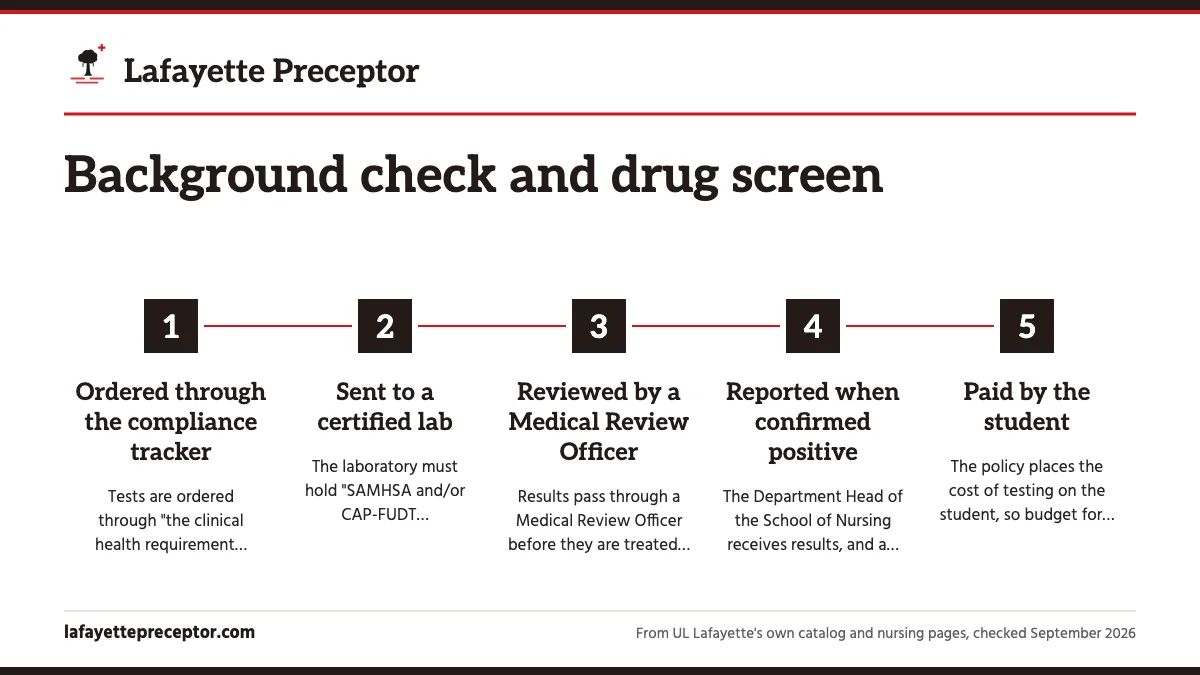
- Ordered through the compliance trackerTests are ordered through "the clinical health requirement compliance tracker software." The handbook does not name the product, so follow the ordering instructions UL Lafayette gives you.
- Sent to a certified labThe laboratory must hold "SAMHSA and/or CAP-FUDT certification," the certification the policy names.
- Reviewed by a Medical Review OfficerResults pass through a Medical Review Officer before they are treated as final.
- Reported when confirmed positiveThe Department Head of the School of Nursing receives results, and a confirmed positive is reported to the Louisiana State Board of Nursing.
- Paid by the studentThe policy places the cost of testing on the student, so budget for it before your first clinical term.
Testing does not stop at entry. The policy also provides for random testing and testing for cause while you remain in the program, so the standard applies in every clinical semester, not only the first.
DNP students: screening before residency
The 2026-27 catalog gives the doctorate its own sentence: "Prior to enrollment in residency courses, students will be required to submit to background checks, drug and alcohol screening, and must meet program health requirements. These screenings will be conducted at the student's expense." The first residency course, NURS 821, falls in semester 4 of the six-semester plan, followed by NURS 822 and NURS 823.
Two features matter for planning. The DNP rule adds alcohol and a background check to the drug screen, and it is tied to residency rather than admission, so schedule it for the term before NURS 821 rather than the week residency starts. Because DNP hours may be completed in Louisiana or in the student's home state, the residency agency may also run its own checks, and those can sit on top of UL Lafayette's.
The DNP residency guide covers the 420 residency hours, the agency mentor and the extra residency courses for students who need more hours.
BSN and Accelerated BSN checks before the first clinical
Pre-licensure students meet their screening before NURS 208, the first clinical course. The catalog requires a Level I background check, or a Level II check for students already licensed or working as certified caregivers, plus a baseline drug screen. A student with any disciplinary action, arrest or impairment in any state needs the Louisiana State Board of Nursing's approval before enrolling in a clinical course.
Accelerated BSN students in the Ochsner program apply to their first clinical course through an application that covers Board clearance, a background check and a drug screen.
For the traditional BSN, the 2022 handbook describes what happens when an agency declines a student after a background check: UL Lafayette may try to place the student at a different agency if space allows, and if no placement is possible, the student cannot continue that clinical course for the semester. See the traditional BSN guide for the rest of the entry sequence.
Your RN license: report changes at once
Screening looks at your record at set points; the license rule watches it the whole time. The ICMSN handbook requires MSN students to keep an unencumbered Louisiana RN license, and it attaches a severe penalty to silence: "Failure to report encumbrances and disciplinary proceedings against the RN license will result in immediate dismissal from the university."
The duty is to report, and the trigger is broad. An encumbrance counts, and so does a disciplinary proceeding, so an open Board matter should reach the program when it begins rather than after it resolves. Put the report in writing from your university email account so there is a dated record.
The RN license requirements guide covers which license each UL Lafayette program accepts, including the certificate's Louisiana APRN license and the DNP's U.S. license.
Planning screening around a practicum
A screening checklist for graduate students
- Read the drug-testing section of the School of Nursing handbook and ask course faculty whether the 2022 text is still current.
- Order the test through the compliance tracker UL Lafayette directs you to, not through an outside lab or an employer.
- Check the timing: the 2022 text set August 1 for fall entry and January 5 for spring entry.
- Have current prescription records ready, since results go to a Medical Review Officer.
- DNP students: schedule the background check, the drug and alcohol screen and the health items the term before
NURS 821. - Ask each clinical site whether it runs its own screen or background check in addition to UL Lafayette's.
A screen can satisfy UL Lafayette and still miss a site's window, so line up both sets of dates. The clinical health requirements guide covers the rest of the file that sits beside your screening results.
Why students trust us with the timing
Screening runs on fixed windows, and missing one delays a clinical start. Whoever ends up arranging your UL Lafayette placement, our desk pairs you with a clinical setting and a preceptor matched to its rules, and we learn the site's screening and background requirements as soon as it accepts you, so you order tests once, in the right window.
Your placement advisor lines up the site's onboarding items with UL Lafayette's policy dates and prepares the preceptor and site details the graduate nursing office needs, so the contract, CV and letter of agreement are not waiting on anyone. UL Lafayette's faculty make the approval decisions; we make sure everything that reaches them is complete and on time. Read how it works or send your program and start term through the contact form.
Questions UL Lafayette students ask
Does UL Lafayette's drug policy apply to MSN and DNP students?
Yes. The drug-testing section of the School of Nursing's Fall 2022 Student Handbook covers the first clinical course in a program of studies at the graduate or undergraduate level, so graduate students fall under it. DNP students also have a catalog requirement for background checks and drug and alcohol screening before residency. Ask course faculty whether a newer handbook has replaced the 2022 text.
Who pays for background checks and drug tests at UL Lafayette?
The student does. The 2022 handbook places the cost of drug testing on the student, and the 2026-27 catalog says DNP background checks and drug and alcohol screens are conducted at the student's expense. UL Lafayette's public pages list no amount, so read the ordering instructions you receive before you place the order.
What happens after a positive drug test?
Under the handbook's policy, results go through a Medical Review Officer before they are final, and the Department Head of the School of Nursing receives them. A confirmed positive is reported to the Louisiana State Board of Nursing. Read the full policy for the school-level steps that follow, and talk to course faculty early if a prescription could affect a result.
Is a background check required for the UL Lafayette MSN?
UL Lafayette's MSN pages publish no separate background check rule, and the ICMSN handbook sends students to their home institution's requirements. The catalog does set checks for the DNP before residency and for BSN students before NURS 208. A clinical site can also require its own check through the agency agreement, so ask course faculty and each site before your first practicum.
Can I use a drug screen from my employer for UL Lafayette?
Ask before counting on it. The handbook's process runs through the School of Nursing's compliance tracker software, a lab with SAMHSA and/or CAP-FUDT certification and a Medical Review Officer. A screen ordered through an employer sits outside that path, so course faculty need to confirm whether it meets the requirement before you skip the school's own test.
Related pages
Last checked 2026-09-27
We check these pages against UL Lafayette's 2026-27 catalog, its online program and state authorization pages, the ICMSN student handbook and Louisiana's nursing rules. Your course faculty and your plan of study have the final word.
Whether UL Lafayette helps or you start alone, we find the preceptor.
Tell us your UL Lafayette program, the practicum coming up and the Louisiana town you train near. We look for preceptors and sites that fit the course and gather the license, CV and agency details that must be on file before your first clinical day.
- Preceptors who meet Louisiana's rules: an active Louisiana license, most hours with an APRN in your population focus
- The preceptor's CV, the agency details and your letter of agreement items gathered early
- Across Acadiana and the rest of Louisiana, plus DNP residencies in your home state
Start your placement plan
Your program, your town and your next clinical semester is all we need to begin.