The three family health practicums in UL Lafayette's FNP
UL Lafayette's MSN Family Nurse Practitioner plan puts all of its precepted work into three 5-credit courses: NURS 582 for children, adolescents and childbearing women, NURS 583 for adults and NURS 584 for older adults. Under the 2026-27 catalog they must add up to at least 750 hours, every one of them in Louisiana. This guide shows how each course fits the FNP plan, which preceptor suits it and what to have ready before semester 3.
Get your placement plan
Tell us your UL Lafayette program and where you live. A placement advisor replies with the preceptor and site options that fit your UL Lafayette course.
One practicum for each slice of family practice
The catalog's FNP plan runs five semesters. The first two hold the shared MSN core, and each of the last three carries one Advanced Practice Nursing: Family Health course, split between lecture and lab contact hours and aimed at a different patient group.
| Course | Plan semester | Credits | Lecture / lab contact | Population |
|---|---|---|---|---|
NURS 582 Family Health I | 3 | 5 | 3 / 13 | Pediatric, adolescent and childbearing women |
NURS 583 Family Health II | 4 | 5 | 3 / 18 | Adult |
NURS 584 Family Health III | 5 | 5 | 3 / 18 | Geriatric |
Lab contact hours are a catalog field, not a count of clock hours at a clinic, and UL Lafayette publishes no split of the 750 by course. The field still hints at weight: Family Health II and III list more lab contact than Family Health I, so semesters 4 and 5 are likely to be the heavier clinical terms. Your course faculty confirm the real target.
A catalog search may also surface NURS 585 Family Health Practicum and NURS 589 Family Health Practicum II, each tied to 120 clinical hours. Neither appears in any 2026-27 plan, so your plan of study, not the course list, decides which practicums you owe.
At least 750 hours, and the 600 you may have read
The 2026-27 catalog sets the FNP floor at a minimum of 750 precepted clinical hours, and UL Lafayette's online program page repeats the figure and places those hours in Louisiana. Older sources say 600: the 2022-23, 2023-24 and 2025-26 catalogs, the 2021 program page, and the FNP requirements page on the nursing site as captured in October 2025.
Read that as a change in the requirement, not a typo. The current catalog comes first. Admitted under an older catalog year? Ask the graduate coordinator which total governs your plan before you build a schedule around it. The NP clinical hours guide sets every NP figure side by side.
Because the catalog leaves the 750 unsplit, ask each course's faculty for that course's hour target when the term opens, then shape the preceptor's calendar to reach it with a margin for missed days.
An older UL Lafayette web page still shows 600 FNP hours. Plan around 750 unless the graduate coordinator confirms a different total for your catalog year.
NURS 582: children, adolescents and childbearing women
Family Health I opens the precepted part of the plan in semester 3, after the pathophysiology, pharmacotherapeutics and health assessment courses of semesters 1 and 2. NURS 509 Population-Based Primary Care runs in the same semester.
The strongest settings see young patients and pregnant or postpartum women in real volume: a family clinic whose days fill with children plus prenatal and well-woman visits, a pediatrics office, or an OB-GYN practice where an NP carries a full schedule. Louisiana's Board wants most of an APRN student's clinical time spent with an APRN licensed and certified in the student's population focus, and it lets a mix of clinicians teach the rest, so time with a pediatrician or an obstetrician can add depth within the split your course faculty approve.
Every preceptor needs an active, unencumbered Louisiana license, and none may take on a third graduate APRN student during the same clinical experience. The full standard, including the consortium's minimums, is on who can precept.
NURS 583: the adult semester
Family Health II sits in semester 4 with 18 lab contact hours, up from 13 in Family Health I. It shares the term with your scholarly work: NURS 595 Focused Scholarly Project, or NURS 599 Thesis Research and Thesis if you chose the thesis track.
Adult primary care is the natural home for this course: family or internal medicine practices, community clinics and health centers where an FNP handles chronic disease, acute visits and prevention for working-age patients. A preceptor who sees a broad mix in a day gives you far more to document than a narrow specialty clinic.
With the scholarly project due the same term, a steady weekly rhythm matters here more than anywhere. Ask for fixed clinic days that match the preceptor's template before the semester starts, so the project and the hours never compete for the same afternoon.
NURS 584: older adults in the final semester
Family Health III closes the plan in semester 5, again with 18 lab contact hours, this time with a geriatric focus. NURS 581, the business, leadership and policy course for NPs, runs beside it, and thesis students finish NURS 599 the same term.
Good fits include primary care offices whose panels skew older, home-based primary care, and long-term care or skilled nursing settings where an FNP sees residents. The family practice that carried you through NURS 583 may also see enough older adults for this course, which can let one agency contract serve two semesters if course faculty approve that preceptor for both.
A setback costs the most here, because a repeated final practicum moves your finish date. Know the grade rules before the term starts; they are on grades and progression.
Getting each practicum ready before its semester
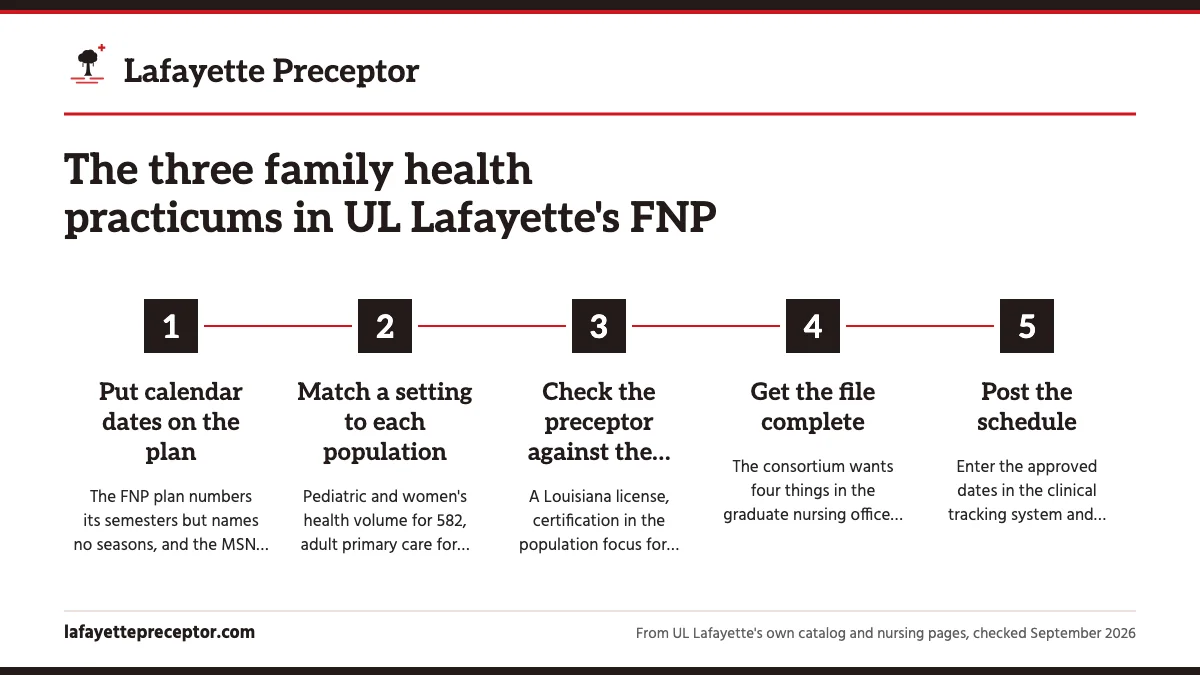
- Put calendar dates on the planThe FNP plan numbers its semesters but names no seasons, and the MSN admits in January and August. Count forward from your start term to find the Fall or Spring that holds
NURS 582, then check term dates on the academic calendar. - Match a setting to each populationPediatric and women's health volume for 582, adult primary care for 583, older adults for 584. Decide early whether one practice can serve more than one course.
- Check the preceptor against the rulesA Louisiana license, certification in the population focus for most of your hours, at least a year of clinical experience, and room for you without a third APRN student on the same days.
- Get the file completeThe consortium wants four things in the graduate nursing office before any clinical day: your health, OSHA and HIPAA items, the preceptor's recent CV, the student-faculty-preceptor letter with every signature, and a current agency contract. The handbook says a brand-new contract may need weeks or even months. The details are on clinical paperwork.
- Post the scheduleEnter the approved dates in the clinical tracking system and update them whenever a clinic day moves.
Why UL Lafayette FNP students choose us
Whatever part UL Lafayette plays in arranging your placement, we treat your three practicums as one plan: a Louisiana preceptor and site for each population, close to where you live, lined up well before each semester opens.
For every course we confirm the preceptor's Louisiana license, certification and experience, collect the CV and practice details the letter of agreement and agency contract call for, and hand you a packet built to the consortium's list. Course faculty at UL Lafayette sign off on every preceptor, with a review by the graduate coordinator; our part is making that file whole and correct before it lands on their desks.
Should a preceptor leave partway through the sequence, the placement desk begins a replacement search at once and keeps the new match inside the same population. Read how it works, or send your details through the form below.
Questions UL Lafayette students ask
Can I complete UL Lafayette FNP clinical hours outside Louisiana?
No. UL Lafayette's state authorization page says FNP students complete clinical rotations in Louisiana and hold a Louisiana registered nurse license, and the MSN application page says the same for every FNP clinical hour. Educational requirements are listed as met for Louisiana and Mississippi, yet even Mississippi residents do their hours in Louisiana. More on Louisiana-only clinicals.
Can the same preceptor take me through two FNP practicums?
UL Lafayette's pages neither require nor rule out a repeat preceptor. Course faculty approve a preceptor course by course, and the patient mix has to match: a broad family practice may suit both the adult and the geriatric semester, while pediatric and prenatal volume may point to a separate site for NURS 582. Ask faculty before counting on a carry-over.
Is NURS 507 a clinical course in the FNP?
NURS 507, Health Assessment and Diagnostic Reasoning for Advanced Practice, sits in semester 2 with 2 lecture and 4 lab contact hours, but the catalog does not describe it as a precepted practicum. The first precepted course in the FNP plan is NURS 582 in semester 3, so semester 2 is a good time to settle its preceptor.
What grade do I need in each FNP practicum?
A B or better. Under UL Lafayette's MSN rules a course below B must be repeated and can be repeated only once, and a C never counts toward the program. The ICMSN handbook adds that a final evaluation judged unsatisfactory by either the preceptor or faculty turns the course grade into an F, and a D or F in any course stops progression.
How early should I plan for NURS 582?
From your first semester. The consortium handbook says securing a fresh agency contract may run from weeks into months, Louisiana's Board expects a new clinical facility cleared no later than four weeks ahead of the first student day, and everything has to be on file before your first clinical day. Starting two semesters out gives you time to recover if a first choice says no.
Related pages
Last checked 2026-09-27
We check these pages against UL Lafayette's 2026-27 catalog, its online program and state authorization pages, the ICMSN student handbook and Louisiana's nursing rules. Your course faculty and your plan of study have the final word.
Whether UL Lafayette helps or you start alone, we find the preceptor.
Tell us your UL Lafayette program, the practicum coming up and the Louisiana town you train near. We look for preceptors and sites that fit the course and gather the license, CV and agency details that must be on file before your first clinical day.
- Preceptors who meet Louisiana's rules: an active Louisiana license, most hours with an APRN in your population focus
- The preceptor's CV, the agency details and your letter of agreement items gathered early
- Across Acadiana and the rest of Louisiana, plus DNP residencies in your home state
Start your placement plan
Your program, your town and your next clinical semester is all we need to begin.