The DNP residency at UL Lafayette: three courses, 420 hours
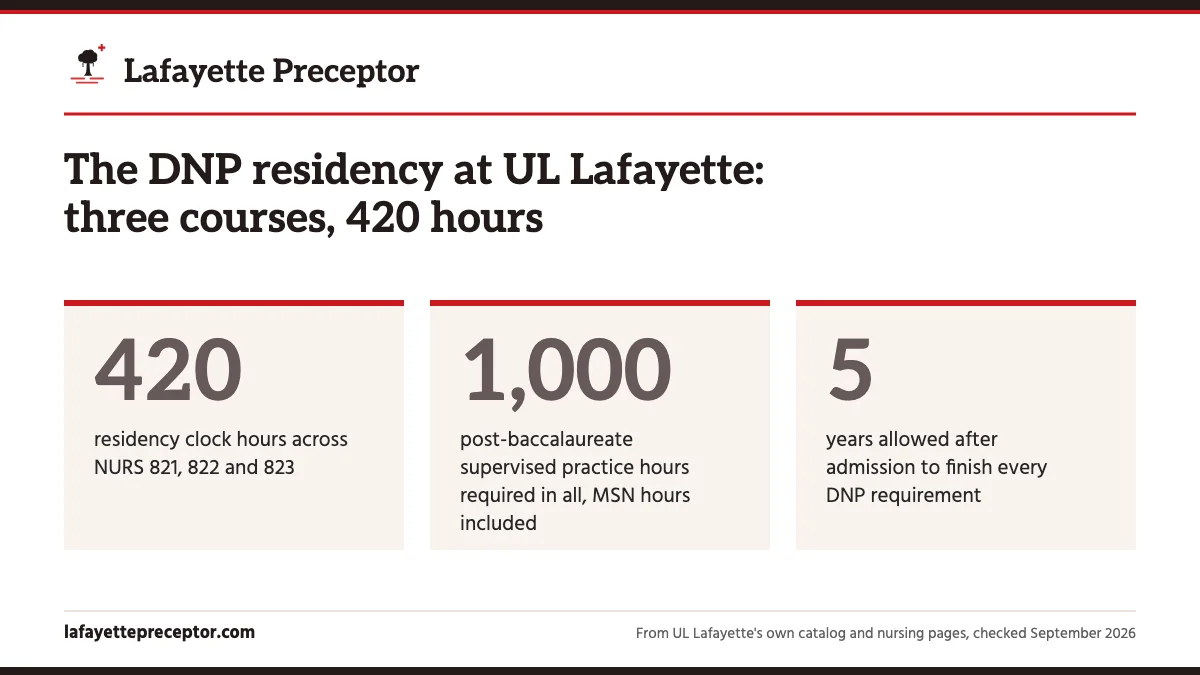
UL Lafayette's post-MSN Doctor of Nursing Practice puts its practice hours into three residency courses in semesters 4 to 6: NURS 821 with 120 hours, NURS 822 with 180 and NURS 823 with 120. Those 420 hours count toward the 1,000 post-baccalaureate supervised hours every DNP graduate needs, and they take place in your specialty, in Louisiana or your home state. Here is how the residency is built and what to settle before semester 4.
Get your placement plan
Tell us your UL Lafayette program and where you live. A placement advisor replies with the preceptor and site options that fit your UL Lafayette course.
Three residency courses, semesters 4 to 6
The first three semesters of the DNP are online coursework: scholarly foundations, epidemiology, biostatistics, evidence methods, informatics and NURS 803 Project Planning. The residency begins once that groundwork is done.
| Plan semester | Course | Clock hours | Catalog credits | Web plan credits | Beside it |
|---|---|---|---|---|---|
| 4 | NURS 821 Residency I | 120 | 3 | 3 | NURS 808 Ethics and Health Care Policy |
| 5 | NURS 822 Residency II | 180 | 4 | 4 | NURS 807 Organizational and Systems Leadership |
| 6 | NURS 823 Residency III | 120 | 3 | 4 | Residency only |
The catalog describes NURS 822 as the "implementation of an evidence-based intervention in collaboration with residency mentor and faculty advisor." Residency II is where your project goes live, with the most hours of the three. What NURS 821 and NURS 823 emphasize comes from course faculty and your faculty advisor, so ask for each course's goals before the semester opens.
How 420 hours sit inside 1,000
The Graduate School section of the catalog sets the larger rule: no fewer than 1,000 supervised practice hours earned after the bachelor's, with the 420 residency hours counted inside that total. Your MSN clinical hours are the rest of the picture. UL Lafayette's Verification of Post-Baccalaureate Practicum Hours form, completed by your MSN program director, records the supervised advanced practice hours from your master's, and an institution-specific form may be substituted.
If your verified MSN hours plus 420 still fall short of 1,000, the catalog sends you to four directed studies courses. Students needing more residency hours register for one of them, with DNP Coordinator permission.
| Course | Title | Credits |
|---|---|---|
NURS 809 | Advanced Directed Studies I | 3 |
NURS 810 | Advanced Directed Studies II | 1 |
NURS 811 | Advanced Directed Studies III | 2 |
NURS 812 | Advanced Directed Studies IV | 4 |
The catalog does not publish hours per credit for these courses, so the DNP Coordinator, who maps out each student's course plan, is the person to size your gap and pick the right one.
Your specialty, in Louisiana or your home state
UL Lafayette's online DNP page places the practica "in the students' specialty area of practice," and the Post-Masters DNP page says the clinical hours "can be completed in Louisiana or your home state." That sets the DNP apart from UL Lafayette's MSN and certificate, whose clinicals stay in Louisiana.
Home state has a condition attached. On UL Lafayette's state authorization page, the DNP's own list is open to students in 44 states plus DC. Six are missing from it: Kansas, Maryland, Oklahoma, Tennessee, Washington and Wyoming. Yet the part of that page organized state by state shows the DNP for all six. Confirm your state with the program before building a residency around it; the details are on state authorization.
Several nursing boards also regulate programs based elsewhere that send students into their facilities. Your state guide summarizes what your nursing board publishes.
The agency and your residency mentor
Two catalog lines tie your residency to one place. Your project committee must seat a mentor from the implementing agency, one who has been approved, and NURS 822 has you run the intervention alongside a residency mentor and your faculty advisor. Planning one agency and one mentor who can fill both roles keeps the project and the hours together; your faculty advisor confirms whether that fits your project.
A strong residency agency gives you access to the patients, staff and data your intervention needs, has leaders willing to let a practice change happen, and has a mentor with enough standing to open doors across three semesters. Choose it early, because the committee, the topic and the residency all follow from it. The project side is covered on the Synthesis Project.
Choosing a residency site after your project topic is approved can force the topic to change. Pick the agency and mentor while the topic is still taking shape.
Clearances before NURS 821
Before you can enroll in a residency course, the catalog has you submit to a background check and to drug and alcohol testing, and meet the program's health standards, with the student paying for the screenings. Schedule all of it during semester 3, while NURS 803 is under way, so a slow result cannot hold up your first residency hours.
Expect the agency to layer its own onboarding on top, such as a separate background check, immunization records or orientation modules. Ask what it needs at the same time you ask about the mentor, and keep copies ready. The agency will also confirm that your nursing license is valid where the residency takes place, so keep it current and unencumbered through all three residency semesters. The screening rules are on background checks and drug screens.
Catalog plan vs web plan
The 2026-27 catalog and the nursing site's post-master's plan agree on 39 credits and 420 residency hours, but they differ in the details. NURS 808 Ethics and Health Care Policy is 4 credits in the catalog and 3 on the web. NURS 823 Residency III is 3 credits in the catalog and 4 on the web. NURS 805 Preventive Care for Populations sits in semester 1 in the catalog and semester 3 on the web, so the semester totals differ too.
Length reads differently as well: the catalog lays out six semesters and the online page says courses run in Fall and Spring, while that page also says a student can finish in two years at the quickest. The catalog comes first, and the DNP Coordinator settles your own plan. The five-year window that opens at admission covers everything, and the DNP's grade rules carry their own conflict, explained on grades and progression.
Why DNP students choose us for the residency
Whatever support UL Lafayette offers in choosing a residency agency, we locate one where you live, inside your specialty, with a mentor suited to the project you plan to run. We look for sites with the access and leadership support an evidence-based intervention needs, and a mentor ready to commit across three semesters.
We gather what the committee and the agency will ask for, time it around the pre-residency screenings, and hold a second agency in reserve should your mentor change jobs. UL Lafayette's faculty approve the mentor and the project; we help you bring them a choice that is ready to approve. If you live outside Louisiana, we search where you live and check your state against UL Lafayette's list first. See how it works.
Questions UL Lafayette students ask
Will hours from my master's count toward the DNP total?
Yes. The requirement counts supervised practice after the bachelor's, so documented MSN hours apply, and the 420 residency hours sit inside the same total. Your MSN program director completes UL Lafayette's verification form or an equivalent from your own school, and any gap is met through NURS 809 to 812 with DNP Coordinator permission.
Is the DNP residency done online?
The DNP's didactic courses are online, but residency hours are supervised practice at an agency in your specialty, in Louisiana or your home state. Campus visits are separate: the catalog requires on-campus activities at the start, with the DNP Orientation Intensive, and at the end, when you present your Synthesis Project.
Who approves my DNP residency mentor?
The catalog says the agency mentor on your Synthesis Project committee must be approved but does not name the approver. Your faculty advisor, who chairs the committee and approves the project topic, is the person to ask. Bring the mentor's role, credentials and the agency's support for your project to that conversation.
What does specialty area of practice mean for a DNP residency?
UL Lafayette's online DNP page places the practica in each student's specialty area of practice. Post-MSN applicants hold master's preparation as an NP, CRNA, CNM, nurse administrator or leader, or nurse educator, and the residency builds on that role. A family NP's residency, for example, would sit in a setting where family NPs practice.
How long does UL Lafayette's DNP take?
The catalog lays out six semesters, with the residency in the last three, and the online page says courses run in Fall and Spring. That page also advertises a two-year finish for students who keep pace. Whichever speed you manage, five years from admission is the outer limit for every requirement.
Related pages
Last checked 2026-09-27
We check these pages against UL Lafayette's 2026-27 catalog, its online program and state authorization pages, the ICMSN student handbook and Louisiana's nursing rules. Your course faculty and your plan of study have the final word.
Whether UL Lafayette helps or you start alone, we find the preceptor.
Tell us your UL Lafayette program, the practicum coming up and the Louisiana town you train near. We look for preceptors and sites that fit the course and gather the license, CV and agency details that must be on file before your first clinical day.
- Preceptors who meet Louisiana's rules: an active Louisiana license, most hours with an APRN in your population focus
- The preceptor's CV, the agency details and your letter of agreement items gathered early
- Across Acadiana and the rest of Louisiana, plus DNP residencies in your home state
Start your placement plan
Your program, your town and your next clinical semester is all we need to begin.