The Synthesis Project, from Orientation Intensive to final presentation
UL Lafayette's post-MSN DNP opens and closes on campus: the DNP Orientation Intensive just before the program starts, and a formal presentation of your Synthesis Project at the end. In between you name a topic, form a committee that includes a mentor from the agency where the project will happen, reach candidacy through the Graduate School and carry the work through NURS 803 and the residency. The agency you choose early shapes every one of those steps.
Get your placement plan
Tell us your UL Lafayette program and where you live. A placement advisor replies with the preceptor and site options that fit your UL Lafayette course.
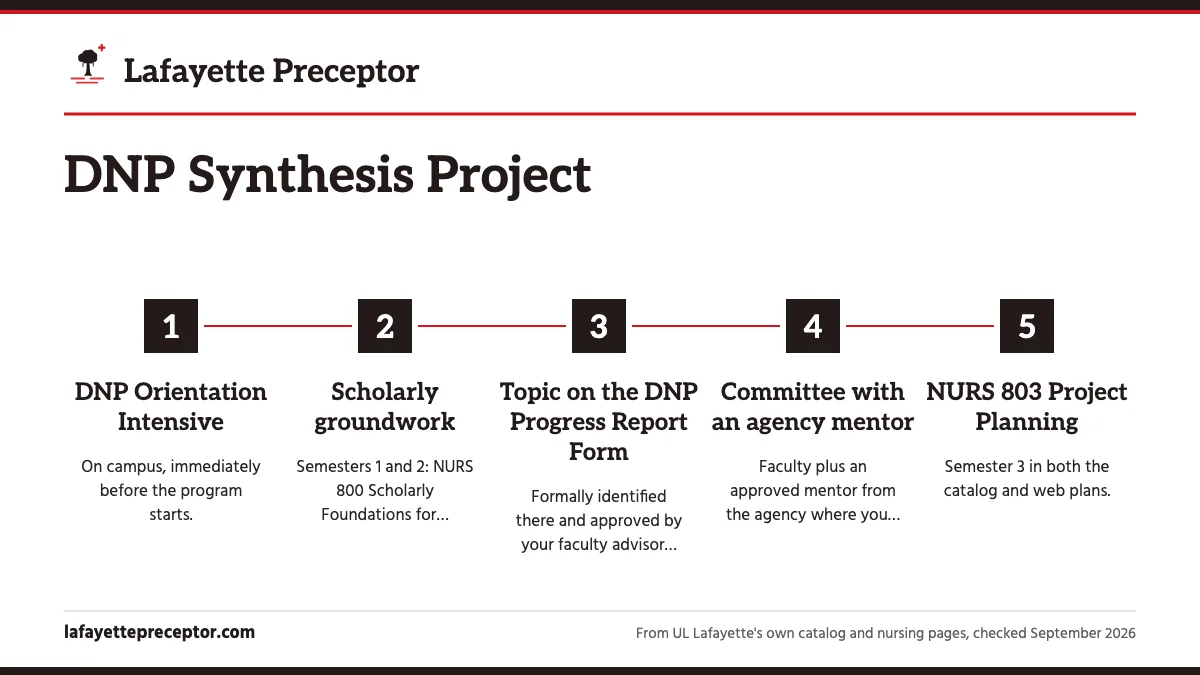
The project path at a glance
The catalog spreads the Synthesis Project across the whole DNP rather than packing it into one course. These are the pieces, in the order they tend to fall.
- DNP Orientation IntensiveOn campus, immediately before the program starts.
- Scholarly groundworkSemesters 1 and 2:
NURS 800Scholarly Foundations for Advanced Practice,NURS 802Epidemiology,NURS 801Biostatistics andNURS 804Clinical Scholarship and Analytic Methods for Evidence-Based Practice. - Topic on the DNP Progress Report FormFormally identified there and approved by your faculty advisor, who chairs your committee.
- Committee with an agency mentorFaculty plus an approved mentor from the agency where you expect to implement the project.
NURS 803Project PlanningSemester 3 in both the catalog and web plans.- CandidacyThrough the Graduate School, with the form it provides and the Graduate Dean's approval.
- Implementation in residency
NURS 822carries out the evidence-based intervention with your residency mentor and faculty advisor. - Final presentationA formal, end-of-program presentation of the Synthesis Project, on campus.
Starting on campus: the DNP Orientation Intensive
The catalog says each student must take part in some on-campus activities, including "the DNP Orientation Intensive at the outset of the program and the formal, end-of-the-program presentation of the Synthesis Project." Your coursework between those two visits runs online.
The DNP admits a Fall cohort only, with applications due May 1, so the Intensive falls just before a Fall term. UL Lafayette does not post its date on the public pages, so watch your admission materials and plan travel early if you live outside Louisiana.
Treat the Intensive as the first step of your project, not only an orientation. It is your best chance to meet faculty in person and start weighing which agency could host your project. Students who arrive with two or three possible agencies in mind give their advisor something concrete to react to.
Naming the topic and building the committee
The catalog is precise about the topic: "The topic of the synthesis project must be formally identified on the DNP Progress Report Form and officially approved by the faculty advisor/committee chairperson." Your faculty advisor and your committee chair are the same person, and the form is the record of the decision. The form itself is not posted on UL Lafayette's public pages, so ask your advisor for it.
The committee's makeup ties the project to a real workplace. Alongside faculty, it includes "an approved mentor from the agency in which the student expects to implement the project." You cannot finish the committee without an agency and a mentor who has agreed to serve, and the mentor must be approved.
That makes agency choice a first-year task. A topic that fits no available agency stalls, while a topic shaped around an agency with the right patients, data and leadership support moves quickly into planning.
NURS 803 Project Planning and candidacy
NURS 803 Project Planning, 3 credits, sits in semester 3 of both the catalog plan and the nursing site plan, the last semester before residency. By its end your topic, agency, mentor and implementation plan should be firm enough to start NURS 821 without redesign.
Candidacy runs through the Graduate School. The catalog says the candidacy form is available from the Graduate School, and the Graduate Dean approves candidacy. UL Lafayette's public pages do not set a date for it within the plan, so ask your faculty advisor when you become eligible and file as soon as you are.
Semester 3 is also when the residency paperwork lands. Background checks, drug and alcohol screening and health requirements come due before any residency course, and your agency will have onboarding of its own. The residency itself is laid out on the DNP residency, and the screening rules on background checks and drug screens.
How your agency choice ties to the residency
The agency you name for the committee is where NURS 822 puts your intervention into practice, working with your residency mentor and faculty advisor. The residency's 420 hours take place in your specialty area of practice, in Louisiana or your home state. Choose well and one agency carries your project, your mentor and your hours for three semesters.
A good project agency does four things. It serves the population your topic is about, it can share the data you need to measure change, its leaders are willing to try a new practice, and it has a mentor with the standing and time to see the work through. An agency missing any of these can still host hours, but it makes a weak home for a Synthesis Project.
Picking a topic first and searching for an agency afterward can mean rewriting the topic. Settle the agency and mentor alongside it.
Finishing: the presentation and the clock
The program ends back on campus with the formal presentation of your Synthesis Project. Plan that trip the way you planned the Intensive, and check the Graduate School deadline to apply to graduate: September 25 for Fall 2026 and February 26 for Spring 2027, with commencement on December 18, 2026 and May 14, 2027. Other dates are on the academic calendar. Your committee members keep their own calendars too, so fix the presentation date with them well before your final semester gets crowded.
Every DNP requirement must be finished within five years of admission. An approved leave of absence, available for up to a year for medical reasons, family necessity or military service, keeps your catalog and extends that limit. Grades matter throughout, and the DNP's two published grade rules do not match; see grades and progression.
Why DNP students choose us for the project agency
However much help UL Lafayette gives with a project agency, we search for a host that matches your specialty and your question, in Louisiana or wherever you live in an accepted state, with a mentor prepared to serve. We look for the access, data and leadership support a Synthesis Project needs, and a mentor willing to join your committee and stay through residency.
We time the search so your agency is settled before your topic goes on the Progress Report Form, and we help you bring your faculty advisor a mentor ready for approval. If a mentor moves on, we find a replacement at a comparable site. For students outside Louisiana, we check your state against UL Lafayette's DNP list before recommending any agency there. See how it works.
Questions UL Lafayette students ask
How often do UL Lafayette DNP students travel to campus?
The catalog names two required on-campus events: the DNP Orientation Intensive at the start of the program and the formal presentation of the Synthesis Project at the end. The didactic courses are online, and the residency happens at your agency in Louisiana or your home state, so most of the program needs no trip to Lafayette.
Who sits on a UL Lafayette DNP Synthesis Project committee?
Faculty, with your faculty advisor as committee chairperson, plus an approved mentor from the agency where you expect to implement the project. The catalog does not publish a set number of faculty members, so your advisor shapes the committee. The agency mentor is the member who connects the project to real practice.
Can I change my project agency after the committee is formed?
UL Lafayette's pages do not address a mid-program change. Because the mentor must come from the agency where you implement the project, a new agency means a new mentor for approval and possibly a revised topic on the DNP Progress Report Form. Raise it with your committee chair as early as possible.
What is the DNP Progress Report Form?
It is the form on which your Synthesis Project topic is formally identified, and your faculty advisor or committee chairperson approves the topic there. The catalog names the form, but UL Lafayette does not post it publicly, so ask your advisor for the current version and for when it should be filed.
What if I need more time to finish the Synthesis Project?
All DNP requirements must be completed within five years of admission. Students in good standing can request a leave of absence of up to one calendar year for medical reasons, family necessity or dependent care, or military service, and an approved leave extends the time limit. Ask at least 30 days ahead, since leave cannot be granted after the fact.
Related pages
Last checked 2026-09-27
We check these pages against UL Lafayette's 2026-27 catalog, its online program and state authorization pages, the ICMSN student handbook and Louisiana's nursing rules. Your course faculty and your plan of study have the final word.
Whether UL Lafayette helps or you start alone, we find the preceptor.
Tell us your UL Lafayette program, the practicum coming up and the Louisiana town you train near. We look for preceptors and sites that fit the course and gather the license, CV and agency details that must be on file before your first clinical day.
- Preceptors who meet Louisiana's rules: an active Louisiana license, most hours with an APRN in your population focus
- The preceptor's CV, the agency details and your letter of agreement items gathered early
- Across Acadiana and the rest of Louisiana, plus DNP residencies in your home state
Start your placement plan
Your program, your town and your next clinical semester is all we need to begin.