Who oversees your UL Lafayette practicum, and how it is graded
In a UL Lafayette preceptorship your preceptor teaches day to day, but nursing faculty stay accountable. Louisiana's rules hand faculty the learning experiences and the evaluation, informed by the preceptor, and require a conference with you and your preceptor every week, without requiring faculty on site. At the end, the consortium's rule is blunt: the course grade drops to an F when the final evaluation is rated unsatisfactory, whether your preceptor or your faculty member gives that rating.
Get your placement plan
Tell us your UL Lafayette program and where you live. A placement advisor replies with the preceptor and site options that fit your UL Lafayette course.
Faculty own the learning experience
Louisiana's Board of Nursing states it in the preceptorship rule, LAC 46:XLVII.3543 A: nurse faculty keep the responsibility for selecting and guiding every student learning experience and for evaluating student performance, with input from preceptors. For you, that means the preceptor is a teacher and a key witness to your progress, while the grade and the decisions about your course rest with faculty.
UL Lafayette's own wording follows the same shape. The PMHNP Post-Master's Certificate describes each clinical course as direct patient care alongside a preceptor in advanced practice whom the program has approved, working under the guidance of graduate faculty. In the Board's definitions, a graduate preceptor can be an APRN, a physician or a dentist, someone who guides, models and teaches to enrich what an advanced practice student learns: a teaching role, with the evaluation held by faculty.
Section 3543 B adds that preceptors are selected by written criteria that faculty and the clinical facility's nursing administration develop together, under Board guidelines. The preceptor requirements guide covers the license, certification and experience standards behind those criteria.
The weekly faculty conference
Sections 3543 C and D require a faculty member to be available to preceptors during the experience and to confer with each preceptor and each student at least once a week while the precepted experience runs. Weekly is a floor. Your course faculty set how the check-ins happen, and in an online program they take place at a distance; the consortium handbook routes all communication with faculty and preceptors through your university email account.
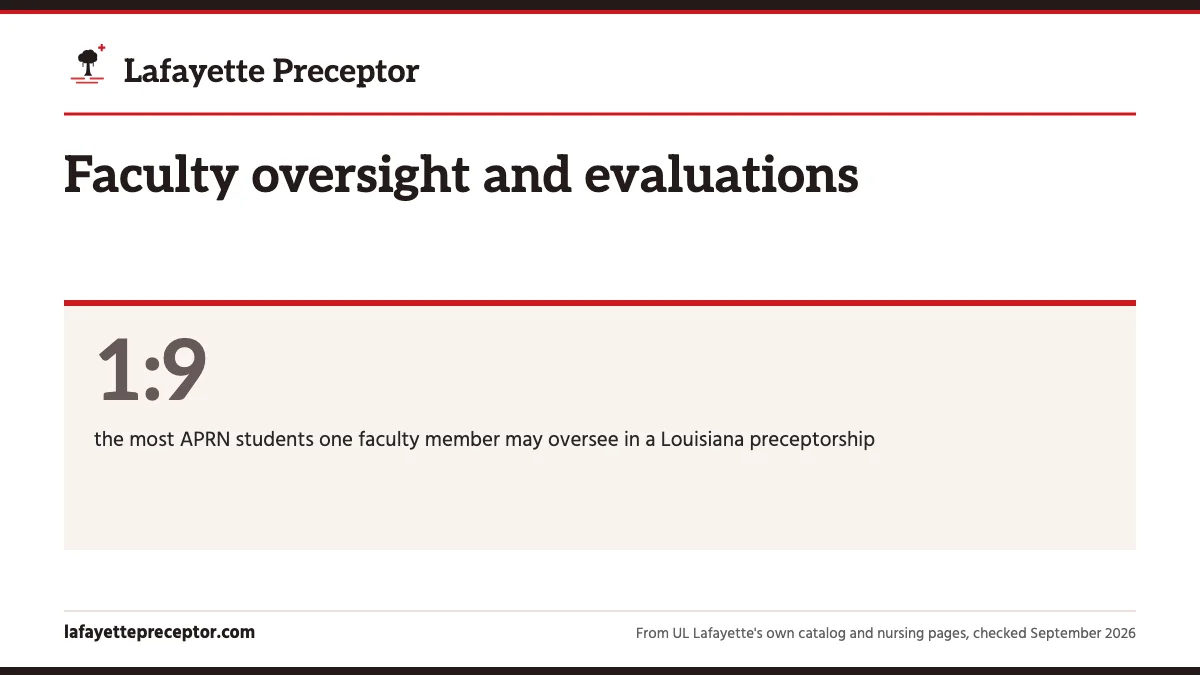
The Board also caps the load on both sides. The faculty ratio for APRN preceptorships tops out at 1:9, and a single preceptor can take on two graduate APRN students at most at one time. Those limits keep the weekly contact real rather than a formality.
Make each conference count. Come with your hours to date, the populations you have seen, anything your preceptor has raised and the skills you want to practice next. A gap named in week three is easy to close; a gap that first shows up on the final evaluation is not.
Direct or indirect, faculty stay responsible
Under 3543 E.2.b, faculty answer for each APRN student at a clinical site, and that holds under direct and indirect supervision alike. The rule gives indirect supervision three jobs: supplementing the preceptor's teaching, serving as liaison to a community agency and evaluating the student's progress.
Faculty do not need to be in the building. Section 3515 J keeps nurse faculty inside the clinical facility during student learning experiences, with exceptions for students who are only observing and for community-based and preceptorship experiences. That exception is what allows an online program to run practicums across Louisiana with faculty working at a distance.
UL Lafayette publishes no rule on how many site visits a course includes, and no public evaluation form. If your course uses a site visit, a virtual meeting with your preceptor or a preceptor survey, your course materials in Moodle and your course faculty are where those details live.
Final evaluations and the clinical F
The ICMSN handbook, which governs UL Lafayette's MSN, makes the final clinical evaluation decisive. In any course with a clinical component, a final evaluation judged unsatisfactory by the preceptor, or by the faculty member, sinks the whole course to an F no matter how the exams and assignments went.
An F reaches well past one course. The consortium ends progression after a D or F in any course, the MSN requires at least a B in all coursework, and the Graduate School treats an F as leaving a graduate student ineligible to continue beyond that semester. The PMHNP certificate also sets a B as the floor in each of its courses. The repeat rules and the DNP's conflicting grade language are covered in the grades and progression guide.
Either evaluator can fail the course. Ask your preceptor and your faculty member for feedback at midpoint, not only at the end.
Honest clinical records
Your clinical record is graded work. The consortium's definition of academic dishonesty includes fabrication while completing academic work for a thesis, for course work and for clinical or practicum experiences. An hour recorded that never happened, a padded patient encounter or a preceptor sign-off supplied by someone else all fall inside it.
For cheating and plagiarism, the Graduate School's penalties run from a zero on the assignment up to dismissal from the University. Confidentiality and HIPAA violations carry their own consequence under the handbook: dismissal. Keep patient identifiers out of your logs, case notes and messages.
Keep your clinical schedule posted and current in the clinical tracking system, as the handbook asks, enter hours on the day you work them and correct mistakes openly with your faculty member. See the clinical tracking system and what counts as clinical hours for how records are kept.
Where we fit
A strong evaluation starts with the right match. UL Lafayette students choose us because we place them with Louisiana preceptors who meet the Board's license and population-focus rules and who understand what a UL Lafayette practicum asks of them: a weekly faculty conference, preceptor input into the evaluation and a final assessment that carries real weight.
Before your first day, your placement advisor briefs the preceptor on those expectations and makes sure what reaches your course faculty is complete, so approval moves quickly and oversight starts on a clear footing. Faculty make the final call on approval and grades; we set you up so their weekly check-ins find a practicum that is working. Preceptors can read what precepting a UL Lafayette student involves, and students can start with how it works.
Questions UL Lafayette students ask
Does a UL Lafayette faculty member visit my clinical site?
UL Lafayette publishes no site-visit rule for its graduate practicums. Louisiana's rules excuse faculty from being inside the facility during a preceptorship, but they do require a faculty member to confer with you and with your preceptor at least weekly. Your course faculty explain how that contact works in your particular course.
Who grades my clinical course, the preceptor or the faculty member?
Faculty. Louisiana's rule gives nurse faculty the evaluation of student performance, with input from preceptors. Your preceptor's observations carry real weight, and an unsatisfactory rating from your preceptor at the final evaluation is enough on its own to fail the course under the consortium's rule, but the course grade itself comes from faculty.
Can one unsatisfactory evaluation fail my practicum?
Yes, if it is the final evaluation. Under the ICMSN handbook, a clinical course ends in an F when the closing evaluation from the preceptor or the faculty member is unsatisfactory, and a D or F in any course stops progression in the MSN. Use the weekly conferences to surface problems early, while a fix is still possible.
How often does faculty contact my preceptor?
At least once a week while the precepted experience runs. Louisiana's Board rule requires a faculty member to confer with each preceptor and each student weekly and to be available to preceptors throughout the experience. Faculty can check in more often than that; weekly contact is the minimum the rule sets.
What happens if my clinical hours are recorded wrong?
Tell your course faculty and correct it openly. An honest error fixed promptly is a record problem. Hours or encounters that were invented are fabrication, which the consortium classes as academic dishonesty in clinical and practicum work, a far more serious matter than a mistake you corrected yourself.
Related pages
Last checked 2026-09-27
We check these pages against UL Lafayette's 2026-27 catalog, its online program and state authorization pages, the ICMSN student handbook and Louisiana's nursing rules. Your course faculty and your plan of study have the final word.
Whether UL Lafayette helps or you start alone, we find the preceptor.
Tell us your UL Lafayette program, the practicum coming up and the Louisiana town you train near. We look for preceptors and sites that fit the course and gather the license, CV and agency details that must be on file before your first clinical day.
- Preceptors who meet Louisiana's rules: an active Louisiana license, most hours with an APRN in your population focus
- The preceptor's CV, the agency details and your letter of agreement items gathered early
- Across Acadiana and the rest of Louisiana, plus DNP residencies in your home state
Start your placement plan
Your program, your town and your next clinical semester is all we need to begin.