When a UL Lafayette preceptor or site falls through
UL Lafayette publishes no graduate procedure for a preceptor who withdraws or a site that closes its doors, so the first move is yours: tell your course faculty and the graduate coordinator right away. A replacement cannot log a single hour until its contract, CV and letter of agreement are on file, and the B-or-better and D-or-F rules make time the one thing you cannot spare. Here is how the pieces fit, and how a second option kept ready shortens the gap.
Get your placement plan
Tell us your UL Lafayette program and where you live. A placement advisor replies with the preceptor and site options that fit your UL Lafayette course.
What UL Lafayette publishes about a lost preceptor
For graduate students, nothing specific. The 2026-27 catalog, the online program pages and UL Lafayette's public nursing pages describe what an approved preceptor must be, but none sets out a procedure for replacing one partway through a course. That holds for the MSN concentrations, the PMHNP certificate and the DNP alike. Read that silence as a reason to move early, not a reason to wait for instructions.
The rules that do exist still frame your choices. The ICMSN handbook requires a full set of clinical documents before any clinical day, Louisiana's Board rules keep faculty responsible for your learning experiences, and the MSN's grade rules leave little room for a course that ends short. Each of those shapes what happens next, and the sections below take them in order.
Who to tell, and how
Your course faculty come first. They approve every preceptor for the course, and under Louisiana's rules the faculty member overseeing a preceptorship confers with the student and preceptor at least weekly, so they are the person who decides what the course needs now. Copy the graduate coordinator, who reviews each preceptor after faculty approval. UL Lafayette lists the Graduate Nursing Program Coordinator as the contact for the MSN concentrations.
DNP students take the same news to their faculty advisor, who chairs the Synthesis Project committee, and to the DNP Coordinator, who plans each student's program. If the person you lost is your residency mentor, the committee changes too, since it includes an approved mentor from your project agency. The clinical roles guide explains each title.
Put it in writing from your university email, which the consortium handbook names as the channel for all communication with faculty and preceptors. A dated message gives everyone the same facts: when the preceptor or site withdrew, how many hours you have logged and what you are already doing to replace them.
Tell faculty the day it happens. A quiet week spent searching alone costs clinical days you cannot recover.
What a replacement needs before hours count
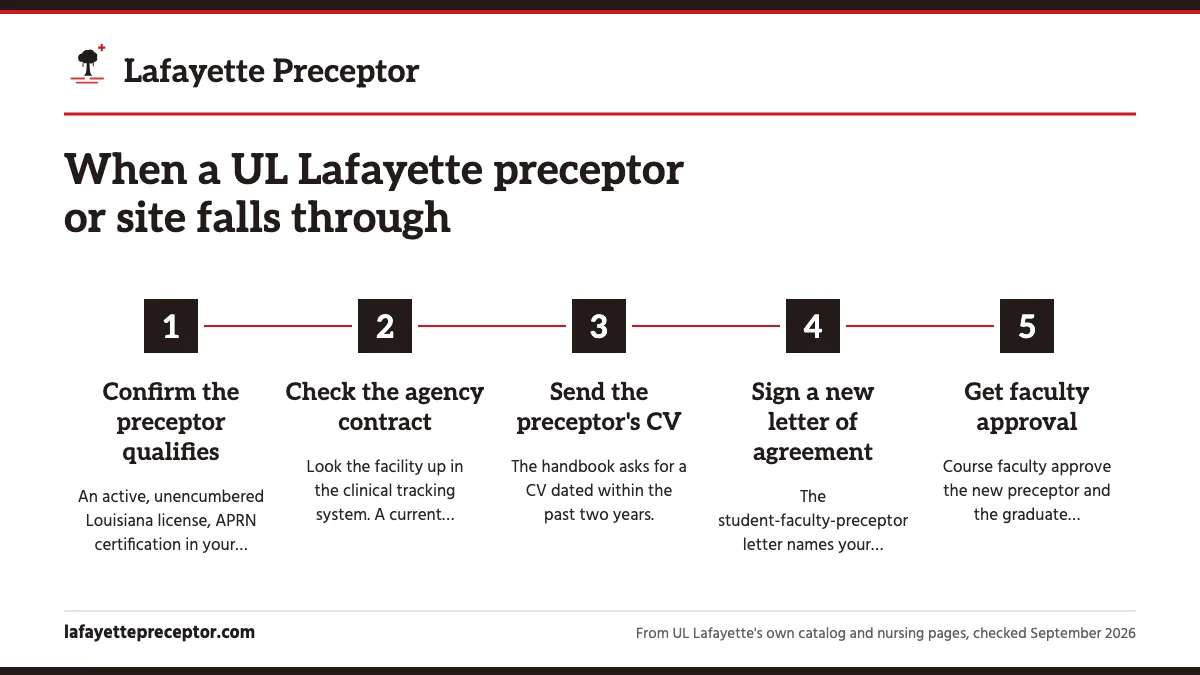
A new preceptor restarts the approval chain. The consortium wants these items settled before any clinical day with that person; the clinical paperwork guide covers each document in full.
- Confirm the preceptor qualifiesAn active, unencumbered Louisiana license, APRN certification in your area, a master's or doctorate in a relevant field and at least one year of clinical experience, with most of your hours under an APRN certified in your population focus.
- Check the agency contractLook the facility up in the clinical tracking system. A current contract saves weeks; a new one can take several weeks to months.
- Send the preceptor's CVThe handbook asks for a CV dated within the past two years.
- Sign a new letter of agreementThe student-faculty-preceptor letter names your preceptor, so a replacement needs its own signed copy.
- Get faculty approvalCourse faculty approve the new preceptor and the graduate coordinator reviews them before you start.
- Post the new scheduleUpdate your clinical schedule in the clinical tracking system so faculty can see the new site and dates.
A replacement inside the same agency usually moves fastest, because the contract is already in place and only the preceptor-specific items change. A site the university has never contracted with takes the longest.
Why the clock matters: grades and progression
The stakes are academic, and UL Lafayette's catalog and the consortium handbook spell them out. Each rule below narrows your options the longer a practicum sits without a preceptor.
| Rule | Where it comes from | What it means after a lost preceptor |
|---|---|---|
| No MSN grade below B; a course below B is repeated, and only once | 2026-27 catalog | Ending short of hours or competencies can cost a full repeat |
| A D or F in any course stops progression | ICMSN handbook | An F in one practicum halts the whole MSN plan |
| An unsatisfactory final evaluation from a preceptor or faculty member is an F | ICMSN handbook | A rushed, poorly matched replacement carries its own risk |
| An incomplete not changed by the posted deadline turns into an F | Graduate School, 2026-27 catalog | Fall 2026 incompletes must be resolved by April 12, 2027 |
| No more than two W grades | ICMSN handbook | Withdrawing from a practicum uses one of the two |
| PMHNP certificate: B or better in every course | 2026-27 catalog | The same pressure applies in NURS 591, NURS 592 and NURS 597 |
| DNP: finish within five years; extra residency hours through NURS 809 to 812 | 2026-27 catalog | Delays eat into the time limit, and the extra-hours courses need DNP Coordinator permission |
An incomplete is given at the instructor's discretion to a student doing passing work who could not finish for unforeseen reasons. It is your course faculty's decision, so raise it early if a replacement will start late. The grades and progression guide covers the DNP grade conflict and the time limits.
How we keep a second option ready
The fastest recovery is one that began before anything went wrong. When we place a UL Lafayette student, your placement advisor keeps a qualified alternative in view while the first match moves through approval: a Louisiana preceptor in the same population focus, within reach of where you live, whose license, certification and CV we have already checked.
If the first preceptor withdraws, we move that alternative forward right away. You get the documents faculty need in one package, a site whose contract status is already known, and a preceptor who has been briefed on UL Lafayette's weekly faculty contact and evaluation expectations. The work that normally eats the first two weeks of a scramble is already done.
Students who reach us after a preceptor has already left get the same urgency. We search, confirm the fit and assemble the paperwork in parallel rather than one step at a time. If that is where you are today, the preceptor dropped out page has a short checklist, and the form below goes straight to the placement desk.
Timing the recovery around UL Lafayette's calendar
Count the clinical days left in the term, not the weeks. Spring 2027 runs January 13 to May 7, with Mardi Gras (February 8-10) and the Easter/Spring Break (March 26 to April 4) inside it, and the last day to drop a full-term class with a W is April 12. A practicum taught at a partner ICMSN school may follow that school's dates instead, and Summer 2027 dates are not yet published. The academic calendar guide has the full list.
Before anything else, bring your hour log up to date in the clinical tracking system so faculty can see exactly what remains. Then work backward from the course end date with your faculty member: can a replacement close the gap in the time left, or does the incomplete conversation need to happen now? Knowing the answer in the first week keeps every option open.
Questions UL Lafayette students ask
What should I do first if my UL Lafayette preceptor cancels?
Email your course faculty from your university account the same day and copy the graduate coordinator. Give the date, the hours you have logged and the population you still need. Faculty approve every preceptor and confer weekly on your progress, so they decide what the course needs next. Then start lining up a replacement who meets the Louisiana and consortium rules.
Can I keep logging hours while a new preceptor's paperwork is pending?
No. The consortium handbook wants the agency contract, the preceptor's CV and the signed letter of agreement on file before any clinical day with that preceptor, together with your own health, OSHA and HIPAA items. Hours completed before approval risk not counting at all. Once approval comes through, keep your schedule in the clinical tracking system current.
Will losing a preceptor mean I fail the course?
Not automatically. UL Lafayette publishes no graduate rule on it, and the outcome depends on how much of the course remains and what your faculty decide. An incomplete is possible at the instructor's discretion, a withdrawal counts against the consortium's two-W limit, and ending the course short can leave you below the B the MSN requires.
How long does it take to approve a replacement site?
It depends mostly on the contract. If the university already holds a current contract with the agency, the new preceptor's CV, a fresh letter of agreement and faculty approval are the main steps. A facility without one needs a new contract, which the handbook says can take several weeks to months to secure.
My DNP residency mentor left. Who do I tell?
Your faculty advisor, who chairs the Synthesis Project committee, and the DNP Coordinator. The committee includes an approved mentor from the agency where the project runs, so a new mentor needs approval as well. If the change leaves you short of residency hours, the catalog routes extra hours through NURS 809 to 812, with the DNP Coordinator's permission.
Related pages
Last checked 2026-09-27
We check these pages against UL Lafayette's 2026-27 catalog, its online program and state authorization pages, the ICMSN student handbook and Louisiana's nursing rules. Your course faculty and your plan of study have the final word.
Whether UL Lafayette helps or you start alone, we find the preceptor.
Tell us your UL Lafayette program, the practicum coming up and the Louisiana town you train near. We look for preceptors and sites that fit the course and gather the license, CV and agency details that must be on file before your first clinical day.
- Preceptors who meet Louisiana's rules: an active Louisiana license, most hours with an APRN in your population focus
- The preceptor's CV, the agency details and your letter of agreement items gathered early
- Across Acadiana and the rest of Louisiana, plus DNP residencies in your home state
Start your placement plan
Your program, your town and your next clinical semester is all we need to begin.