Your own network, UL Lafayette's process or a placement service
Every route to a UL Lafayette practicum ends at the same point: a preceptor who meets Louisiana's rules, a complete file in the graduate nursing office and approval from course faculty. What differs is where the search begins and who carries the work along the way. UL Lafayette may take a large role in your placement or a small one; either way, our desk brings you a preceptor and clinical setting that clear its rules.
Get your placement plan
Tell us your UL Lafayette program and where you live. A placement advisor replies with the preceptor and site options that fit your UL Lafayette course.
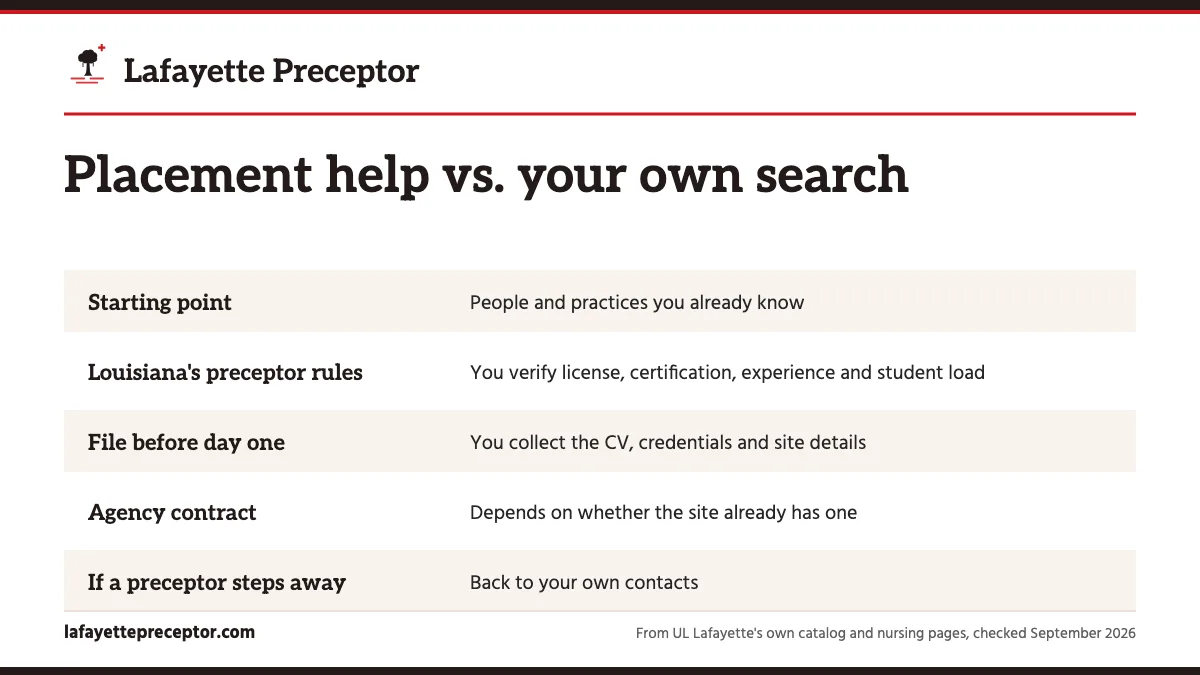
One destination, three ways to reach it
Fix the end point before comparing routes. Whatever path you take, your preceptor holds an active, unencumbered Louisiana license, and most of your hours are spent with an APRN certified in your population focus. Before the first clinical day, the consortium expects four things on file: a current agency contract, your preceptor's curriculum vitae, the letter of agreement with all three signatures, and your own health, OSHA and HIPAA records. Course faculty then approve each preceptor after the graduate coordinator's review.
So the useful question is not which route skips those steps, because none does, but how fast and how completely each one carries you through them. The three routes below are not exclusive, and they combine well.
Route one: your own network
Your own contacts are often the warmest leads: a nurse practitioner you have worked beside, a clinic near home, a psychiatric practice where a colleague trained. Someone who already knows your work may say yes quickly.
The work that follows is yours to carry. You confirm the license, the population-focus certification, the year of experience and whether the clinician already supervises two graduate APRN students. You collect a CV from the last two years and the site details a contract needs, and that contract may not exist yet. If the lead is your employer, your clinical time must stay unpaid and outside your job duties; see workplace clinicals.
Large systems add their own rules. Ochsner tells students from every school to leave its providers and staff uncontacted and to send requests, preceptors of interest included, through the school's coordinator in its InPlace system, allowing at least four months for any new agreement.
Route two: UL Lafayette's own process
Your first conversation belongs with UL Lafayette. The graduate coordinator can tell you what support comes with your course, and course faculty can tell you what they expect from a preceptor in that practicum. UL Lafayette's current public pages set standards for preceptors and sites without describing how graduate placements are arranged, so ask directly rather than assume.
Questions worth asking early
- What placement support applies to my course and term?
- Does the university already hold a contract with the site I have in mind?
- Which settings and populations suit this practicum's hours?
- How are hours credited if I train with more than one clinician?
- What must be on file, and by when, before my first clinical day?
You can also look up a facility in the clinical tracking system to see whether a university contract is already in place. The clinical placement process page follows the whole path from admission to final evaluation.
Route three: a placement service built for UL Lafayette
A placement service takes on the search, the matching and the paperwork. With us, that means a search built around your course, term and parish; every candidate tested against Louisiana's Board rule and the ICMSN minimums before you hear a name; the preceptor's license, certification and CV collected; site details ready for a contract; and a letter of agreement ready for signatures.
It also means someone watching the calendar with you. Because a new agency contract can run to weeks or months, we start early, and while your hours run a placement advisor stays reachable with a second option in view. Approval is UL Lafayette's call alone; our job is a file that arrives whole, correct and inside the rules on its first review. To see what separates a strong service from a weak one, read choosing a placement service.
The three routes side by side
Each row below is a stage every UL Lafayette practicum passes through. Read across to see who handles it on each route.
| Stage | Your own network | UL Lafayette's process | A placement service |
|---|---|---|---|
| Starting point | People and practices you already know | Your graduate coordinator and course faculty | Your program, course, term and parish |
| Louisiana's preceptor rules | You verify license, certification, experience and student load | Faculty review each preceptor at approval | Every candidate checked before you see a name |
| File before day one | You collect the CV, credentials and site details | Held by the graduate nursing office once complete | Gathered and organized, letter of agreement ready to sign |
| Agency contract | Depends on whether the site already has one | Required on file; a new one can take weeks to months | Site details ready early so a new contract has time |
| If a preceptor steps away | Back to your own contacts | Ask course faculty how your course handles it | Replacement search matched to the same course |
| Final approval | UL Lafayette's course faculty | UL Lafayette's course faculty | UL Lafayette's course faculty |
Notice the last row. No route changes who approves; the difference is how much of the path you walk alone.
Combining routes, and where to start
The routes work best together. Start with UL Lafayette so you know what your course provides and expects. Hand any lead from your own network to your placement advisor, who tests it against the rules and builds the file around it; if the lead falls short, a wider search is already under way. Approval stays with UL Lafayette's faculty from start to finish.
Timing decides how much choice you have. UL Lafayette posts no graduate placement deadline, so work in reverse from the opening day of the term that holds your first precepted course, and leave room for a contract that may still need drafting. Tell us your program and term using the contact form, or start with how it works.
Questions UL Lafayette students ask
Does using a placement service change how UL Lafayette approves my preceptor?
No. The graduate coordinator reviews each preceptor and course faculty approve them, whichever route produced the name. What a service changes is the state of the file on arrival: complete, current and already checked against Louisiana's Board rule and the consortium's minimums, so the review can focus on fit rather than on missing items.
A preceptor already agreed to take me. Do I still need help?
Perhaps not with the search, but the rest of the path still applies. Confirm the preceptor meets the license, population and experience rules, learn whether a university contract already covers the site, and assemble the CV and letter of agreement. We can take a lead you bring, handle those checks and the file, and keep a backup ready in case plans change.
May I phone an Ochsner nurse practitioner directly to ask about precepting?
Ochsner's published rule for students of every school is to leave its providers, clinicians and staff alone and route each request, including a preceptor you hope to work with, through the school's coordinator in the InPlace system. It also asks for at least four months to process a new agreement. Plan any Ochsner hopes with those rules in mind.
What if no route has produced a preceptor yet?
Widen the search and start it sooner. Look beyond your own parish, consider settings you had not planned on that still fit your course's population, and talk with your graduate coordinator about timing. The can't find a preceptor guide lays out next steps, and a placement advisor can open a search once you send your course and term.
Related pages
Last checked 2026-09-27
We check these pages against UL Lafayette's 2026-27 catalog, its online program and state authorization pages, the ICMSN student handbook and Louisiana's nursing rules. Your course faculty and your plan of study have the final word.
Whether UL Lafayette helps or you start alone, we find the preceptor.
Tell us your UL Lafayette program, the practicum coming up and the Louisiana town you train near. We look for preceptors and sites that fit the course and gather the license, CV and agency details that must be on file before your first clinical day.
- Preceptors who meet Louisiana's rules: an active Louisiana license, most hours with an APRN in your population focus
- The preceptor's CV, the agency details and your letter of agreement items gathered early
- Across Acadiana and the rest of Louisiana, plus DNP residencies in your home state
Start your placement plan
Your program, your town and your next clinical semester is all we need to begin.