Who can precept a UL Lafayette graduate nursing student
A UL Lafayette NP preceptor has to satisfy two sets of rules at once: Louisiana's Board of Nursing rule on preceptorships and the ICMSN's minimum qualifications. Put simply, that means an APRN with an active Louisiana license, certification in your population, a relevant master's or doctorate, a year or more in practice and room for another student. We check each of those before a name ever reaches your course faculty.
Get your placement plan
Tell us your UL Lafayette program and where you live. A placement advisor replies with the preceptor and site options that fit your UL Lafayette course.
How Louisiana defines a graduate preceptor
Louisiana's nursing education rules (LAC 46:XLVII.3503) define a graduate preceptor as "an advanced practice registered nurse, physician, or dentist, who provides guidance, serves as a role model, resource person, and clinical educator" for an advanced practice nursing student. The same section describes working under an approved preceptor as guidance from a licensed APRN, physician, dentist or another person the Board approves, within the same or a related practice role, population or specialty.
So the Board's starting pool is broader than nurse practitioners alone. The rules that follow in section 3543 narrow it, and the consortium's own minimums narrow it again for UL Lafayette's MSN students. Once both filters have run, the person carrying most of your hours has to be an APRN certified in your population.
Section 3543 B also ties preceptor selection to written criteria that faculty and the clinical facility's nursing administration develop together, following Board guidelines.
Louisiana's working rules, line by line
Section 3515 J adds one practical point: faculty do not have to be inside the facility during a preceptorship. The daily teaching rests with the preceptor, while faculty stay responsible for the student and keep in touch every week.
| Rule | What it requires | What it means for your match |
|---|---|---|
| G.1 License | Every preceptor holds an active, unencumbered Louisiana RN and/or APRN license | The Louisiana license is confirmed before anything else about the preceptor |
| G.3.a Majority | Most clinical experience is under an APRN licensed and certified in the population focus, primary and/or acute care as appropriate | Your main preceptor is an APRN certified in your population: family for FNP, psychiatric-mental health for PMHNP |
| G.3.b Mix | A mix of clinicians may provide direct clinical teaching | A physician or another specialty can add hours alongside the majority, not in place of it |
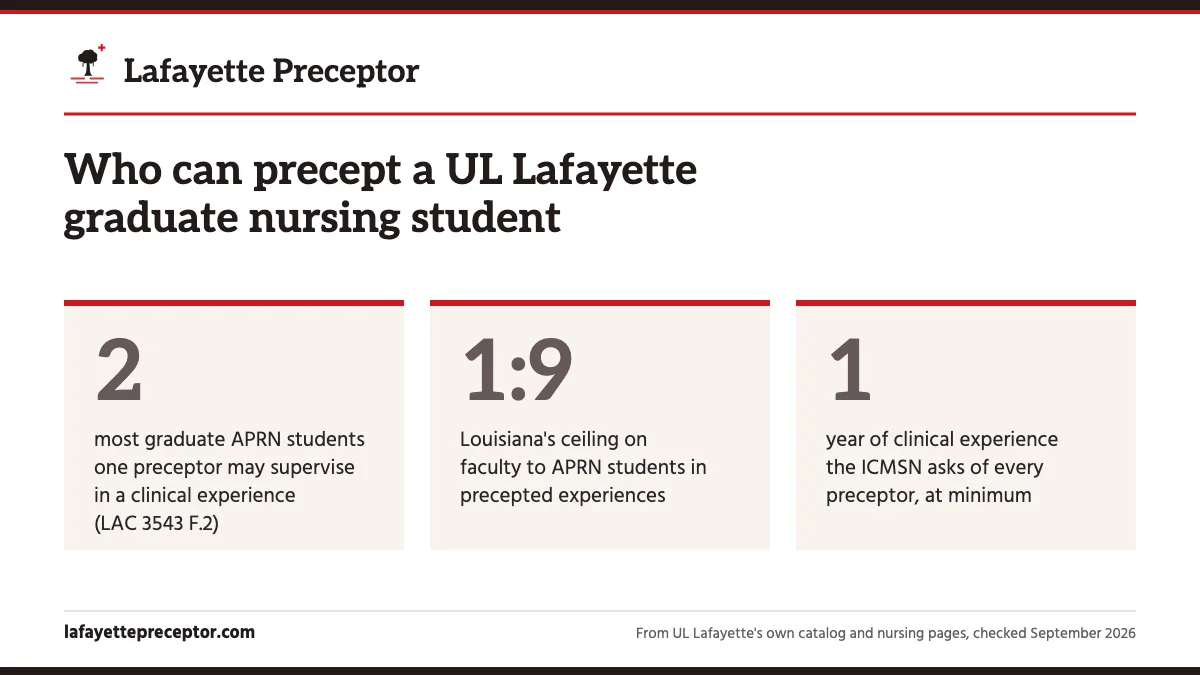
| F.2 Ratios | No more than two graduate APRN students per preceptor in any clinical experience; no more than one faculty member per nine APRN students | A preceptor's current student load is part of every match |
| D Faculty contact | Faculty confer with each preceptor and student at least weekly | Your preceptor can expect a weekly check-in from UL Lafayette faculty |
The ICMSN's minimum qualifications
The ICMSN student handbook, the operative handbook for UL Lafayette's MSN, sets a floor of its own for every preceptor:
- Graduate preparation, a master's or doctorate, in a field that fits the course
- A current, unencumbered license, which for UL Lafayette students means Louisiana
- APRN certification in the area the student is training in
- A practice setting suited to the course's learning
- At least one year of clinical experience
Approval runs in a set order. The graduate coordinator reviews each preceptor first, and course faculty give the approval. The preceptor's CV, dated within the past two years, is part of the file that makes the review possible, and it must be filed ahead of the first clinical day, along with the rest of the clinical paperwork.
Because UL Lafayette keeps MSN clinicals inside Louisiana, the license question is already answered: the state of practice is Louisiana. The Louisiana-only clinicals guide explains that rule.
Matching the preceptor to the course
Per-course hours for the FNP and PMHNP practicums are not published, so we build each match around the course description and confirm the hour picture with your course faculty. For Nursing Education's NURS 557, which runs in precepted class, lab and clinical settings, ask course faculty which of the consortium's qualifications they apply to an education preceptor.
| Course | Patients the course centers on | Preceptor we lead with |
|---|---|---|
NURS 582 Family Health I | Pediatric, adolescent and childbearing women | An FNP-certified APRN whose practice sees these patients |
NURS 583 Family Health II | Adults | An FNP-certified APRN in an adult-heavy practice |
NURS 584 Family Health III | Older adults | An FNP-certified APRN with a geriatric caseload |
NURS 591, NURS 592, NURS 593 (MSN) | Psychiatric-mental health | A PMHNP-certified APRN |
NURS 591, NURS 592, NURS 597 (certificate) | Psychiatric-mental health; NURS 597 with an older-adult emphasis | A PMHNP-certified APRN, for NURS 597 one who sees older adults |
The PMHNP certificate and the DNP
In UL Lafayette's catalog, each certificate clinical course is direct patient care with a preceptor the catalog calls approved and advanced practice, working under graduate faculty guidance, for 120 to 210 hours per course. Certificate students already hold a Louisiana APRN license and national NP certification, so the population match is the question that counts: the larger share of hours belongs with a psychiatric-mental health certified APRN.
The DNP follows a different model. Its residency courses, NURS 821, NURS 822 and NURS 823, pair you with a residency mentor, and your Synthesis Project committee includes an approved mentor from the agency where you expect to carry out the project. The DNP residency guide covers that role and the 420 residency hours.
What preceptors should know before saying yes
A preceptor who agrees to take a UL Lafayette student signs the student-faculty-preceptor letter of agreement, supplies a CV no more than two years old and should plan on weekly contact from faculty during the practicum. Faculty evaluate the student with the preceptor's input, and an unsatisfactory final evaluation from a preceptor results in an F for the course, so the preceptor's judgment carries real weight.
Preceptors also carry the cap: two graduate APRN students at a time is the Louisiana limit, across every school they teach for. A clinician weighing a UL Lafayette request can read our page for preceptors, and the faculty oversight guide explains the evaluation side, including how weekly contact works in practice.
How we match to these rules
Before we introduce a preceptor, they have cleared the same checks UL Lafayette's reviewers apply, which keeps the review short. Each match is weighed against six points.
- License: an active, unencumbered Louisiana license, verified first
- Certification: APRN certification matching your population, for the bulk of your hours
- Background: graduate preparation in a related field plus a year or more in clinical practice
- Capacity: room within Louisiana's two-student limit for the dates you need
- Setting: a practice whose patients match the course you are taking
- File: a current CV and credential details packaged for the graduate coordinator's review
Course faculty hold the final approval, and we send them a preceptor who already fits Louisiana's rule and the consortium's minimums. Read how it works, then send us your course and term through the form below.
Questions UL Lafayette students ask
Can a physician precept a UL Lafayette NP student?
Physicians and dentists fit Louisiana's definition of a graduate preceptor, and section 3543 lets several kinds of clinicians teach. Even so, most of your clinical time belongs with an APRN holding certification in your population, and the ICMSN's minimums are written around APRN certification. Ask your course faculty before planning hours with a physician.
Can my preceptor take two UL Lafayette students at once?
Louisiana allows a preceptor to supervise up to two graduate APRN students during any clinical experience, so a second student fits within the rule and a third does not, whichever programs the students come from. When we propose a preceptor, we confirm how many graduate students they already have for your dates.
Can a brand-new NP be my preceptor?
Not under the ICMSN minimums until they have a full year of clinical experience. The consortium also looks for a relevant master's or doctorate, APRN certification in the area and a current, unencumbered license. A new NP can become a strong preceptor a year later; until then, we look to clinicians with more time in practice.
How recent does a preceptor's CV need to be?
The ICMSN handbook asks for a preceptor CV dated within the last two years, filed in the graduate nursing office before any clinical day. An older CV needs updating before the file is complete. We request a fresh copy the moment a preceptor agrees, so it is ready for the graduate coordinator's review.
Does UL Lafayette publish its own preceptor handbook?
No UL Lafayette preceptor handbook or preceptor qualification page appears on its public sites. The standards come from the ICMSN student handbook and Louisiana's Board rules, and the certificate's catalog entry adds that its preceptors are approved advanced practice clinicians working under graduate faculty. Course faculty and the graduate coordinator answer whatever those sources leave open.
Related pages
Last checked 2026-09-27
We check these pages against UL Lafayette's 2026-27 catalog, its online program and state authorization pages, the ICMSN student handbook and Louisiana's nursing rules. Your course faculty and your plan of study have the final word.
Whether UL Lafayette helps or you start alone, we find the preceptor.
Tell us your UL Lafayette program, the practicum coming up and the Louisiana town you train near. We look for preceptors and sites that fit the course and gather the license, CV and agency details that must be on file before your first clinical day.
- Preceptors who meet Louisiana's rules: an active Louisiana license, most hours with an APRN in your population focus
- The preceptor's CV, the agency details and your letter of agreement items gathered early
- Across Acadiana and the rest of Louisiana, plus DNP residencies in your home state
Start your placement plan
Your program, your town and your next clinical semester is all we need to begin.