When your UL Lafayette preceptor drops out
A preceptor who backs out is a setback, not a verdict on your semester. Tell your course faculty the same day, get every hour already worked into your log and start the replacement's paperwork at once, because no new hour counts until that file is approved. The MSN's B-or-better rule and the consortium's D-or-F progression rule are the reason speed matters, and the reason we move a qualified replacement forward as quickly as the file allows.
Get your placement plan
Tell us your UL Lafayette program and where you live. A placement advisor replies with the preceptor and site options that fit your UL Lafayette course.
Before the practicum or partway through
Timing changes the problem. If the preceptor pulled out before your first clinical day, you have lost planning time but no hours. The task is a clean restart: a new preceptor, perhaps a new site, and a complete file before the course opens. The target is the same as before, a Louisiana-licensed APRN in your population focus with room for another student.
If the exit came mid-course, you also have logged hours to protect and a shrinking supply of clinical days. The questions sharpen: how many hours remain, how many weeks remain, and can one replacement close that gap before the term ends, or will it take two? Your course faculty's reading of those numbers shapes everything that follows.
Either way, UL Lafayette publishes no graduate procedure for this moment, so the steps below come from the rules it does publish and from the consortium handbook that governs the MSN.
The first two days
Small, fast moves in the first two days protect more of your semester than anything you do later.
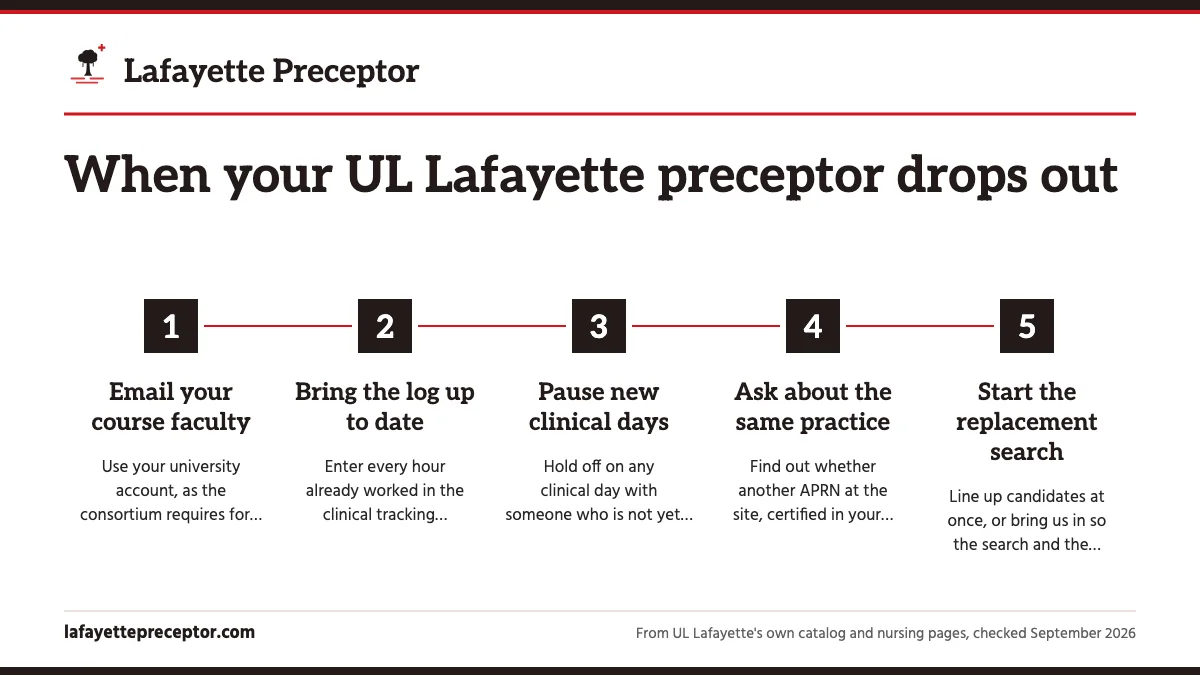
- Email your course facultyUse your university account, as the consortium requires for faculty and preceptor contact. Give the date the preceptor withdrew, your hours so far and the population you still need. Copy the graduate coordinator. DNP students write to their faculty advisor and the DNP Coordinator.
- Bring the log up to dateEnter every hour already worked in the clinical tracking system and correct the posted schedule so it no longer shows days that will not happen.
- Pause new clinical daysHold off on any clinical day with someone who is not yet approved, however willing they are.
- Ask about the same practiceFind out whether another APRN at the site, certified in your population, could step in. That path keeps the existing contract.
- Start the replacement searchLine up candidates at once, or bring us in so the search and the paperwork run together.
Protecting the hours you already logged
Hours completed with an approved preceptor under a complete file are the base of your recovery, so treat them carefully. Check that each one appears in the clinical tracking system, which the consortium requires and where your clinical schedule is posted, and that every entry matches a day you actually worked. The clinical tracking system guide explains what the system holds.
If the preceptor is leaving on good terms, ask whether they will share their view of your work with your faculty member. Louisiana's rules have faculty evaluate students with input from preceptors, and a word from the person who watched your first weeks helps the faculty member judge what remains.
Resist any temptation to round up. The consortium counts fabrication in clinical or practicum work as academic dishonesty, and a padded log turns a scheduling problem into an integrity case.
What the replacement needs before new hours count
A new preceptor restarts approval. The file needs the agency contract (already current if the replacement practices at the same contracted site), the new preceptor's CV from within the past two years, a fresh letter of agreement with the new preceptor's signature, course faculty approval and the graduate coordinator's review. New hours count only after that. Our backup preceptors guide walks the full sequence, and the clinical paperwork guide covers each document.
Look inside the same practice first. A second APRN there, certified in your population, shares the site's contract, so the new file shrinks to a CV, a new signed letter and faculty sign-off. A practice the university has never contracted with carries the longest wait, since a new agency contract can run from weeks into months.
What is at stake: the grade rules
UL Lafayette's MSN counts no grade below a B. A course that ends below B has to be taken again, you get one repeat, and a C never applies to the program. The consortium adds a harder stop: a D or F in any course makes you ineligible to progress, and in a clinical course an unsatisfactory final evaluation from either your preceptor or your faculty member produces an F. PMHNP certificate students need a B or better in every course too.
DNP students face two catalog statements that disagree: the program page lets a course below B be repeated once, while the Graduate School section ends eligibility at a second C. The grades and progression guide sets out both.
The practical lesson is that fit matters as much as speed. A replacement who covers the right population and can give you enough clinical days is worth a short wait; a rushed match who cannot is its own risk.
The final evaluation decides the grade, so a poorly matched replacement can cost as much as no replacement at all.
How we find your replacement
Tell us the course, its population, the hours left, the weeks left and where you live. Your placement advisor searches Louisiana for an APRN certified in that population with room under the two-student limit, and looks hardest at sites whose contract with the university is already current, so the slowest document is settled before you ask.
We then build the replacement file with you: license and certification confirmed, a recent CV in hand, the letter of agreement details ready for signatures and your own compliance items listed, so faculty see a complete package. Whether or not UL Lafayette takes a hand in finding the replacement, ours is chosen to meet its rules, and faculty give the final approval on a file built to need no second round.
If the gap in hours is large, the behind on clinical hours page explains how a second preceptor can help you finish.
Questions UL Lafayette students ask
My preceptor quit mid-semester. Do the hours I already logged still count?
UL Lafayette publishes no graduate rule on this, so your course faculty decide how completed hours fit into finishing the course. Before you ask, make sure every hour you worked is recorded accurately in the clinical tracking system, with dates that match your schedule. A clean, honest log gives faculty the clearest picture of what remains.
Can another APRN at the same clinic take over as my preceptor?
Often that is the quickest fix, provided the colleague qualifies: a Louisiana license, certification in your population, a master's or doctorate, at least a year of clinical experience and fewer than two graduate APRN students already. The site's contract carries over, but you still need their CV, a new signed letter of agreement and faculty approval.
Should I withdraw from the course after losing my preceptor?
Talk to your course faculty before deciding. The consortium allows an MSN student no more than two W grades, so a withdrawal spends one. An incomplete is possible only at the instructor's discretion for passing work, and an incomplete from fall 2026 that is not changed by April 12, 2027 becomes an F.
Does a new preceptor need a new letter of agreement?
Yes. The consortium's letter of agreement is signed by the student, the faculty member and the preceptor, so a replacement preceptor means a new letter with the new preceptor's signature. The graduate nursing office also needs the replacement's CV from within the past two years before any clinical day together.
Related pages
Last checked 2026-09-27
We check these pages against UL Lafayette's 2026-27 catalog, its online program and state authorization pages, the ICMSN student handbook and Louisiana's nursing rules. Your course faculty and your plan of study have the final word.
Whether UL Lafayette helps or you start alone, we find the preceptor.
Tell us your UL Lafayette program, the practicum coming up and the Louisiana town you train near. We look for preceptors and sites that fit the course and gather the license, CV and agency details that must be on file before your first clinical day.
- Preceptors who meet Louisiana's rules: an active Louisiana license, most hours with an APRN in your population focus
- The preceptor's CV, the agency details and your letter of agreement items gathered early
- Across Acadiana and the rest of Louisiana, plus DNP residencies in your home state
Start your placement plan
Your program, your town and your next clinical semester is all we need to begin.