Behind on clinical hours in a UL Lafayette practicum
A shortfall in hours is fixable while the course is still open and much harder once it closes. Know your exact target, raise the gap with your course faculty early and add clinical days the honest way, often through a second approved preceptor. The consortium's clinical F, UL Lafayette's incomplete rules and, for the DNP, the NURS 809 to NURS 812 courses set the boundaries you work within.
Get your placement plan
Tell us your UL Lafayette program and where you live. A placement advisor replies with the preceptor and site options that fit your UL Lafayette course.
Start with the exact number
You cannot plan a recovery without knowing the target, and UL Lafayette's sources do not always agree on it. The 2026-27 catalog sets the FNP and PMHNP totals at 750 precepted hours, while older web pages and the 2025-26 catalog show 600; for Nursing Education the catalog reads 240 where the web says 300. When they differ, check the catalog first, then have your course faculty confirm which figure governs your plan of study.
Per-course targets are published for some programs and not others. On the PMHNP certificate's online page, NURS 591 carries 180 hours, NURS 592 carries 210 and NURS 597 carries 120. Nursing Education splits its practicum time into 60 hours for NURS 544 and 180 for NURS 557, and the DNP residency runs 120, 180 and 120 hours across NURS 821 to NURS 823. For the FNP and PMHNP practicums, per-course hours are not public, so the syllabus and your faculty member are the authority. The NP hours guide explains the conflicts.
What a shortfall does to the grade
UL Lafayette publishes no formula that turns a given number of missing hours into a given grade. The consequences arrive through two rules instead. Under the consortium's handbook, a final clinical evaluation judged unsatisfactory, whether by the preceptor or by faculty, ends in an F for the course. And the MSN counts nothing below a B, with a single retake for a course that falls short.
An F weighs far more than a retake. Under the consortium's rules, any course graded D or F leaves an MSN student unable to progress, and the Graduate School bars a student with an F from further graduate enrollment once the current semester ends. The PMHNP certificate holds its students to the same B floor in every course. The grades and progression guide has the full set, including the DNP's conflicting C rules.
A gap raised in week six is a scheduling problem. The same gap discovered at the final evaluation is a grading problem.
Incompletes: time, with a hard stop
An I is your instructor's call. UL Lafayette's catalog reserves it for someone whose work is passing but whom unforeseen circumstances kept from completing the course. It buys time, not hours: you still need an approved preceptor and site to finish them.
- An I left unchanged at the posted deadline converts to an F on its own.
- November 16, 2026 is the cutoff for an I earned in spring 2026 or in either summer 2026 session.
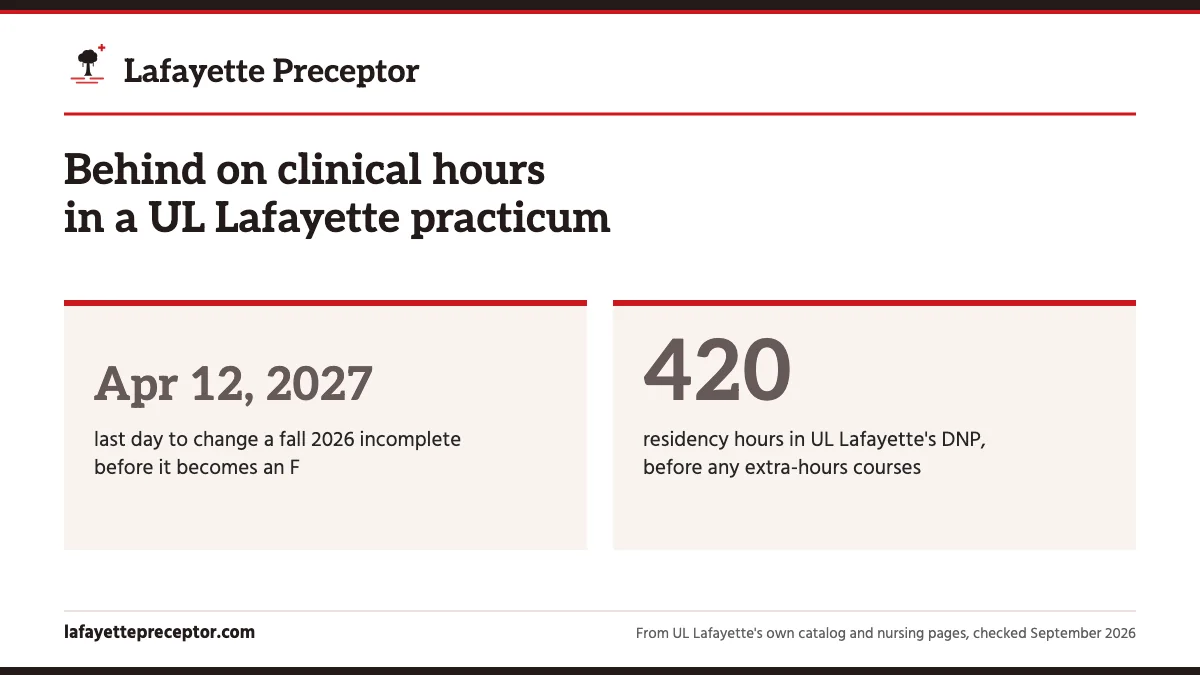
- April 12, 2027 is the cutoff for an I earned in fall 2026 or the 2026 winter intersession.
- Stretching that cutoff takes five sign-offs (yours, your instructor's, the department head's, the dean over the course and the Graduate School dean), and even then it stops at the following semester's last day for changing incompletes.
- A permanent incomplete is possible only with the Graduate School dean's approval.
The request belongs to you and your instructor, so raise it while your work is still passing, not after the final evaluation.
DNP: extra residency hours through NURS 809 to 812
The DNP builds in its own route for students who need more practice time. The residency courses carry 420 hours, and the program requires 1,000 post-baccalaureate supervised practice hours in all, with MSN hours counting toward the total. Your MSN program director reported those earlier hours on the Verification of Post-Baccalaureate Practicum Hours form when you applied, or on an institution-specific form in its place.
When residency time runs short, the catalog points students to one of the four Advanced Directed Studies courses, NURS 809 through NURS 812, worth 3, 1, 2 and 4 credits, each opened by the DNP Coordinator's permission. Plan them early: the DNP gives you five years from admission to finish everything. The DNP residency guide covers the residency sequence and the agency mentor.
Real hours, logged honestly
Catching up has to happen in real clinical time. Invented or inflated clinical records fall under the consortium's academic dishonesty rules, so backfilled dates or padded entries put far more at risk than the hours themselves. Keep your schedule current in the clinical tracking system as you add days, so faculty see the recovery as it happens.
A few rules shape which new hours count. If you catch up at your own workplace, the consortium requires those hours to be separate from your job duties and unpaid. Most of an NP student's clinical time has to be spent with an APRN who holds both the license and the certification for that population. In the PMHNP certificate, NURS 590 contributes observation time rather than direct care; the 510 direct-care hours come from the three clinical courses. The guide to what counts covers the details.
How a second preceptor closes the gap
The most reliable way to add clinical days is to add a preceptor. Louisiana's Board lets other clinicians share the hands-on teaching, provided the core of your time stays with an APRN certified in your population, so a second approved preceptor can open days your first one cannot offer.
Each added preceptor brings the same file as the first: a current contract for their site, a recent CV, a signed letter of agreement and faculty approval, and each preceptor's student load tops out at two. That is where we come in. Whether UL Lafayette plays a part in your placements or not, your placement advisor finds a second Louisiana preceptor who fits its rules, with open days that match your calendar, and builds that file while you keep working with the first.
Faculty give the final approval; the file we bring them is complete from the start. Tell us your remaining hours and your deadline with the form below.
Questions UL Lafayette students ask
Can I finish my clinical hours after the UL Lafayette semester ends?
Only through an incomplete, and that is your instructor's decision; it is meant for passing work interrupted by circumstances nobody planned for. For a fall 2026 course the I has to be resolved by April 12, 2027, or it becomes an F. You still need an approved preceptor and site to complete the hours.
Can I catch up on hours at the place where I work?
Possibly. Your employer can host your clinical hours under consortium rules, as long as they are separate from your job duties and unpaid. Faculty approval still applies, and the site's contract, the preceptor's CV and the signed letter all need to be in place first. Shifts you are paid to work as a nurse are job hours, not clinical hours.
Do observation hours count toward my NP total?
Only where a course says so. The PMHNP certificate's online page attaches 60 observational hours to its psychotherapy course, while the certificate's 510-hour catalog total comes from direct-care courses. The PMHNP concentration describes its hours as direct patient care. Ask your course faculty before you plan catch-up days around observation.
How do DNP students get more residency hours at UL Lafayette?
Through the Advanced Directed Studies courses, NURS 809 to 812, which the catalog reserves for students who need additional residency hours. They carry 3, 1, 2 and 4 credits, and each needs the DNP Coordinator's permission. Talk with your faculty advisor early, since the whole program has a five-year limit from admission.
Which hour total applies to me, 750 or 600?
The 2026-27 catalog says 750 precepted hours for both the FNP and PMHNP concentrations, while older catalogs and UL Lafayette's web requirement pages say 600. The catalog is the first source to check, and your course faculty confirm which figure applies to your plan of study. Get the answer in writing before you plan your remaining clinical days.
Related pages
Last checked 2026-09-27
We check these pages against UL Lafayette's 2026-27 catalog, its online program and state authorization pages, the ICMSN student handbook and Louisiana's nursing rules. Your course faculty and your plan of study have the final word.
- ICMSN student handbook (rev. 10/06/2025)
- UL Lafayette 2026-27 catalog: Graduate School regulations
- UL Lafayette 2026-27 catalog: Graduate School rules for the Doctor of Nursing Practice
- UL Lafayette Online: PMHNP Post-MSN Certificate
- UL Lafayette 2026-27 catalog: MSN, Family Nurse Practitioner Concentration
Whether UL Lafayette helps or you start alone, we find the preceptor.
Tell us your UL Lafayette program, the practicum coming up and the Louisiana town you train near. We look for preceptors and sites that fit the course and gather the license, CV and agency details that must be on file before your first clinical day.
- Preceptors who meet Louisiana's rules: an active Louisiana license, most hours with an APRN in your population focus
- The preceptor's CV, the agency details and your letter of agreement items gathered early
- Across Acadiana and the rest of Louisiana, plus DNP residencies in your home state
Start your placement plan
Your program, your town and your next clinical semester is all we need to begin.