The clinical tracking system for UL Lafayette NP practicums
The ICMSN handbook requires UL Lafayette NP students to subscribe to the clinical tracking system their home school names and to keep that subscription through the NP practicum courses. UL Lafayette's public pages do not name the product, so your course faculty and the Moodle materials for your practicum are where you confirm it. Here is what the system is for, and how to keep it in step with your preceptor and site.
Get your placement plan
Tell us your UL Lafayette program and where you live. A placement advisor replies with the preceptor and site options that fit your UL Lafayette course.
What the consortium requires
The rule is short and sits in the ICMSN student handbook, revised 10/06/2025. NP students must subscribe to "the respective clinical tracking system as required by their home institution" and keep the subscription active for as long as they are enrolled in NP practicum courses. For a UL Lafayette student, the home institution is UL Lafayette, whichever consortium university teaches a given course.
That wording tells you two things. First, the consortium leaves the product to each university, so instructions passed along by a classmate at McNeese, Nicholls or Southeastern may describe a different setup from yours. Second, the subscription spans the whole practicum sequence, from the first precepted course to the last, so plan for it as a standing part of the program rather than a one-term task.
Three jobs the system does for your practicum
What the handbook and your course tie to the system
- The approved clinical schedule. The handbook says the schedule "must be posted and regularly updated in the clinical tracking system." It is the record of where and when you are in clinic.
- Contract checks. Students log in to see whether the university already holds a contract with a facility, ideally before committing to a site.
- Clinical records your course asks for. If your course has you record hours, patient encounters or evaluations in the same system, the syllabus sets the format and the deadlines.
The third item depends on your course, because UL Lafayette's public pages do not describe how clinical hours are logged. Read each practicum syllabus for its own instructions. The what counts as clinical hours guide covers which hours qualify, wherever they end up recorded.
Checking a facility before you commit
The contract check is the most valuable thing the system does before a semester starts. A preceptor can agree to take you, yet clinical days cannot begin until the graduate nursing office has a current agency contract on file, and a new contract can take weeks or even months to put in place.
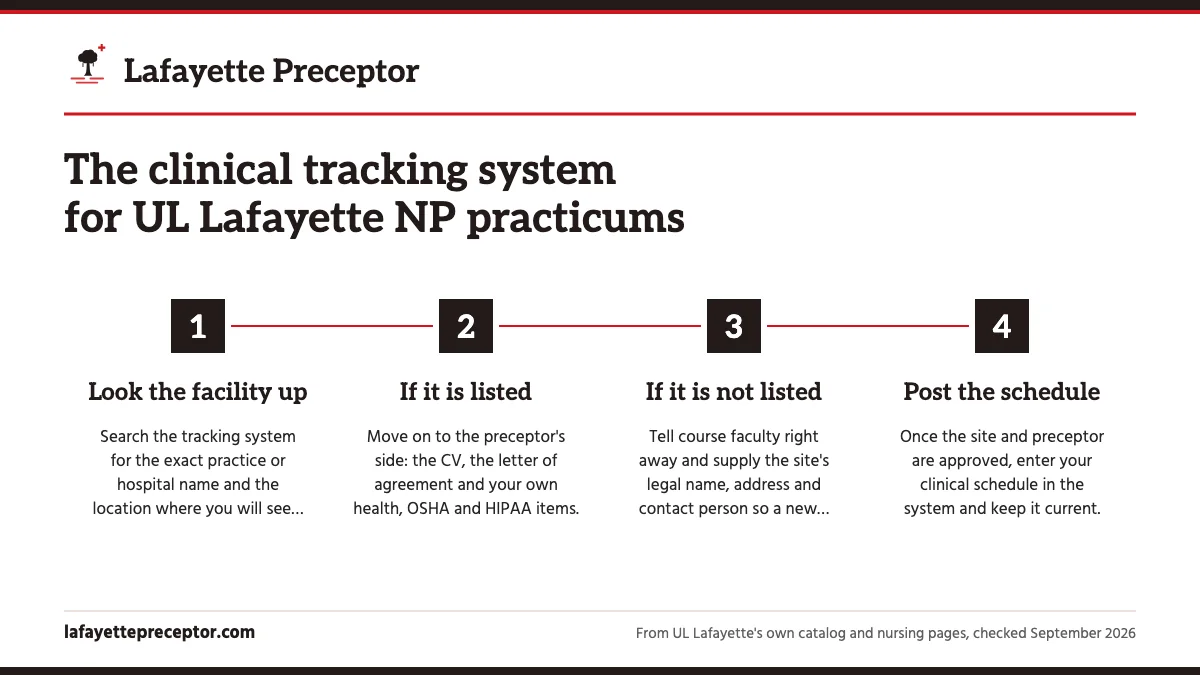
- Look the facility upSearch the tracking system for the exact practice or hospital name and the location where you will see patients.
- If it is listedMove on to the preceptor's side: the CV, the letter of agreement and your own health, OSHA and HIPAA items.
- If it is not listedTell course faculty right away and supply the site's legal name, address and contact person so a new contract can start. Louisiana also requires Board approval of a clinical facility at least four weeks before students use it.
- Post the scheduleOnce the site and preceptor are approved, enter your clinical schedule in the system and keep it current.
The clinical paperwork guide lists everything the graduate nursing office needs before your first day.
Keeping the schedule current and accurate
"Regularly updated" is the phrase to take seriously. The schedule in the system should match the days you are actually in clinic, so change it before a swap, a make-up day or a clinic closure, not after. Louisiana's rules have faculty conferring with each preceptor and student at least weekly during a precepted experience, and an accurate schedule keeps that contact grounded in where you really are.
Accuracy is also an integrity matter. The ICMSN handbook counts "fabrication in the process of completing academic work for thesis, course work and clinical or practicum experiences" as academic dishonesty, and UL Lafayette's catalog sets dismissal from the university as the maximum penalty for cheating. A schedule entry for a day you did not attend, or hours your preceptor would not sign, falls inside that definition.
Check the university calendar before the term begins. Spring 2027 includes Mardi Gras, Feb 8-10, and Easter and Spring Break, Mar 26 to Apr 4; if your preceptor's clinic keeps different closures, plan the schedule around both. The academic calendar guide has the full list.
Which product? Where to confirm
UL Lafayette's public pages, including the catalog and the online program pages, do not name the clinical tracking system. The School of Nursing's Fall 2022 BSN handbook mentions an unnamed compliance tracker used to order drug screens, and nothing public says whether that tool and the consortium's tracking system are one and the same.
Confirm the product, the subscription steps and the sign-up timing through UL Lafayette's own channels:
- Course faculty for your first practicum, who approve your preceptor and set the course's clinical requirements.
- The syllabus, announcements and clinical documents inside the practicum's Moodle course.
- The faculty advisor named for your program on UL Lafayette's online advising page.
- The graduate nursing office in V.L. Wharton Hall, Room 307.
Subscribe only after UL Lafayette tells you which system and which account setup to use; a sign-up based on a search result or another school's instructions may not be the one your course reads.
How we make your tracking system entries easy
Everything in the tracking system depends on a confirmed preceptor and site, and that is the part we handle. Whether or not UL Lafayette takes a hand in placing you, we secure a Louisiana preceptor and site that fit its rules, and we ask you to run the contract check on the first day so a site without a contract starts its paperwork while there is still time.
Your placement advisor hands you, in one place, the details the system and the approval need: the preceptor's Louisiana license and certification, the CV, the site's full name and address, and the days the preceptor can take you. That makes the first schedule entry quick and every update simple. UL Lafayette's course faculty approve every preceptor; we make sure what reaches them is complete. See how it works or reach the placement desk through the contact form.
Questions UL Lafayette students ask
When should I set up the clinical tracking system?
Before your first practicum, as soon as UL Lafayette gives instructions. The handbook ties the subscription to NP practicum courses, which begin with NURS 582 in the FNP's third semester and NURS 591 in the PMHNP's fourth. The contract check is useful even earlier, while you are still choosing a site. See your first clinical course.
Do Nursing Education students use the clinical tracking system?
The handbook's subscription rule refers to NP practicum courses. The Nursing Education practicums, NURS 544 and NURS 557, are precepted too, but UL Lafayette's public pages do not say whether they use the same system. Ask course faculty for NURS 544 before the term starts, and follow the instructions posted in that course's Moodle page.
What if my clinical site is not in the tracking system?
It means the contract check did not find an agreement with that facility. Tell course faculty right away and supply the site's details, because a new agency contract can take weeks or months, and Louisiana requires Board approval of a new clinical facility at least four weeks before students first use it.
Do DNP students use the ICMSN clinical tracking system?
The ICMSN handbook governs the MSN, which the four consortium universities share. The DNP is UL Lafayette's own program, and its public pages do not name a tracking tool for the residency courses, NURS 821 through NURS 823. Ask the DNP Coordinator or your faculty advisor how residency hours and schedules are recorded.
Can I change my clinical schedule after it is posted?
Yes, and the handbook expects it: the approved schedule must be posted and regularly updated. Make the change before the day it affects, tell your preceptor and course faculty, and keep entries matched to the days you actually attend, since a schedule that misstates clinical time can turn into an academic integrity question.
Related pages
Last checked 2026-09-27
We check these pages against UL Lafayette's 2026-27 catalog, its online program and state authorization pages, the ICMSN student handbook and Louisiana's nursing rules. Your course faculty and your plan of study have the final word.
Whether UL Lafayette helps or you start alone, we find the preceptor.
Tell us your UL Lafayette program, the practicum coming up and the Louisiana town you train near. We look for preceptors and sites that fit the course and gather the license, CV and agency details that must be on file before your first clinical day.
- Preceptors who meet Louisiana's rules: an active Louisiana license, most hours with an APRN in your population focus
- The preceptor's CV, the agency details and your letter of agreement items gathered early
- Across Acadiana and the rest of Louisiana, plus DNP residencies in your home state
Start your placement plan
Your program, your town and your next clinical semester is all we need to begin.