Grades, repeats and progression in UL Lafayette nursing
In UL Lafayette's MSN a B is the floor: a lower grade means repeating the course, you get one repeat, and a C earns no credit toward the MSN. Under the consortium's rules, one D or F anywhere in the plan halts progression, and an unsatisfactory final clinical evaluation turns into an F. The DNP's two catalog sources disagree about what a C means, and every graduate student works inside a 3.0 GPA rule and a time limit.
Get your placement plan
Tell us your UL Lafayette program and where you live. A placement advisor replies with the preceptor and site options that fit your UL Lafayette course.
The rules by program
UL Lafayette's grade rules come in three layers: the program's own catalog entry, the ICMSN handbook for MSN students, and the Graduate School rules that cover every graduate student. All three apply at once, so the strictest one sets your real limit.
| Program | Minimum course grade | Repeats | What stops progression |
|---|---|---|---|
| MSN: FNP, PMHNP, Nursing Education | B | A course below B is repeated, once only; a C never counts | A D or F in any course (ICMSN handbook) |
| PMHNP Post-Master's Certificate | B in all courses | Ask the graduate coordinator how a repeat is scheduled | Graduate School rules apply |
| Doctor of Nursing Practice | B on the program page | Program page: repeat once; Graduate School: one C permitted | A second C (Graduate School's DNP section) |
| All graduate students | C is the lowest grade that earns graduate credit | Advised to repeat the course the next time it is offered | GPA below 3.0, more than two Cs, more than 6 credit hours of C, or a grade below C |
| Traditional BSN | C, plus Satisfactory in every lab or clinical component | One required nursing course may be repeated | A second W, D or F in the repeated course |
MSN: a B in every course, and one repeat
The catalog entries for all three MSN concentrations spell it out: "Students who earn less than a 'B' grade in a course will be required to repeat that course. A course may be repeated only once." A C never satisfies a requirement, so all it buys is the right to take the course again. The PMHNP web page adds a minimum GPA of 3.0.
The consortium adds where the repeat happens. Under the consortium's handbook, a C course is retaken by your home school's policy, at UL Lafayette itself whenever UL Lafayette teaches it. The Graduate School advises repeating unacceptable work the next time the course is offered, which for a practicum usually means a later semester, a fresh set of precepted hours and a later finish. Delayed graduation covers what that does to your timeline.
A D or F, and the clinical F
The ICMSN handbook draws a hard line at the bottom of the scale: an MSN student who earns a D or an F, in any course at all, can no longer progress in the graduate nursing program. The repeat rule covers grades below B; a D or F works as a stop, and the path back runs through an appeal, described below.
Clinical courses carry a second route to an F. The handbook states that when a preceptor or faculty member gives an unsatisfactory final evaluation in a course with a clinical component, the course grade is an F, however your exams and papers went. That puts real weight on the preceptor match. A preceptor whose patients do not fit the course's population, or who leaves halfway through, makes a strong final evaluation much harder to earn.
Louisiana's rules have faculty judge your performance with input from preceptors, and they call for a faculty check-in with you and your preceptor every week of the precepted experience, so feedback should reach you well before the final evaluation. Faculty oversight and evaluations explains how that works.
The PMHNP certificate and the DNP's conflicting C rules
The PMHNP Post-Master's Certificate asks for a B or better in every course, including the three clinical courses, NURS 591, NURS 592 and NURS 597. With four semesters in an accelerated sequence, a repeat can reshape the whole plan, so ask the graduate coordinator how one would be scheduled before you need to know.
The DNP is where UL Lafayette's own sources collide. The DNP program page says a course graded below B must be repeated, and only once. The Graduate School's DNP section reads differently: "No more than one course in which a grade of C has been earned may be permitted; a student who earns a second grade of C becomes ineligible to continue in the DNP program."
Under the first rule a single C forces a repeat; under the second a single C can stand, and a second one ends the program. Until the DNP Coordinator confirms which governs your plan, treat every DNP course, the three residency courses included, as needing a B.
Graduate School rules: GPA, Cs and the appeal
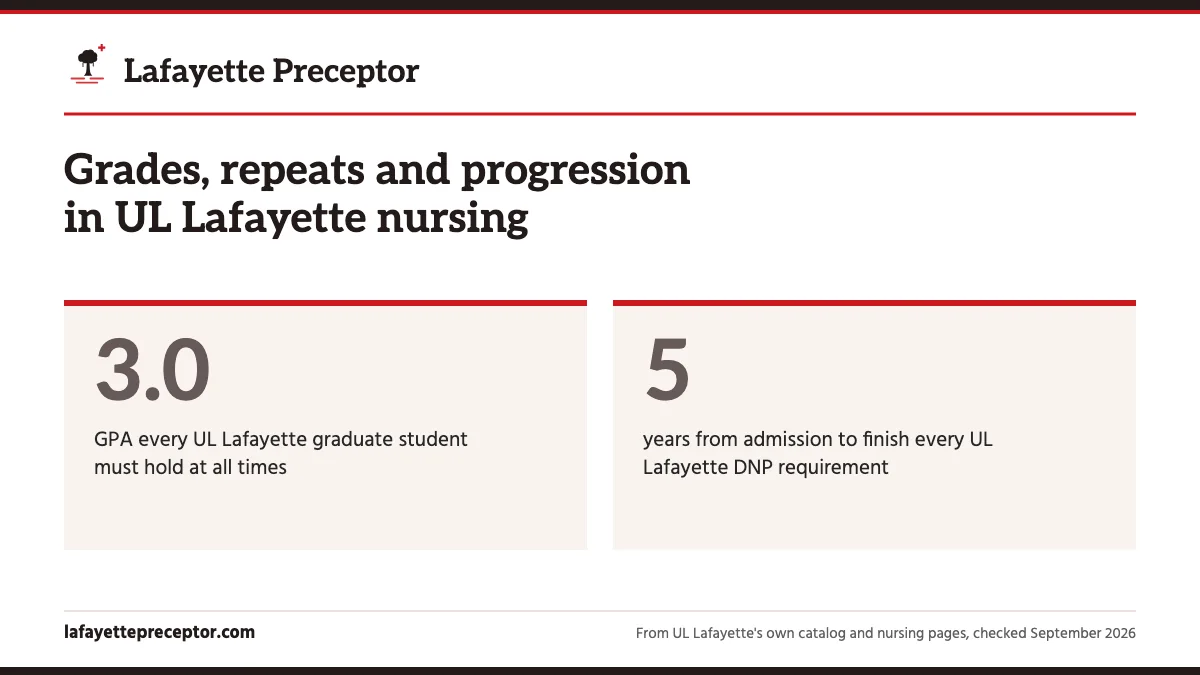
Every UL Lafayette graduate student also answers to the Graduate School. You must keep a 3.0 GPA at all times, may receive no more than two grades of C, may carry no more than 6 credit hours of C, and may receive nothing lower than a C. Break any of those and you become ineligible to register. A grade of F leaves a graduate student ineligible to go on past the current semester, and an unreported grade counts as an F.
Incompletes deserve attention too. An I that is not changed by the posted deadline becomes an F automatically, so unfinished practicum hours have a hard stop; the academic calendar lists the 2026-27 deadlines.
Once you are ineligible, the only route back is an appeal to the Graduate Council Standing Committee on Graduate Appeals. The appeal pairs a petition letter from you with a response from your program's committee.
Time limits and seat limits
Every graduate program runs on a clock. Graduate School rules say credits counted toward a master's may be no more than six years old when it is conferred, and doctoral credits no more than nine. The DNP sets a tighter clock of its own: every requirement finished within five years of admission to the DNP. An approved leave of absence, which can last up to a calendar year and is granted on medical, family, dependent-care or military grounds, keeps your original catalog and extends the allotted time.
Seats can also run short. The MSN reserves the right to limit enrollment in nursing courses, and when it does, students are chosen by academic ranking on their overall GPA in graduate nursing courses; the DNP carries a similar clause. A C pulls that GPA down, which is one more reason a failed practicum can cost more than a single semester.
Protecting your grade from the placement side
Many clinical grade problems start before the first clinical day: a preceptor outside your population focus, a site without enough patients for your course, a preceptor who leaves mid-semester. We build placements to head those off. Whether or not UL Lafayette arranges any part of your placement, we match you with a Louisiana preceptor certified in your population, confirm the practice can carry your course's hours, and stay on call to line up a replacement quickly if the preceptor drops. You keep the same placement advisor for the whole sequence, so the search for the next course's preceptor starts before the current one ends.
If that has already happened, preceptor dropped out is the page to read next. If your next practicum is still ahead, tell us the course and semester in the form below.
Questions UL Lafayette students ask
What grade do I need in UL Lafayette MSN courses?
Every course needs a B or better. Anything lower sends you back through that course, and each course allows just one second attempt. A C earns nothing toward the MSN, and the consortium handbook treats any D or F as the end of progression.
Can I fail a UL Lafayette practicum because of my preceptor's evaluation?
Yes. A poor closing evaluation from the preceptor, or from course faculty, converts the clinical course grade to an F under the ICMSN handbook, and an F halts MSN progression. Faculty evaluate with preceptor input under Louisiana's rules and confer with your preceptor weekly, so ask for feedback early rather than waiting for the final evaluation.
How long do I have to finish the UL Lafayette DNP?
Five years from admission to the DNP, according to the catalog's DNP requirements. The Graduate School's general limit for doctoral credits is nine years, but the DNP's own five-year rule is the tighter one and the one to plan around. An approved leave of absence extends the allotted time.
What GPA do UL Lafayette graduate nursing students need?
The Graduate School requires a 3.0 GPA at all times, and the PMHNP web page and the DNP requirements page both repeat that figure. Falling below it makes you ineligible to register, and the route back is an appeal to the Graduate Council Standing Committee on Graduate Appeals.
Does a C count in the UL Lafayette DNP?
The sources disagree. The DNP program page requires a repeat for any grade below B, allowed once. The Graduate School's DNP section permits one course with a C and makes a second C disqualifying. Ask the DNP Coordinator which rule governs your plan, and treat B as your target everywhere until you hear back.
Related pages
Last checked 2026-09-27
We check these pages against UL Lafayette's 2026-27 catalog, its online program and state authorization pages, the ICMSN student handbook and Louisiana's nursing rules. Your course faculty and your plan of study have the final word.
- UL Lafayette 2026-27 catalog: MSN, Family Nurse Practitioner Concentration
- UL Lafayette 2026-27 catalog: Graduate School regulations
- UL Lafayette 2026-27 catalog: Graduate School, Doctor of Nursing Practice requirements
- UL Lafayette 2026-27 catalog: Psychiatric Mental Health Nurse Practitioner, PMC
- ICMSN student handbook (rev. 10/06/2025)
Whether UL Lafayette helps or you start alone, we find the preceptor.
Tell us your UL Lafayette program, the practicum coming up and the Louisiana town you train near. We look for preceptors and sites that fit the course and gather the license, CV and agency details that must be on file before your first clinical day.
- Preceptors who meet Louisiana's rules: an active Louisiana license, most hours with an APRN in your population focus
- The preceptor's CV, the agency details and your letter of agreement items gathered early
- Across Acadiana and the rest of Louisiana, plus DNP residencies in your home state
Start your placement plan
Your program, your town and your next clinical semester is all we need to begin.