Precepting a UL Lafayette nursing student
Precepting a UL Lafayette student means teaching in your own practice while UL Lafayette's faculty stay responsible for the course. Louisiana's Board sets the ground rules, from your Louisiana license to a cap of two graduate APRN students per preceptor, and the ICMSN sets minimum qualifications for the MSN's practicums. If you have room for a student, the form on this page is where to say so.
Tell us you can precept
Pick "I'm a preceptor (not a student)" and share your specialty, practice setting and location.
What the role involves
Under Louisiana's Board rules, three kinds of clinicians can serve as graduate preceptors: APRNs, physicians and dentists. The role is to guide an advanced practice nursing student as role model, resource person and clinical educator. UL Lafayette's catalog frames its PMHNP certificate clinicals the same way: an approved advanced practice preceptor teaches, and graduate faculty guide that preceptor.
Faculty keep the academic responsibility. Choosing and steering each learning experience belongs to nurse faculty, and so does judging the student's performance, informed by what preceptors report. A faculty member stays reachable for you throughout and talks with each preceptor-student pair every week, at minimum. Faculty presence inside your practice is not required for a preceptorship under Louisiana's rules, and UL Lafayette posts no rule on how often faculty visit.
Day to day, the student sees your patients under your guidance, you tell faculty how the student is progressing, and faculty decide the grade. The faculty oversight guide explains the weekly contact and the final evaluation.
Louisiana's rules for preceptors
The Louisiana Administrative Code sets these conditions for preceptorships in the state's nursing programs. They hold whichever UL Lafayette graduate course you take on.
- Your Louisiana RN or APRN license (or both) is current, with no encumbrance on it.
- The larger share of an NP student's clinical time goes to an APRN licensed and certified in the student's population focus; other clinicians may add direct teaching around that core.
- At any one time, you take on two graduate APRN students or fewer.
- A faculty member checks in with you and your student every week.
- Faculty grade the student, drawing on your observations.
- The university and your agency hold a written agreement that spells out each side's responsibilities, liability insurance coverage among them, and includes a termination clause.
The Louisiana NP practice guide sets these rules beside Louisiana's wider APRN law.
The ICMSN minimums and the paperwork
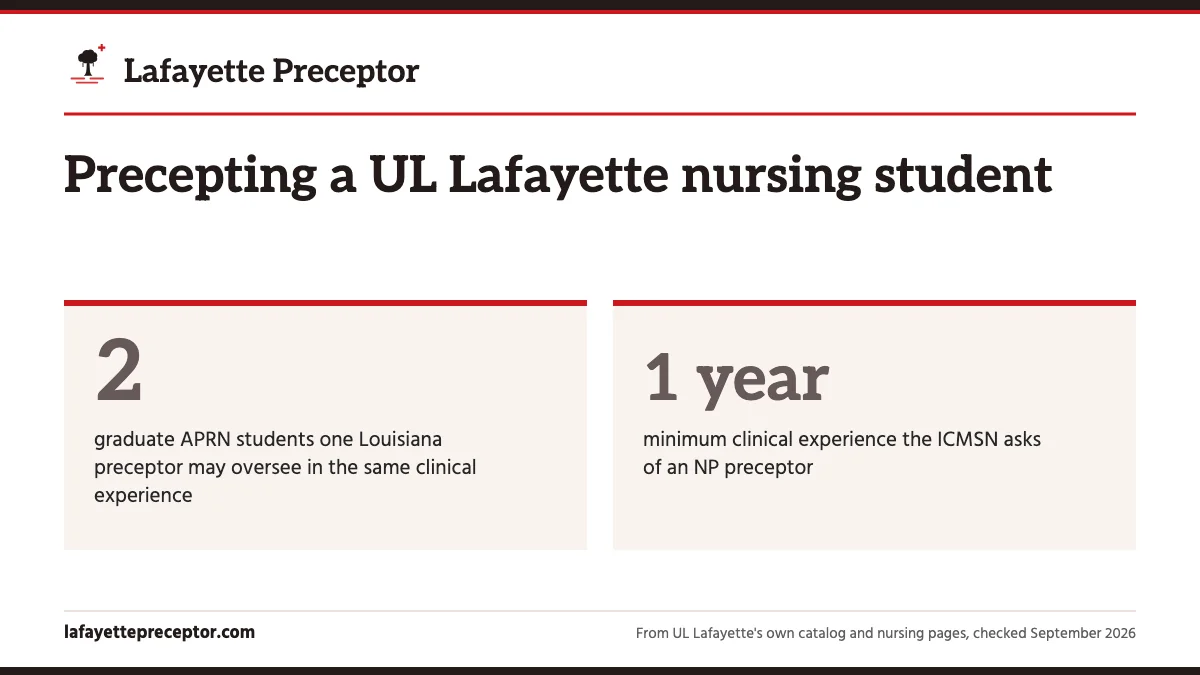
UL Lafayette offers its MSN together with three partner universities as the ICMSN, and the consortium's handbook sets the preceptor minimums for NP practicums: graduate preparation, a master's or doctorate, in a field that fits the course; a current license with no encumbrance; APRN certification matching what the student is studying; a practice setting suited to the course; and at least one year of clinical experience. Approval comes from the student's course faculty, with a review by the graduate coordinator.
Before the student's first clinical day with you, the graduate nursing office needs your CV, updated within the past two years, a three-way letter of agreement that you, the student and the faculty member all sign, and a current contract between the university and your agency. When the student is also your employee, the consortium keeps their clinical hours apart from their paid work: separate from job duties and unpaid. The preceptor requirements guide has the full detail.
Courses and hours you might precept
UL Lafayette publishes hours per course for some programs and program totals for others. Where a per-course figure is not public, course faculty give the target for the term.
| Program | Course | Focus | Published hours |
|---|---|---|---|
| MSN FNP | NURS 582 | Pediatric, adolescent and childbearing women | Per course not public; 750 in all (catalog), 600 on older pages |
| MSN FNP | NURS 583 | Adult | Per course not public |
| MSN FNP | NURS 584 | Geriatric | Per course not public |
| MSN PMHNP | NURS 591, NURS 592, NURS 593 | Psychiatric mental health | Per course not public; 750 in all (catalog), 600 on the web requirements page |
| PMHNP certificate | NURS 591, NURS 592, NURS 597 | Psychiatric mental health; NURS 597 emphasizes older adults | 180, 210 and 120 |
| MSN Nursing Education | NURS 544, NURS 557 | Clinical practicum; precepted class, lab and clinical settings | 60 and 180 |
| DNP | NURS 821, NURS 822, NURS 823 | Residency | 120, 180 and 120 |
Nursing education practicums take place in class, lab and clinical settings, so course faculty confirm what a preceptor there needs. Program totals sit in the clinical hours guide.
The DNP agency mentor
UL Lafayette's DNP is a post-MSN program built around a practice project, and it asks for a different kind of partner. Each student's Synthesis Project committee includes an approved mentor from the agency where the project will be carried out, and NURS 822 is the semester in which the student puts an evidence-based intervention into practice, working alongside that mentor and a faculty advisor.
Mentoring a DNP student means helping a project take root in your organization across the residency courses, NURS 821 to NURS 823, which carry 420 hours in all. DNP residency hours can be completed in Louisiana or in the student's home state, so a mentor outside Louisiana is possible for this program. The DNP residency guide covers the courses and the committee.
How to tell us you can precept
The form here has a program list, and the option for you reads "I'm a preceptor (not a student)". Along with it, share your license and certification, your population focus or specialty, your practice setting, the city or parish where you work, which terms have room for a student, and how many graduate students you already oversee, so the two-student cap is respected from the start.
Your placement advisor then matches you with a UL Lafayette student whose course fits your practice and schedule. We handle the preparation around the approval: we request your CV, gather the details for the letter of agreement, check your agency's contract status and make sure the student's health, OSHA and HIPAA items are in order before anyone asks for your time. UL Lafayette's course faculty give the final approval; our job is a file with nothing missing on their first read.
Questions UL Lafayette students ask
Do I need a Louisiana license to precept a UL Lafayette student?
For the MSN and PMHNP certificate practicums, yes. Louisiana's Board expects each preceptor to carry a Louisiana RN or APRN license that is active and unencumbered, and UL Lafayette keeps those clinicals in Louisiana. DNP residency hours can be completed in the student's home state, so faculty confirm what a mentor outside Louisiana needs.
How many UL Lafayette students can I precept at the same time?
Two, at most. Louisiana's rule lets one preceptor oversee no more than a pair of graduate APRN students in the same clinical experience, and that count includes students from every school, not only UL Lafayette. Tell us about any other students you supervise when you offer, and we plan around the cap.
Will UL Lafayette faculty visit my practice?
Not necessarily. Louisiana lets faculty oversee a preceptorship without being physically present, and UL Lafayette posts no site-visit rule. What the rules do require is contact: a faculty member speaks with you and your student each week, stays reachable throughout, and grades the student with your observations in hand.
Can a physician precept a UL Lafayette NP student?
A physician fits Louisiana's definition of a graduate preceptor, and the Board lets several kinds of clinicians share the direct teaching. The larger share of an NP student's clinical time, though, has to be with an APRN licensed and certified in the student's population focus, and course faculty approve every preceptor.
What paperwork will I be asked for?
A current CV, updated within two years, and your signature on the letter of agreement alongside the student and faculty member. Your license and certification are checked against the consortium's minimums, and the university needs a current contract with your agency. We gather these pieces with you so the approval moves quickly.
Related pages
Last checked 2026-09-27
We check these pages against UL Lafayette's 2026-27 catalog, its online program and state authorization pages, the ICMSN student handbook and Louisiana's nursing rules. Your course faculty and your plan of study have the final word.
- Louisiana Administrative Code 46:XLVII.3543, Preceptorship Learning Experiences
- Louisiana Administrative Code 46:XLVII.3503, definitions
- ICMSN student handbook (rev. 10/06/2025)
- UL Lafayette 2026-27 catalog: Psychiatric Mental Health Nurse Practitioner, PMC
- UL Lafayette 2026-27 catalog: Graduate School rules for the Doctor of Nursing Practice
Whether UL Lafayette helps or you start alone, we find the preceptor.
Tell us your UL Lafayette program, the practicum coming up and the Louisiana town you train near. We look for preceptors and sites that fit the course and gather the license, CV and agency details that must be on file before your first clinical day.
- Preceptors who meet Louisiana's rules: an active Louisiana license, most hours with an APRN in your population focus
- The preceptor's CV, the agency details and your letter of agreement items gathered early
- Across Acadiana and the rest of Louisiana, plus DNP residencies in your home state
Start your placement plan
Your program, your town and your next clinical semester is all we need to begin.