How Louisiana's nurse practitioner rules shape your preceptor search
The Louisiana State Board of Nursing grants the APRN license, ties diagnosis and treatment to a collaborative practice agreement and sets a high bar for prescribing. The same rulebook decides who may precept, limits each preceptor's student load and makes out-of-state programs file six months ahead. Those rules explain why one preceptor has room and another is booked for a year, and they shape how we search for UL Lafayette students.
Get your placement plan
Tell us your UL Lafayette program and where you live. A placement advisor replies with the preceptor and site options that fit your UL Lafayette course.
Who licenses Louisiana's nurse practitioners
One board, the Louisiana State Board of Nursing, handles RN and APRN licensure; practical nurses fall under a different board. Section 4507 sets three conditions for the APRN license: a current RN license, a finished graduate program or post-graduate certificate in the role and population, and national certification.
Louisiana's compact membership dates to July 1, 2019: a nurse whose multistate RN privilege comes from another member state can use it here. The compact covers RN licensure only. How UL Lafayette treats multistate holders, residency wording included, is set out on the RN license requirements page.
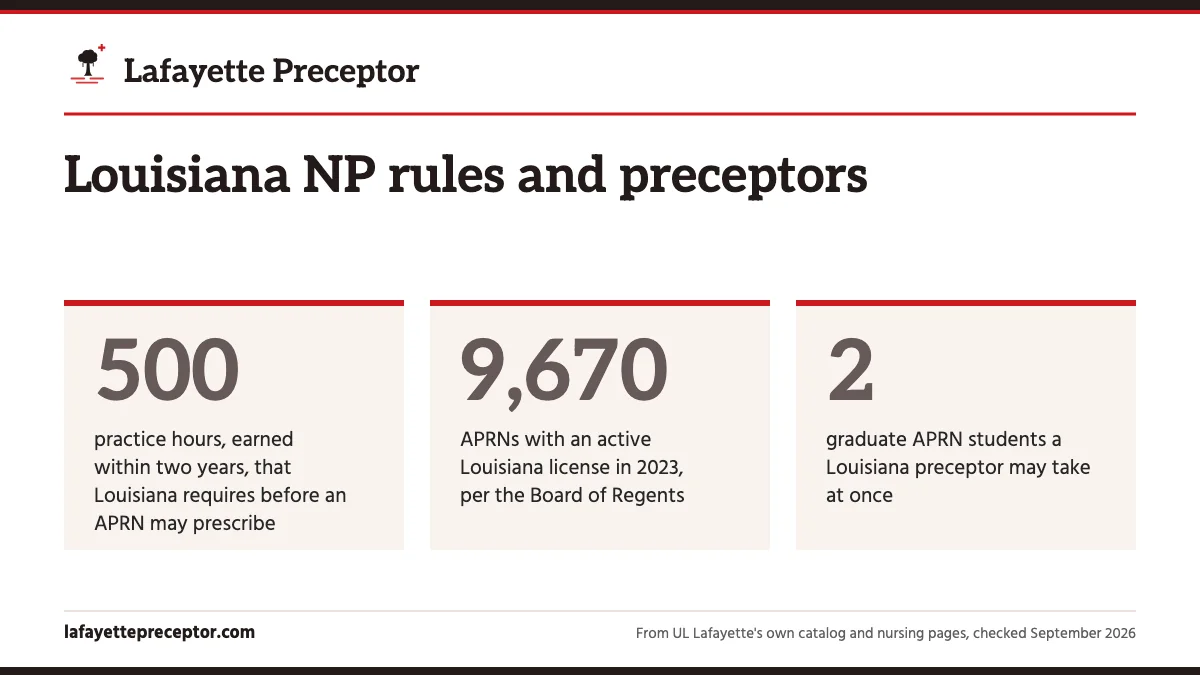
The Health Works Commission's 2024 report, published by the Board of Regents, puts the 2023 figure at 9,670 active Louisiana APRN licenses, up 9% from 9,048 a year earlier, with 7,955 of those APRNs (82%) living in the state. A large pool still does not mean open slots.
Collaborative practice: who needs an agreement and what it covers
Louisiana separates nursing's own scope from medical work. An APRN practicing only within nursing scope under R.S. 37:913(3)(a) has no need for a collaborative practice agreement, or CPA. Once an APRN diagnoses and manages medical conditions, a CPA becomes mandatory, and the partner on it is a physician or a dentist.
Section 4513.B lists what every CPA must spell out: when and how the collaborating physician or dentist can be reached, the methods for managing the practice (clinical practice guidelines among them), and who looks after patients when one partner is absent.
In a practicum, this usually means your FNP or PMHNP preceptor practices within a CPA, and the collaborating physician belongs to the clinic you join. Louisiana's precepting rule permits a blend of clinicians to add direct teaching, so that physician may contribute hours. The larger share of your time stays with an APRN certified for your patient population.
Prescribing and controlled substances
Prescribing carries Louisiana's most specific conditions. Section 4513 layers hours, coursework and controlled substance limits on top of the license:
| Condition | What Louisiana asks | Why it matters to you |
|---|---|---|
| Practice hours | At least 500 hours in the past two years, earned while licensed as an APRN or while applying for that license, in the same role and population | Hours from your graduate program can count if they qualified you for certification, so your precepted time matters after graduation too |
| Coursework | 45 contact hours apiece in advanced pharmacology, pathophysiology and health assessment | The rule looks back at your graduate coursework in these three subjects |
| Controlled substance limits | None for chronic or intractable pain, none for obesity, none for the prescriber or relatives | Chronic pain and weight-loss prescribing of controlled drugs sits outside what an APRN preceptor may model |
| Schedules II through V | Confined to the APRN's practice, with continuing education, a Louisiana controlled dangerous substance license and DEA registration | A preceptor holding those registrations can walk you through each one |
Because practicum hours may later support that 500-hour requirement, careful logging in the clinical tracking system pays off from day one.
The Board's rules for preceptors
Section 3543 covers precepted clinicals. Licensure comes first: only an active, unencumbered Louisiana license, RN or APRN, qualifies. The majority of hours then go to an APRN whose license and certification match the student's population focus. No preceptor may carry a third graduate APRN student at the same time, faculty check in weekly with preceptor and student alike, and the faculty ceiling in APRN preceptorships is 1:9.
Faculty grade performance with the preceptor's input, and preceptors are selected under written criteria that faculty and the facility write together. The ICMSN adds minimums of its own, and the preceptor requirements page sets the two side by side.
Out-of-state programs and the six-month rule
Nursing programs administered from another state need Board approval before running clinicals in Louisiana. Section 3539 has them send a request letter, course materials and a clinical facility survey half a year before the first offering begins, at the latest. Their instructors teaching here need Louisiana licenses, a graduate clinical spreadsheet from the Board is due two weeks after each experience begins, and approval runs for up to three years. The Board's published roster of approved programs is long.
UL Lafayette, an in-state program with full Board approval, sits outside the six-month rule. Other timing rules still apply: agency agreements are written, spell out liability coverage and give either side a way to end them, and the Board wants its facility survey no less than four weeks before a site's first student use (section 3529). Approved out-of-state students chase the same scarce slots, one reason the New Orleans guide stresses starting early.
No state tax credit for preceptors
Louisiana has no preceptor tax credit; none appears in state law. A nurse practitioner or physician here who agrees to teach you does it for the profession and for you, not for a tax break.
That makes the request itself matter. Preceptors weigh time, patient flow and paperwork, and an ask that arrives complete, with dates, course goals and UL Lafayette's expectations, is far easier to accept. Preceptors can see what we prepare for them on precept a UL Lafayette student.
What Louisiana's rules mean for your search
However your UL Lafayette placement gets arranged, the preceptor and site we deliver satisfy the university's rules and the state's. Louisiana's law becomes a working checklist:
- License first: an active, unrestricted Louisiana license, confirmed before anything else
- Population fit: FNP certification for the family courses, PMHNP certification for the psychiatric ones
- Capacity: a nurse practitioner who already has two graduate APRN students on the schedule is full, however willing
- Collaborative clinics: the physician partner can add teaching hours without displacing the APRN majority
- Lead time: written agreements and the Board's facility survey take weeks, and health systems add their own calendars
- Competition: approved out-of-state programs call the same practices, so earlier requests land better
Questions UL Lafayette students ask
Do nurse practitioners in Louisiana need a collaborating physician?
Any APRN who diagnoses and manages medical problems does. Louisiana requires a collaborative practice agreement, and the partner is a physician or a dentist. The agreement covers the partner's availability, how the practice is managed, including clinical guidelines, and who covers patients during absences. APRNs working strictly within nursing's own scope need none.
Can my UL Lafayette clinical hours count toward prescriptive authority?
They can. Louisiana's prescribing rule asks for 500 practice hours within the prior two years in your role and population, and hours from a graduate program count when they made you eligible for certification. Keep complete logs, and confirm specifics with the LSBN at application time.
Does Louisiana offer preceptors a tax credit?
No. Louisiana's law contains no tax credit for precepting nurse practitioner students. Preceptors here teach without any state incentive, so a complete, well-organized request that respects their clinic day carries real weight.
Can a physician be my preceptor in Louisiana?
A physician can contribute. The Board's definition of who may precept a graduate student names physicians along with APRNs and dentists, and a blend of clinicians may teach. Most of your hours, though, stay with a population-certified APRN, and the ICMSN minimums assume APRN preceptors, so a physician supplements rather than replaces.
Does a multistate compact license let me do clinicals outside Louisiana?
Not for UL Lafayette's NP concentrations. The compact lets a multistate RN license work in Louisiana, but UL Lafayette asks MSN students to complete every clinical experience inside the state, and preceptors need an active Louisiana license. The Louisiana state guide covers the wider picture.
Related pages
Last checked 2026-09-27
We check these pages against UL Lafayette's 2026-27 catalog, its online program and state authorization pages, the ICMSN student handbook and Louisiana's nursing rules. Your course faculty and your plan of study have the final word.
- Louisiana Administrative Code 46:XLVII.4513: APRN practice and prescriptive authority
- Louisiana Administrative Code 46:XLVII.3543: preceptorship learning experiences
- Louisiana Administrative Code 46:XLVII.3539: out-of-state program offerings
- NCSBN: Nurse Licensure Compact implementation map
- Louisiana Board of Regents: 2024 Health Works Commission report
Whether UL Lafayette helps or you start alone, we find the preceptor.
Tell us your UL Lafayette program, the practicum coming up and the Louisiana town you train near. We look for preceptors and sites that fit the course and gather the license, CV and agency details that must be on file before your first clinical day.
- Preceptors who meet Louisiana's rules: an active Louisiana license, most hours with an APRN in your population focus
- The preceptor's CV, the agency details and your letter of agreement items gathered early
- Across Acadiana and the rest of Louisiana, plus DNP residencies in your home state
Start your placement plan
Your program, your town and your next clinical semester is all we need to begin.