The two practicums in UL Lafayette's Nursing Education MSN
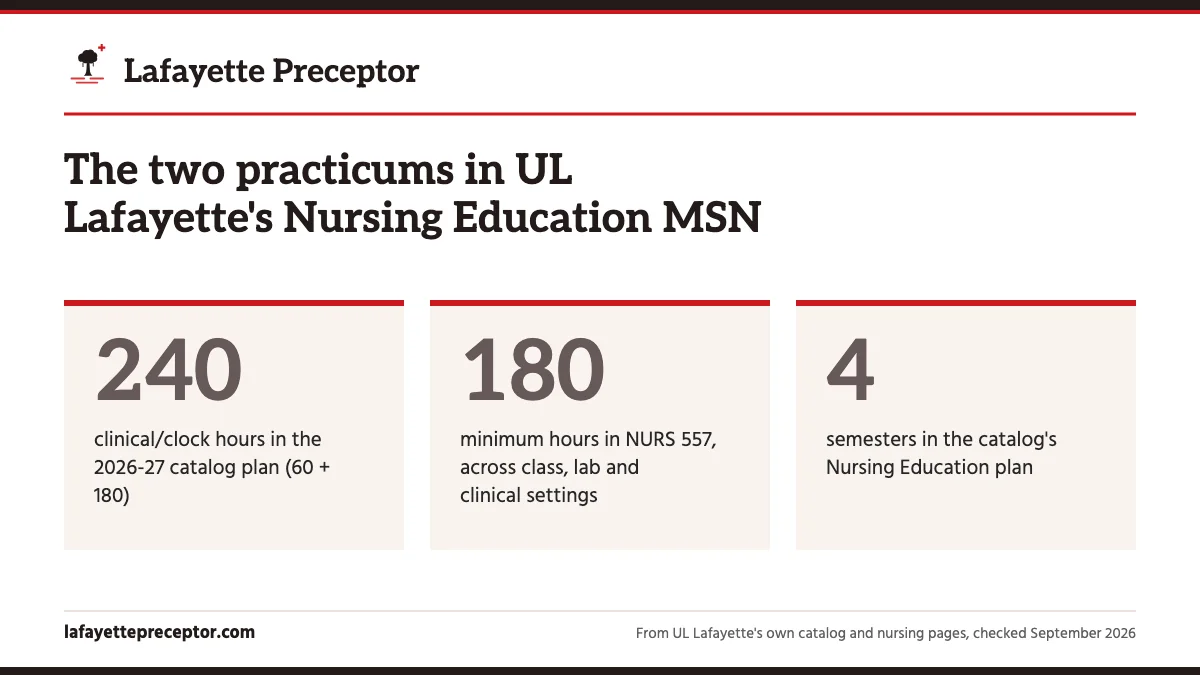
UL Lafayette's MSN in Nursing Education has two precepted courses: NURS 544, a 1-credit clinical practicum of at least 60 hours in semester 3, and NURS 557, a 3-credit teaching practicum of at least 180 hours in semester 4. The catalog adds them to 240 hours; an older program page says 300. This guide covers what each course asks, how the Fall-only courses around them shape the timing, and what a strong educator preceptor looks like.
Get your placement plan
Tell us your UL Lafayette program and where you live. A placement advisor replies with the preceptor and site options that fit your UL Lafayette course.
Two courses with two different jobs
The Nursing Education plan runs four semesters, and only the last two carry precepted hours. The first is small and clinical; the second is large and built around teaching.
| Course | Plan semester | Credits | Lab contact | Minimum hours |
|---|---|---|---|---|
NURS 544 Advanced Clinical Practicum in Nursing Practice | 3 | 1 | 4 | 60 clinical/clock hours |
NURS 557 Nursing Education Practicum | 4 | 3 | 12 | 180 clinical/clock hours |
The catalog entry for NURS 544 says little beyond the requirement to complete at least 60 clinical/clock hours, and its title points at advanced nursing practice rather than teaching. Course faculty set its focus, so ask early what kind of setting they expect.
NURS 557 is spelled out more fully. The catalog describes it as implementing nurse educator roles "in selected precepted class, lab, and clinical settings." That phrase is the brief for your preceptor search: one practicum, three kinds of teaching space. The full plan of study is on the Nursing Education MSN page.
240 in the catalog, 300 on the web
The 2026-27 catalog lists 240 clinical/clock hours for the concentration, which is exactly the two course minimums added together. The Nursing Education requirements page on the nursing site, as captured in September 2025, says 300 practicum hours.
Leave the gap unresolved on paper until someone with authority closes it. The catalog comes first, and the graduate coordinator settles which number governs your plan. Both course figures are written as minimums, so a course can ask for more than 60 or 180 without contradicting the catalog. The hub for every program's totals is clinical hours by program.
Write the preceptor agreement around the hour target your course faculty confirm, not around 240. If the target turns out higher, you avoid renegotiating in the middle of the semester.
Timing: the Fall-only courses around the practicums
Three courses in this plan are marked Fall only. NURS 534 Nursing Education: Roles, Issues, and Foundations sits in semester 1. NURS 536 Teaching Methodologies and Technologies and NURS 570 Measuring Outcomes in Nursing Education sit in semester 3, beside NURS 544 and your NURS 595 or NURS 599 work. Semester 2 holds NURS 535 Curriculum and Program Development, and semester 4 pairs NURS 557 with NURS 509.
Read as printed, that puts NURS 544 in a Fall term and NURS 557 in the Spring that follows. This is a reading of the plan, not a stated rule, and the MSN admits in January as well as August, so check the order with your advisor before any preceptor hears a date.
A Spring NURS 557 meets UL Lafayette's breaks for Mardi Gras and Easter, while a teaching host keeps its own calendar, which may differ. Map both calendars before promising class sessions; UL Lafayette's term dates are on the academic calendar.
What NURS 557 asks: class, lab and clinical
By semester 4 you have taken the teaching methods, curriculum and outcomes courses, and NURS 557 is where you use them. The catalog names three settings, so the best arrangement lets you teach in each: a didactic class, a skills or simulation lab, and supervision of students on a clinical unit.
Two kinds of hosts tend to offer all three. A school of nursing, whether a practical nursing, associate or baccalaureate program, runs classes, labs and clinical groups every term. A hospital education or professional development department runs orientation, competency labs and unit teaching for new nurses. If one educator cannot cover every setting, ask course faculty whether a second can fill the gap.
Aim for sessions you plan, deliver and evaluate yourself. Watching an expert teach is useful for a day or two, but 180 hours should leave you with lesson plans, evaluation tools and feedback you can show a hiring committee.
What a strong educator preceptor looks like
Look for someone who
- Holds a master's or doctorate in nursing or a related field and a current, unencumbered license, in line with the consortium's minimums on who can precept
- Brings at least a year of clinical experience and real teaching time in a classroom, lab or clinical group
- Teaches in more than one of the three settings
NURS 557names - Will hand you whole sessions to design and run, then critique them honestly
- Has room across the entire semester, not just a few weeks
- Works where an agency contract can be finished before your first day
The consortium's minimums also list certification in the area. Ask course faculty which certification they look for in an education preceptor, since the list serves nurse practitioner tracks as well. The paperwork each preceptor triggers is on clinical paperwork.
Where the practicums can happen
UL Lafayette's MSN overview says all of its concentrations complete clinical experiences in Louisiana, while the MSN application page states that rule only for the FNP. At the same time, the state authorization page accepts Nursing Education students from Arizona, Arkansas, Georgia, Louisiana, Mississippi, South Carolina, Virginia and West Virginia.
Those sources do not line up neatly. If you live in one of the seven other states, get the graduate coordinator's answer in writing before planning a practicum at home. The details are on Louisiana-only clinicals and state authorization.
A Louisiana host is also the simplest route for the preceptor. Louisiana's Board rules call for preceptors with an active, unencumbered Louisiana license, and every piece of the consortium's paperwork, from the agency contract to the letter of agreement, has to clear the graduate nursing office before day one. Starting in-state removes a layer of questions before your first practicum day.
Why Nursing Education students choose us
Educator practicums need a different search from NP rotations, and we run it that way. Whether or not UL Lafayette helps arrange your hosts, we look for Louisiana schools of nursing and hospital education teams with an educator who can give you class, lab and clinical teaching, plus a practice setting that suits NURS 544.
We confirm each preceptor's credentials and teaching background, gather the CV and agency details, and hand you a file ready for UL Lafayette's course faculty, who approve every preceptor with the graduate coordinator's review. For NURS 544, we match the clinical setting to the focus your course faculty set, so the smaller practicum gets the same care as the larger one. If a host changes plans, the placement desk finds another before your hours slip. See how it works.
Questions UL Lafayette students ask
Do Nursing Education students need an APRN preceptor?
UL Lafayette publishes no separate preceptor list for the education track. Louisiana's rule that most clinical time be spent with a same-population APRN is written for APRN students, and the consortium's minimums ask for a graduate-prepared, licensed preceptor with at least a year of clinical experience. Course faculty approve each preceptor, so confirm what they expect.
Is NURS 544 a teaching practicum?
The catalog names it Advanced Clinical Practicum in Nursing Practice, and the entry requires at least 60 clinical/clock hours for 1 credit. The practicum built around teaching is NURS 557, with its class, lab and clinical settings. Course faculty set NURS 544's focus each term, so ask what setting and goals they expect before you choose a site.
Can I complete NURS 557 where I already teach or work?
The ICMSN handbook allows a preceptor at your workplace, as long as your practicum hours are separate from your job duties and unpaid. A hospital educator role or a faculty post can still host you if the practicum work is clearly distinct from what you are paid to do. Course faculty decide whether an arrangement qualifies.
Does a January start change the Nursing Education sequence?
The MSN admits in January and August, and the Nursing Education plan marks three courses Fall only, including NURS 534 in the first semester. UL Lafayette does not publish a separate spring-start sequence, so ask your advisor how a January start orders the courses before you set practicum dates with anyone.
How many hours a week does NURS 557 take?
UL Lafayette does not say whether NURS 557 runs full term or in a half term. Across a full 16-week term, 180 hours works out to roughly 11 and a quarter hours weekly; a shorter window pushes that up sharply. Settle the term format first, then build the weekly plan with your preceptor.
Related pages
Last checked 2026-09-27
We check these pages against UL Lafayette's 2026-27 catalog, its online program and state authorization pages, the ICMSN student handbook and Louisiana's nursing rules. Your course faculty and your plan of study have the final word.
Whether UL Lafayette helps or you start alone, we find the preceptor.
Tell us your UL Lafayette program, the practicum coming up and the Louisiana town you train near. We look for preceptors and sites that fit the course and gather the license, CV and agency details that must be on file before your first clinical day.
- Preceptors who meet Louisiana's rules: an active Louisiana license, most hours with an APRN in your population focus
- The preceptor's CV, the agency details and your letter of agreement items gathered early
- Across Acadiana and the rest of Louisiana, plus DNP residencies in your home state
Start your placement plan
Your program, your town and your next clinical semester is all we need to begin.