510 hours in four semesters: the PMHNP certificate's practicums
UL Lafayette's Psychiatric Mental Health Nurse Practitioner Post-Master's Certificate packs 20 credits into four accelerated semesters, and 510 of its clinical hours are direct patient care in Louisiana. Those hours live in NURS 591, NURS 592 and NURS 597, after an observational start in NURS 590. Here is the hour map, what the catalog asks of your preceptor, and how a working NP can line up four semesters without a gap.
Get your placement plan
Tell us your UL Lafayette program and where you live. A placement advisor replies with the preceptor and site options that fit your UL Lafayette course.
The hour map, course by course
The certificate's first semester is didactic plus observation. From the second semester on, every term carries a direct-care practicum, and the hours rise before they taper.
| Semester | Course | Credits | Hours | Kind of hours |
|---|---|---|---|---|
| I | NURS 508 Diagnostic Considerations and Psychopharmacology for Psychiatric Disorders | 3 | None listed | Didactic |
| I | NURS 590 Psychotherapy for the Advanced Practice Psychiatric Nurse | 3 | 60 | Observational |
| II | NURS 591 Psychiatric Mental Health I | 5 | 180 | Direct patient care |
| III | NURS 592 Psychiatric Mental Health II | 5 | 210 | Direct patient care |
| IV | NURS 597 Psychiatric Mental Health III, older-adult emphasis | 4 | 120 | Direct patient care |
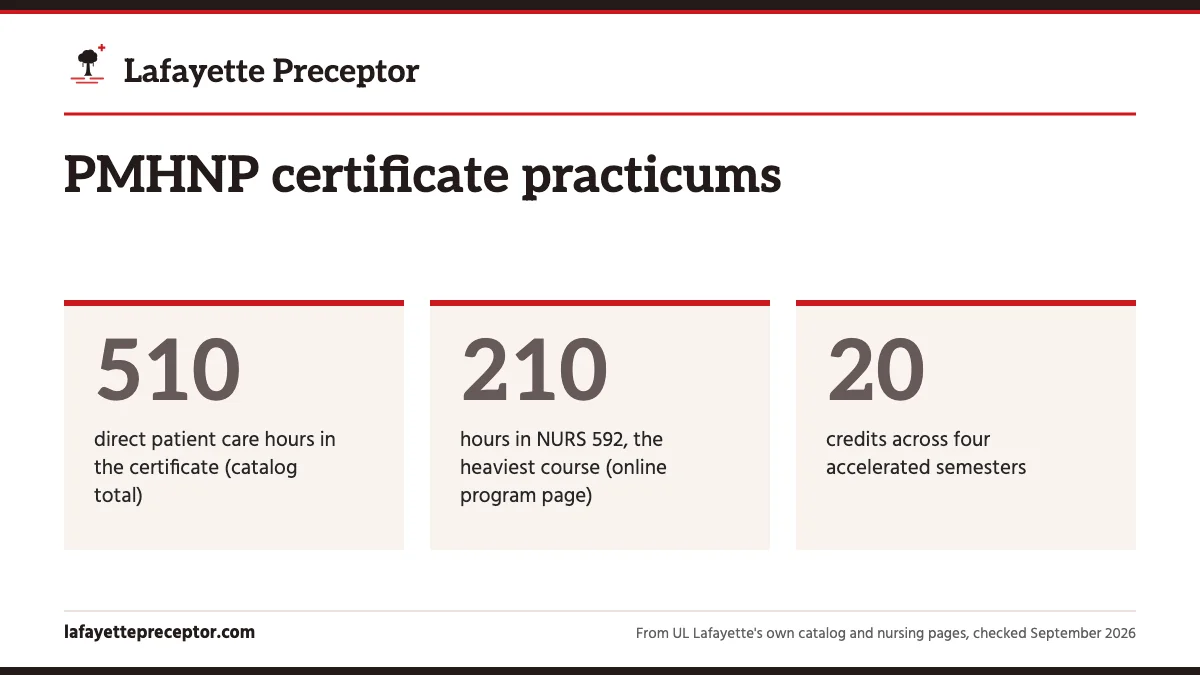
The per-course figures come from UL Lafayette's online certificate page. The 2026-27 catalog gives the total, 510 clinical hours, and describes each clinical course as holding "direct patient care clinical experiences (120 - 210 hours in each course)." The three direct-care courses add to exactly 510, so the 60 observational hours in NURS 590 sit on top of that total rather than inside it.
What the catalog says about your preceptor
The catalog's wording is short: in each clinical course the student works with "an approved advanced practice preceptor guided by graduate faculty." Three ideas sit in that line. The preceptor practices at an advanced level, someone approves the choice before hours begin, and UL Lafayette's graduate faculty stay involved while you train.
Louisiana's Board fills in the rest. Every preceptor needs an active, unencumbered Louisiana license, the larger share of your clinical time must be with an APRN whose certification matches the population focus you are studying, and a single preceptor may oversee two graduate APRN students at most during any clinical experience.
That population focus is psychiatric-mental health. Your current certification as an ACNP, ANP, FNP, GNP or WHNP got you admitted, but it does not change who can precept you: the core of your 510 hours belongs with a psychiatric APRN. The consortium's full preceptor standard is on who can precept.
Direct patient care, all in Louisiana
UL Lafayette's online page calls for a minimum of 510 direct patient care hours in Louisiana, and the state authorization page repeats the point for the certificate: clinical rotations happen in Louisiana, with a Louisiana registered nurse license. Admission already asks for an unencumbered Louisiana APRN license alongside a Louisiana or multistate RN license, so the whole certificate is built around Louisiana practice. Mississippi appears on UL Lafayette's list of states where the program meets educational requirements, yet the hours themselves still stay in Louisiana. The wider rule is explained on Louisiana-only clinicals.
Observation and direct care are not interchangeable. The 60 hours tied to NURS 590 are labeled observational, while the 180, 210 and 120 in the practicums are hands-on care you deliver under supervision. The line between the two is drawn on what counts as clinical hours.
Planning four semesters as an experienced NP
The certificate moves quickly. After one didactic term you owe 180 hours, then 210, then 120, which leaves little slack for a preceptor who falls through. Treat semester I as the planning term: while you study psychopharmacology and psychotherapy, get the NURS 591 preceptor confirmed and the file for that site complete.
Continuity helps. A psychiatric practice that can carry you through NURS 591 and NURS 592 covers 390 hours under one agency contract, if course faculty approve the same preceptor for both. NURS 597 then asks for a setting with enough older patients, such as geriatric psychiatry, psychiatric consults in long-term care, or memory care services with a PMHNP on staff.
Mind the weekly load. Spread across a full 16-week term, 210 hours comes to about 13 hours a week; squeezed into fewer weeks, it climbs fast. UL Lafayette does not publish whether these courses run full term or in a half term, so ask before you promise a preceptor a schedule. If your own employer offers psychiatric services, read workplace clinicals before counting on hours there.
NURS 597 and the older-adult finish
The certificate's last course shares a title with the MSN's NURS 593, Psychiatric Mental Health III, but it is a separate course: 4 credits with 3 lecture and 8 lab contact hours, and an older-adult emphasis. The online page attaches 120 hours to it, the smallest of the three direct-care blocks.
An NP coming from an adult, gerontological or family background may already work near the right patients, which can make NURS 597 the easiest site to find. The standard does not relax, though: the hours still need a psychiatric preceptor, a Louisiana license, faculty approval and a finished file before day one.
The certificate counts only grades of B or higher, and the final practicum is held to the same bar. The MSN's three-course sequence is compared on PMHNP practicums.
Why certificate students choose us
You already run a caseload, and a four-semester certificate leaves no room for a blank term. Whether UL Lafayette steps in on your placements or not, we map all three practicums at once: Louisiana psychiatric APRNs for NURS 591 and NURS 592, and an older-adult setting for NURS 597, each close enough to fit around your job.
We verify each preceptor's Louisiana license, psychiatric certification and experience, collect the CV and agency details the approval needs, and give you a file that fits the consortium's paperwork list, so UL Lafayette's graduate faculty receive everything they need in one pass. We also plan around your own clinic days, since you are likely still seeing patients of your own. Should a preceptor back out, the placement desk opens a new search immediately. The process is on how it works; the form below starts it.
Questions UL Lafayette students ask
Is the certificate's 510 hours the same as the MSN PMHNP's 750?
No. They are separate programs. The Post-Master's Certificate is for nurse practitioners already certified in another population, and its catalog total is 510 direct patient care hours, plus 60 observational hours in NURS 590 on the online page. The MSN PMHNP concentration sets a minimum of 750 precepted hours in the 2026-27 catalog.
What licenses do I need for the PMHNP certificate?
The catalog asks for an unencumbered Louisiana or multistate RN license and an unencumbered Louisiana APRN license, plus current national certification as an ACNP, ANP, FNP, GNP or WHNP. Admission also calls for an MSN from a CCNE- or ACEN-accredited program, a 3.0 graduate GPA and prerequisites in advanced health assessment, pharmacotherapeutics and pathophysiology.
When do certificate clinical hours begin?
Cohorts start in January or August. Semester I holds NURS 508 and NURS 590, whose 60 hours are observational, and the first direct-care course, NURS 591 with 180 hours, comes in semester II. The plan numbers semesters rather than naming seasons, so confirm with your advisor which calendar term that is for your cohort.
Does the PMHNP certificate require campus visits?
UL Lafayette's certificate page describes the didactic courses as 100% online, and the catalog lists no on-campus session for the certificate, unlike the DNP. Your in-person time is the clinical work itself, at Louisiana sites with an approved preceptor. Check your course syllabi for any scheduled virtual sessions.
Can I use the same psychiatric preceptor for every practicum?
UL Lafayette's pages neither require nor forbid it. Course faculty approve preceptors course by course, and NURS 597's older-adult emphasis may call for a site with more older patients than your earlier preceptor sees. Keeping one preceptor for NURS 591 and 592 can be the simplest route, if faculty agree.
Related pages
Last checked 2026-09-27
We check these pages against UL Lafayette's 2026-27 catalog, its online program and state authorization pages, the ICMSN student handbook and Louisiana's nursing rules. Your course faculty and your plan of study have the final word.
Whether UL Lafayette helps or you start alone, we find the preceptor.
Tell us your UL Lafayette program, the practicum coming up and the Louisiana town you train near. We look for preceptors and sites that fit the course and gather the license, CV and agency details that must be on file before your first clinical day.
- Preceptors who meet Louisiana's rules: an active Louisiana license, most hours with an APRN in your population focus
- The preceptor's CV, the agency details and your letter of agreement items gathered early
- Across Acadiana and the rest of Louisiana, plus DNP residencies in your home state
Start your placement plan
Your program, your town and your next clinical semester is all we need to begin.