Clinical health requirements for UL Lafayette nursing students
A UL Lafayette clinical course starts with a complete health file. The ICMSN handbook says a student who does not meet the home school's clinical health requirements cannot stay enrolled in any clinical nursing course, and health, OSHA and HIPAA documents must be on file before the first clinical day. This guide covers what UL Lafayette publishes, what it leaves to course faculty and the site, and how to keep the file current all semester.
Get your placement plan
Tell us your UL Lafayette program and where you live. A placement advisor replies with the preceptor and site options that fit your UL Lafayette course.
The rule that can end a clinical course
The consortium handbook that governs UL Lafayette's MSN, revised 10/06/2025, is blunt about health compliance. Students who do not show their home institution's clinical health requirements "will not be allowed to remain enrolled in any clinical nursing course." The rule reaches every clinical course, from the first family health practicum to the last psychiatric one, and it applies however well the rest of the semester is going.
Timing comes from a second handbook rule. Before any clinical day, the graduate nursing office must hold your health, OSHA and HIPAA documents alongside the agency contract, the preceptor's CV and the signed letter of agreement. The clinical paperwork guide covers the contract, CV and letter; this page covers the health side of that file.
A missing or expired health item is enough to keep you out of a clinical course, even with a preceptor confirmed and every other form signed.
What UL Lafayette asks for at admission
Immunization comes up first, at admission. The 2026-27 catalog lists "Evidence of immunization" among the admission requirements for the MSN concentrations, and the nursing site's How to Apply page asks for proof as well. Keep a clean digital copy of every record you send, because you will reach for the same documents again when a clinical course nears.
Admission evidence is a starting point, not the full clinical file. A record that satisfied the admissions office may be older than a site accepts by the time your first practicum begins, which for the FNP is NURS 582 in the third semester and for the PMHNP is NURS 591 in the fourth. See your first clinical course for each program's timing.
Doctoral students meet a separate line in the catalog, which ties program health requirements to the start of residency along with screening. The background check and drug screen guide covers that DNP rule in full.
The BSN list: a worked example with dates
UL Lafayette's most detailed published health list belongs to the pre-licensure BSN. The catalog names the items and sets two due dates, which makes it a useful model of what a clinical health file holds.
| Item | What the catalog specifies |
|---|---|
| Physical examination | Part of the health documents for clinical courses |
| Immunizations and TB | Listed together as one requirement |
| BLS | Basic Life Support through the American Heart Association or the American Red Cross |
| Health insurance | Proof of coverage |
| Urine drug screen | Submitted with the same packet |
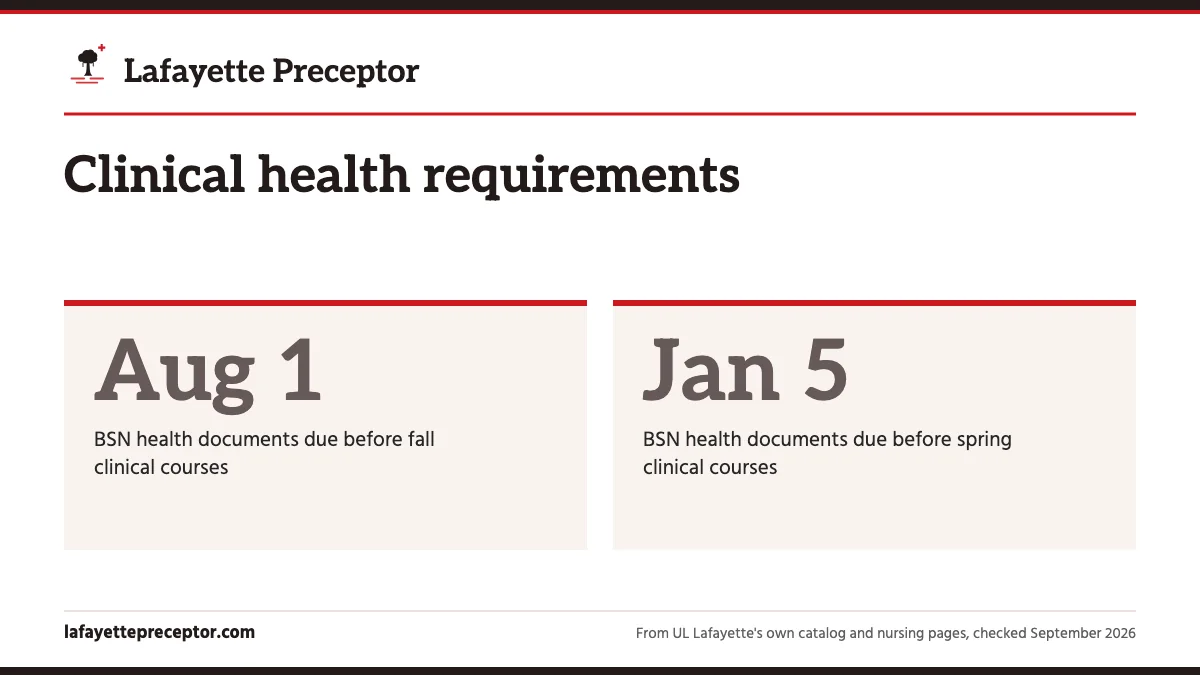
| Due dates | Aug 1 before fall clinical courses; Jan 5 before spring clinical courses |
Graduate students should plan on a current BLS card for every clinical course, and the BSN list's American Heart Association or Red Cross standard is a sound one to meet. UL Lafayette's graduate pages publish no itemized list or due date of their own, so the syllabus and announcements in the practicum's Moodle course, and your course faculty, are where the graduate version is confirmed.
OSHA, HIPAA and confidentiality
The handbook lists OSHA and HIPAA documents next to health records as items that must be on file before clinicals begin. UL Lafayette's public pages do not describe the format those documents take, so follow the checklist in your course materials rather than borrowing another program's list.
Confidentiality carries the heaviest penalty in this area. The ICMSN handbook states that confidentiality and HIPAA violations "will lead to the dismissal of the student." That reaches well past the chart. Patient names, dates of birth, photos and identifying details have no place in clinical logs, discussion posts, case presentations, messages to classmates or notes you carry out of the clinic.
Make de-identification a habit from the first day. Write case summaries by age range and presenting problem, keep identifiers out of your clinical notebook, and ask your preceptor how the site wants students to handle printed schedules and patient lists before you leave with anything.
What a clinical site can add
UL Lafayette's list is a floor, not a ceiling. Louisiana's nursing rules require every agreement between a nursing program and a clinical agency to be in writing and to state each party's rights and responsibilities, including liability insurance coverage (LAC 46:XLVII.3529). Through that agreement a hospital or clinic can ask for items beyond UL Lafayette's list, and the site's version governs your days there.
Large systems publish their own compliance calendars. Ochsner Health, for example, sets compliance due dates that apply to students from every school it hosts: July 15 for fall, Dec 15 for spring and May 15 for summer. A smaller practice may simply hand you its onboarding forms at the first visit.
Ask each site, early, for its student onboarding list: site-specific forms, badge or orientation steps and any screening window. Date items that expire so they cover the last clinical day of the term, not only the first.
Keeping the file current through the program
A health file ages. Certification cards expire, screening results carry dates and insurance plans change at renewal. The BSN schedule shows UL Lafayette's rhythm: documents are due before each fall term and again before each spring term, so compliance is checked term by term rather than once at entry.
Build a tracker of your own listing each item, its issue date, its expiry date and the last clinical day of the course it must cover. For spring 2027 the full term runs Jan 13 to May 7, and the academic calendar guide lists the A-term and B-term dates in case your practicum runs on a shorter schedule.
Renew anything that would lapse mid-term before the practicum starts. Replacing a card in the middle of a busy rotation costs clinical days, and under the consortium rule a lapse is not a clerical detail but a reason you cannot remain in the course.
Why UL Lafayette students choose us for this step
A preceptor search and a health file run on the same clock, and we run them together. Any way your UL Lafayette placement comes together, we pair you with a preceptor and clinical setting suited to its rules, then ask the site for its onboarding list the moment it says yes, so you know what to renew while there is still time.
Your placement advisor keeps the site's extra items, the handbook's health, OSHA and HIPAA requirement and your expiry dates on one list, and prepares the preceptor and site details the graduate nursing office needs for the contract, CV and letter of agreement. UL Lafayette's course faculty approve every preceptor; we make sure what reaches them is complete the first time. See how it works or tell us your program and start term through the contact form.
Questions UL Lafayette students ask
Does UL Lafayette publish a vaccine list for graduate nursing clinicals?
Not in detail. The 2026-27 catalog asks MSN applicants for evidence of immunization, and the catalog's BSN list pairs immunizations with TB screening, but no itemized graduate vaccine schedule appears on UL Lafayette's public pages. Clinical sites can add requirements through the agency agreement, so check the practicum's Moodle materials and ask course faculty before your first clinical course.
What happens if a health item expires in the middle of a practicum?
Treat it as serious. Under the ICMSN handbook, a student who cannot show the home school's clinical health requirements is not allowed to remain enrolled in a clinical nursing course, so a lapse can cost you the course. Date every renewal to cover the last clinical day of the term, and renew before the practicum starts if a card would expire partway through.
Do UL Lafayette nursing students need health insurance for clinicals?
For the BSN, yes: the catalog lists health insurance among the documents due before clinical courses, and the School of Nursing's 2022 handbook requires students in clinical nursing courses to keep health, medical and accident coverage. UL Lafayette's public pages state no separate graduate rule, so MSN, certificate and DNP students confirm with course faculty and ask whether their clinical site requires proof.
Can I reuse the immunization records I sent with my MSN application?
Keep them ready, but check the dates first. Admission asks for evidence of immunization, while the clinical file must be current for your clinical dates and may include items admission never asked for, such as a site's own forms. Keep copies of everything you submitted and ask course faculty whether admission records carry over to the clinical file.
Who checks my health documents before my first clinical day?
The ICMSN handbook requires the documents to be on file in the graduate nursing office, in V.L. Wharton Hall, Room 307, before any clinical day. Course faculty set each practicum's requirements, and the site may check its own list at orientation. Submit early enough that a missing item can be fixed before your first scheduled day with the preceptor.
Related pages
Last checked 2026-09-27
We check these pages against UL Lafayette's 2026-27 catalog, its online program and state authorization pages, the ICMSN student handbook and Louisiana's nursing rules. Your course faculty and your plan of study have the final word.
Whether UL Lafayette helps or you start alone, we find the preceptor.
Tell us your UL Lafayette program, the practicum coming up and the Louisiana town you train near. We look for preceptors and sites that fit the course and gather the license, CV and agency details that must be on file before your first clinical day.
- Preceptors who meet Louisiana's rules: an active Louisiana license, most hours with an APRN in your population focus
- The preceptor's CV, the agency details and your letter of agreement items gathered early
- Across Acadiana and the rest of Louisiana, plus DNP residencies in your home state
Start your placement plan
Your program, your town and your next clinical semester is all we need to begin.