The UL Lafayette · Ochsner Accelerated BSN: 15 months, in person
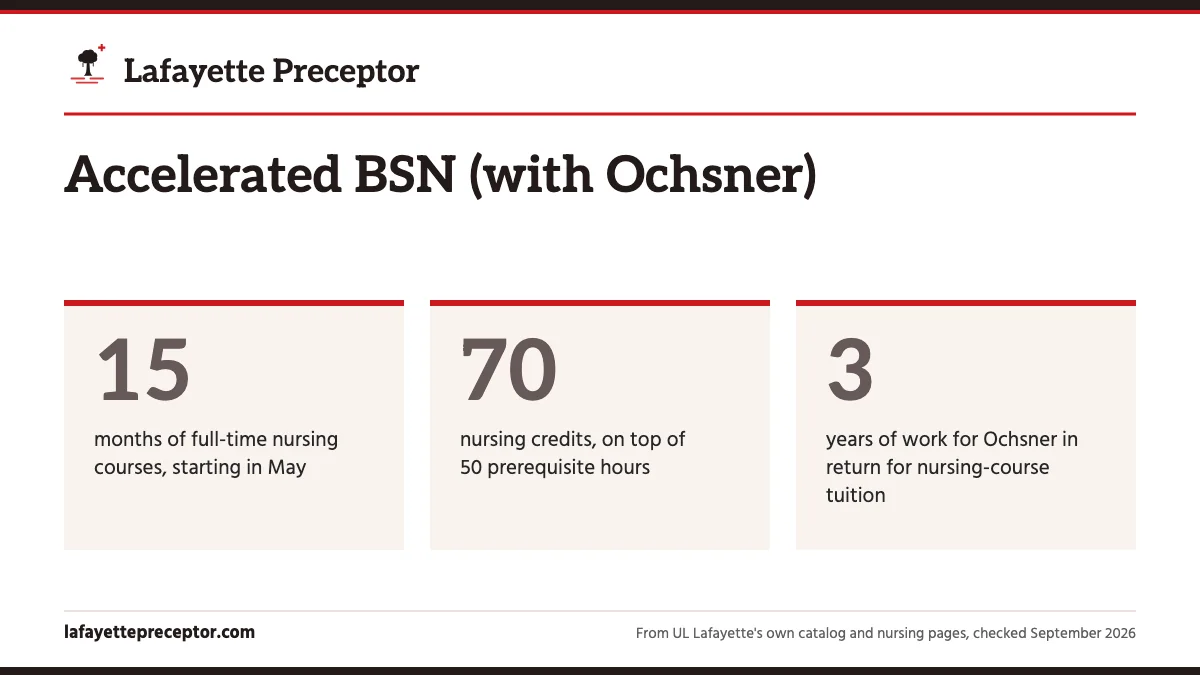
The UL Lafayette · Ochsner Accelerated BSN is a second route into nursing for anyone holding a bachelor's in another field: 15 months of full-time, in-person nursing courses that begin each May. Clinical rotations happen at Ochsner Lafayette General or an Ochsner-affiliated agency, and Ochsner covers tuition for the nursing courses in exchange for a three-year work commitment.
Thinking beyond the Accelerated BSN?
Tell us which graduate program you are considering and your likely start year.
How the program is set up
The catalog lists this track as Nursing, BSN (Accelerated); the School of Nursing calls it the UL Lafayette · Ochsner Accelerated BSN Program. It totals 120 credits: 50 hours of general-education prerequisites that you finish before you start, and 70 credits of nursing coursework packed into 15 months of full-time study.
UL Lafayette describes it as an accelerated, in-person, intensive program, and the catalog adds that some courses use hybrid interactive learning. Expect to be in Lafayette, in class, in the simulation labs or on a clinical unit, for most of those 15 months.
The program is still young. The School of Nursing's FAQ page described the third cohort as planned for May 2026, and by that spring the program page announced that applications for the 2027 cohort were open. Check the program page for the current application window before you plan your prerequisites around a particular May.
If a four-year path fits you better, the traditional BSN guide covers the eight-semester route and its NURS 208 entry process.
The term plan: intersessions, A-terms and B-terms
The catalog lays the program out by term name rather than by semester, and most terms are eight weeks long. Every clinical course has a matching A-suffix number in this track.
| Term | Courses (credits) | Clinical-type course |
|---|---|---|
| May, 3-week intersession | NURS 260A Transition to Professional Nursing (6) | None |
| Summer, 8 weeks | NURS 208A Fundamentals of Caregiving (4); NURS 209A Health Assessment Skills (4) | NURS 208A |
| Fall A, 8 weeks | NURS 309A Clinical Pharmacology (4); NURS 345A Nutrition and Clinical Diet Therapy (3) | Not listed |
| Fall B, 8 weeks | NURS 308A Adult Health and Illness I (9); NURS 346A Nursing and Healthcare Policy (2) | NURS 308A |
| Spring A, 8 weeks | NURS 340A Community and Psychiatric/Mental Health Nursing (9); NURS 408A Trends in Genetics and Genomics (2) | NURS 340A |
| Spring B, 8 weeks | NURS 403A Childbearing Family, Child and Adolescent Health Care (9); NURS 419A Contemporary Approaches to Nursing Leadership and Management (4) | NURS 403A |
| May, 3-week intersession | NURS 405A Informatics and Evidence for Best Practice (4) | None |
| Summer, 8 weeks | NURS 418A Adult Health and Illness II (9); NURS 420A Bridge to Professional Practice (1) | NURS 418A; NURS 420A is simulation |
The catalog names the terms but not their dates. For reference, UL Lafayette's 2026-27 calendar runs Fall A from Aug 24 to Oct 13, Fall B from Oct 19 to Dec 8, Spring A from Jan 13 to Mar 9 and Spring B from Mar 15 to May 4. No Summer 2027 dates had been posted by the end of September 2026. Your cohort schedule from the program is the one to follow, and the academic calendar guide tracks the university dates.
Clinical rotations at Ochsner
Clinical placement in this track comes through the partnership. The catalog places rotations at Ochsner Lafayette General, the program page says Ochsner Lafayette General or an Ochsner-affiliated agency, and the FAQ page speaks of Ochsner Health facilities. The wording differs, but every version points to Ochsner, and none involves a search on your part.
The first clinical-type course is NURS 208A, in the summer term right after the May intersession, with 4.5 lab contact hours in its catalog entry. The four big clinical courses that follow, NURS 308A, NURS 340A, NURS 403A and NURS 418A, carry 13.5 lab contact hours each, and NURS 420A closes the program with simulation. No overall count of clinical hours appears in UL Lafayette's published pages for this track.
Before clinicals begin, you apply to the first clinical course. That application covers Louisiana State Board of Nursing clearance, criminal background screening and drug testing; our background check and drug screen guide sets out how the School of Nursing handles each.
Admission: what you need before May
- A completed bachelor's outside nursing, earned at a school the catalog calls institutionally accredited (the program pages say regionally accredited)
- The 50 prerequisite hours completed before the nursing courses begin
- Science courses taken within the last 10 years; older ones expire
- An in-person interview
- A minimum GPA, where the sources differ (see below)
The GPA is the conflict to watch. The catalog's admission criteria list a 2.6, but the transfer paragraph on the same catalog page, the NURS 260A course entry and both program web pages say 3.0. Treat 3.0 as the working target and ask the program which figure it applies to your application.
Science courses are the other common snag. If your biology or chemistry sits close to the 10-year line, check its date against the May you are aiming for, since a course that expires before you start will need to be retaken.
Catalog admission criteria say 2.6; the program pages and NURS 260A say 3.0. Confirm the GPA with UL Lafayette before you apply.
Tuition and the three-year Ochsner commitment
Ochsner pays tuition for the nursing courses. In return, each student commits by contract to work for Ochsner for three years. The program's FAQ is firm on the point: there is no exception, and paying the tuition yourself to avoid the commitment is not an option. UL Lafayette's pages give no amounts.
Read the commitment as part of the program itself, not an add-on. It sets where you start your nursing career and what your first three working years look like, so weigh it alongside the prerequisites and the pace when you decide whether this track fits.
The work years also shape any graduate plans. If you begin a master's while you work and later hold a graduate practicum at your own employer, the consortium behind UL Lafayette's MSN requires that practicum time to sit apart from your paid shifts and your normal duties; the workplace clinicals page explains the rule.
Grades and progression
The standard is the same as the four-year track's core rule: a C or better in every major nursing course, and a Satisfactory in every lab or clinical component. A strong score on exams cannot offset an unsatisfactory clinical component.
At this pace there is little slack. Courses come in eight-week blocks and three-week intersessions, and each clinical course builds on the one before, so a single setback can move you out of step with your cohort. The catalog and program pages do not spell out how a repeat works inside the accelerated sequence; if you are struggling in a course, talk with your faculty early and ask how a repeat would affect your place.
The broader grade rules across UL Lafayette's programs are compared on the grades and progression page.
Where we fit: after the Accelerated BSN
Your Accelerated BSN rotations come through Ochsner, so there is no preceptor search during these 15 months. Our service begins where the graduate practicum does, and it helps to know what that stage asks for while you are still planning.
UL Lafayette's online MSN, offered through the ICMSN consortium, has its own clinical rules: clinical experiences in Louisiana, a letter of agreement and agency contract on file before the first practicum day, and preceptors held to the Louisiana Board's requirements. For one concentration in depth, read the MSN FNP guide.
When your graduate practicum comes up, whatever part UL Lafayette plays in arranging it, our placement desk sources a preceptor and a site within reach of home, matches both to the course and prepares a complete approval file for faculty review. Reach us any time through the contact page.
Questions UL Lafayette students ask
Does Ochsner pay for the whole Accelerated BSN?
UL Lafayette's pages say Ochsner pays tuition for the nursing courses, the 70 credits you take in the 15-month program. The 50 hours of general-education prerequisites are finished before you start, and the pages do not describe Ochsner covering those. No amounts are published, so ask the program for current figures.
Can I pay my own tuition instead of taking the Ochsner work commitment?
No. The program's FAQ says the three-year commitment to work for Ochsner applies with no exception, and self-paying the nursing tuition to avoid it is not offered. If a set employer for three years does not fit your plans, the traditional four-year BSN is UL Lafayette's other pre-licensure route.
Is the UL Lafayette Accelerated BSN online?
It is not an online program. UL Lafayette calls it an in-person, intensive program, and the catalog notes that some courses use hybrid interactive learning. Clinical rotations happen in person at Ochsner facilities, so plan to live within reach of Lafayette.
How recent do my science prerequisites need to be?
Science courses count only if they were taken within the past 10 years, according to the catalog and the program's FAQ. Measure that window against the May you plan to start, not against the day you apply. A course that falls outside the window before the program begins has to be taken again.
When does the Accelerated BSN start?
Each cohort starts in May with NURS 260A, Transition to Professional Nursing, a three-week intersession course. The first clinical-type course, NURS 208A, follows in the eight-week summer term. The program page announced in 2026 that applications for the 2027 cohort were open; check it for the current deadline.
Related pages
Last checked 2026-09-27
We check these pages against UL Lafayette's 2026-27 catalog, its online program and state authorization pages, the ICMSN student handbook and Louisiana's nursing rules. Your course faculty and your plan of study have the final word.
- UL Lafayette 2026-27 catalog: Nursing, BSN (Accelerated)
- UL Lafayette 2026-27 catalog: College of Nursing and Health Sciences
- LHC Group · Myers School of Nursing: UL Lafayette · Ochsner Accelerated BSN Program
- LHC Group · Myers School of Nursing: Accelerated BSN FAQs
- UL Lafayette Registrar: Academic Calendar
Whether UL Lafayette helps or you start alone, we find the preceptor.
Tell us your UL Lafayette program, the practicum coming up and the Louisiana town you train near. We look for preceptors and sites that fit the course and gather the license, CV and agency details that must be on file before your first clinical day.
- Preceptors who meet Louisiana's rules: an active Louisiana license, most hours with an APRN in your population focus
- The preceptor's CV, the agency details and your letter of agreement items gathered early
- Across Acadiana and the rest of Louisiana, plus DNP residencies in your home state
Start your placement plan
Your program, your town and your next clinical semester is all we need to begin.