Doing your UL Lafayette clinicals where you already work
The ICMSN handbook lets a UL Lafayette graduate student complete clinical hours at the facility that employs them, with a preceptor on staff there, provided those hours stay apart from job duties and fall outside paid time. Everything else still applies: Louisiana's license and population-focus rules, the paperwork on file before day one and faculty approval of the preceptor. This guide covers how to keep the two roles apart and when a different site serves you better.
Get your placement plan
Tell us your UL Lafayette program and where you live. A placement advisor replies with the preceptor and site options that fit your UL Lafayette course.
What the consortium handbook allows
UL Lafayette offers its MSN through the ICMSN, a four-university nursing consortium, so the consortium's student handbook (revised October 6, 2025) sets the clinical procedure. Its section on setting up NP and nurse educator clinical experiences permits a preceptor at the agency that employs you. The condition attached is short: clinical hours have to be kept separate from your job duties, and they have to be unpaid time.
The reason is simple once you see a practicum as a course rather than a shift. The hours you record are graded learning in an advanced practice or educator role, supervised by an approved preceptor and overseen by UL Lafayette faculty. Time spent doing your staff RN job, even beside a nurse practitioner, is still employment, and a preceptor standing nearby does not convert it into clinical time.
The rule sits in the consortium's procedure for the NP and Nursing Education concentrations. If you are in the PMHNP Post-Master's Certificate or the DNP, ask your course faculty or the DNP Coordinator how they want time at your employer kept apart from your job before you plan around it.
Keeping clinical time and work time apart
The cleanest arrangement is one where anyone reading your calendar could tell at a glance which hours were clinical and which were work. A few habits make that easy to show.
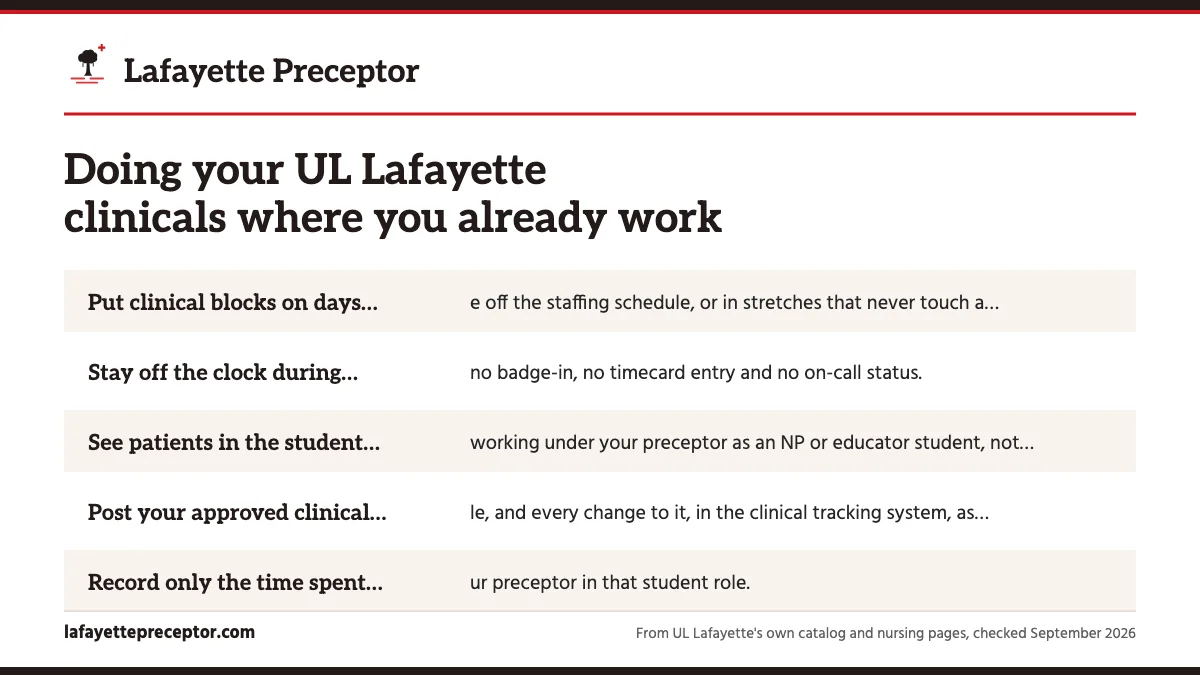
- Put clinical blocks on days you are off the staffing schedule, or in stretches that never touch a paid shift.
- Stay off the clock during clinical time: no badge-in, no timecard entry and no on-call status.
- See patients in the student role, working under your preceptor as an NP or educator student, not carrying a unit assignment as the staff RN.
- Post your approved clinical schedule, and every change to it, in the clinical tracking system, as the handbook directs.
- Record only the time spent with your preceptor in that student role.
- Give your manager the clinical dates in writing so nobody pulls you onto the floor partway through a session.
If a short-staffed unit asks you to pick up an assignment during a clinical block, the time you spend covering it is job duty. Protect the block, or reschedule it with your preceptor and let your faculty member know.
Paid time and job duties never become clinical hours, even with a nurse practitioner in the room.
Louisiana's rules still apply at your employer
A familiar workplace relaxes nothing. Louisiana's Board of Nursing rules (LAC 46:XLVII.3543) require each preceptor to carry a Louisiana RN or APRN license (or both) that is active and unencumbered, and they place most of your clinical time with an APRN who is licensed and certified in your population focus. A preceptor's load is capped at two graduate APRN students per clinical experience. The consortium adds its own minimums, and each preceptor needs course faculty approval followed by a graduate coordinator review; the preceptor requirements guide goes through each standard.
Your employer also needs the same file as any outside agency, beginning with a current agency contract with the university. Being on the payroll does not stand in for that contract, and drawing up a new one is a matter of weeks to months, by the handbook's estimate. The clinical paperwork guide lists every item the graduate nursing office holds before your first day.
Geography matters as well. Every MSN clinical experience has to happen in Louisiana, so an employer across the state line cannot host MSN or certificate hours, however long you have worked there. DNP residency hours are different: UL Lafayette allows them either in Louisiana or in the state where you live. See Louisiana-only clinicals for the details.
Matching your workplace to the course
The larger question is often whether your workplace sees the patients your course needs. The FNP sequence moves across the lifespan: NURS 582 Family Health I covers pediatric, adolescent and childbearing patients, NURS 583 Family Health II covers adults and NURS 584 Family Health III covers older adults. An adult internal medicine practice might suit the second course well and leave the first without the patients it calls for. The FNP practicums guide describes each course.
PMHNP students need psychiatric and mental health patients across NURS 591, NURS 592 and NURS 593, and certificate students finish with NURS 597, which carries an older-adult emphasis. A medical-surgical employer rarely offers that mix. Nursing Education students have more room: NURS 557 has you teaching in precepted classroom, lab and clinical settings, so an employer with a staff education department may host it well.
For the DNP, an agency connection is built into the program. The Synthesis Project committee includes a program-approved mentor drawn from the agency hosting your project, and NURS 822 implements that project with your residency mentor and faculty advisor. When that agency is also your employer, settle early with your faculty advisor how residency time and job time will stay distinct.
When a different site is the better choice
Working where you train saves driving and gives you a head start on the systems. It is not always the stronger option, and these signs point elsewhere.
- Your unit cannot release you on non-working days, so clinical blocks keep turning into shifts.
- The only willing preceptor is your direct supervisor, and you would prefer your final evaluation to come from someone outside your reporting line.
- Your workplace covers one course's population but not the next one in your sequence.
- The APRNs on staff are certified in a different population focus from yours.
- The university holds no current contract with your employer, and the semester starts before a new one could be signed.
- You want exposure beyond the practice habits you already know.
A split plan often works best: one practicum at work where the fit is strong, the others at sites chosen for the populations and range your remaining courses call for.
Where we fit
UL Lafayette students choose us because we treat the workplace question as part of the search from day one. Your placement advisor checks whether your employer can carry each practicum: the preceptor's Louisiana license and certification, the population the course needs, whether the agency contract is already current, and whether your clinical days can sit outside your paid schedule.
Where your workplace fits, we prepare the preceptor's documents and help you plan a schedule that keeps the two roles cleanly apart. Where it falls short for a course, we find a preceptor and site elsewhere in Louisiana that meet the same rules. However your placement comes together on UL Lafayette's side, what reaches your course faculty is complete and ready for their approval. Read how it works, then tell us about your employer in the form below.
Questions UL Lafayette students ask
Can I do UL Lafayette clinical hours at the hospital where I work?
Yes. The ICMSN handbook allows a preceptor at your employer, as long as the clinical time is kept distinct from what you are paid to do. The preceptor still has to meet Louisiana's license and certification rules and the consortium's minimums, with course faculty approval and a graduate coordinator review. The facility must also have an agency contract with the university in force before your first clinical day.
Can my manager or supervisor be my preceptor?
UL Lafayette's public pages and the consortium handbook do not speak to reporting lines. What they require is an approved preceptor who meets the Louisiana and ICMSN standards, with clinical hours kept apart from your job. Because a preceptor's final evaluation can decide your course grade, ask your course faculty before you commit to a supervisor as your preceptor.
Do clinical hours count if I am on the clock?
No. The consortium requires clinical hours to be unpaid time, separate from the work you are employed to do. Hours your employer pays for, or hours spent on your regular assignment, are employment even when a nurse practitioner is close by. Schedule clinical blocks away from paid shifts and record only the time spent with your preceptor in the student role.
Does my employer need a contract with UL Lafayette if I already work there?
Yes. Employment does not replace the agency contract the graduate nursing office keeps on file. Look your facility up in the clinical tracking system to see if a university contract already exists. If it does not, start early, because the handbook warns that securing a new contract can take several weeks to months.
Can I use an employer in another state for my clinical hours?
Not for MSN students or those in the PMHNP certificate, whose clinical hours all stay in Louisiana under a Louisiana RN license. DNP residency hours may be done in Louisiana or in your home state, so an out-of-state employer may suit a DNP student, subject to the same approval steps and a mentor the program approves.
Related pages
Last checked 2026-09-27
We check these pages against UL Lafayette's 2026-27 catalog, its online program and state authorization pages, the ICMSN student handbook and Louisiana's nursing rules. Your course faculty and your plan of study have the final word.
Whether UL Lafayette helps or you start alone, we find the preceptor.
Tell us your UL Lafayette program, the practicum coming up and the Louisiana town you train near. We look for preceptors and sites that fit the course and gather the license, CV and agency details that must be on file before your first clinical day.
- Preceptors who meet Louisiana's rules: an active Louisiana license, most hours with an APRN in your population focus
- The preceptor's CV, the agency details and your letter of agreement items gathered early
- Across Acadiana and the rest of Louisiana, plus DNP residencies in your home state
Start your placement plan
Your program, your town and your next clinical semester is all we need to begin.