Studying nursing with UL Lafayette from anywhere in Louisiana
Louisiana is the only state where every UL Lafayette online nursing program is open to you, and the nurse practitioner tracks keep all of their clinical time here. That puts Louisiana's own rules in charge of your practicum: the license your preceptor holds, how many students that preceptor may take, the RN license you carry and how many programs from other states are chasing the same clinicians. This guide takes each rule in turn, then sends you to your region.
Get your placement plan
Tell us your UL Lafayette program and where you live. A placement advisor replies with the preceptor and site options that fit your UL Lafayette course.
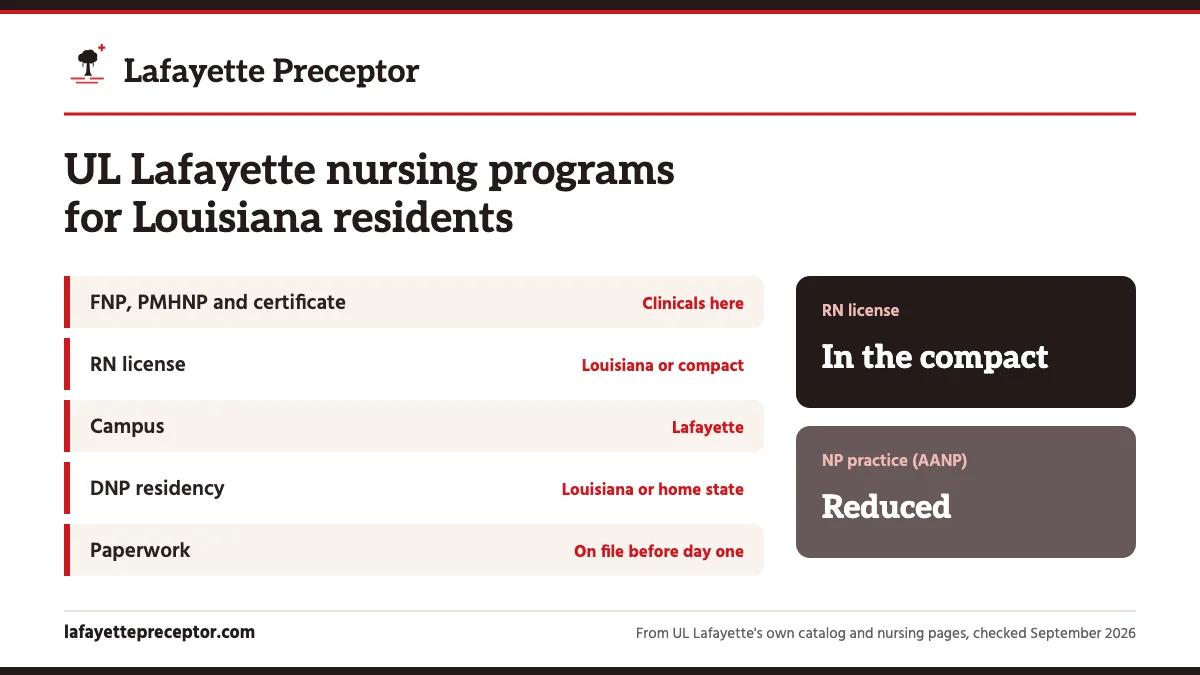
Louisiana's row, program by program
UL Lafayette's state authorization page gives Louisiana the strongest marks it gives any state. The table uses the university's own labels for Louisiana residents, with the one rule each program adds on top.
| Program | Status for Louisiana residents | Note |
|---|---|---|
| MSN Family Nurse Practitioner | Meets educational requirements | Clinical rotations in Louisiana, with a Louisiana RN license |
| MSN Psychiatric/Mental Health NP | Meets educational requirements | The same shared entry and in-state clinical rule as the FNP |
| PMHNP Post-Master's Certificate | Meets educational requirements | Admission also calls for an unencumbered Louisiana APRN license |
| MSN Nursing Education | Accepted (one of eight states) | On the program list, yet absent from the state-by-state section, Louisiana included |
| Doctor of Nursing Practice (post-MSN) | Accepted | Residency hours in Louisiana or your home state; two on-campus events in Lafayette |
| BSN and Accelerated BSN | Campus programs in Lafayette | Semester coordinators assign BSN lab days; Accelerated BSN rotations are at Ochsner Lafayette General or an Ochsner-affiliated agency |
For MSN students, one sentence decides where you train: UL Lafayette wants every clinical experience in its MSN concentrations completed inside Louisiana. The exact wording, its sources and the DNP exception sit on the Louisiana-only clinicals page. This guide picks up where that page stops, with what the rule means once your practicum is in-state.
Three Board rules every Louisiana preceptor has to fit
Louisiana's preceptorship rule, LAC 46:XLVII.3543, is the filter every clinical placement passes through, and it binds UL Lafayette as a Louisiana-approved program. Three of its parts decide whether a willing clinician can actually take you on.
- License. Every preceptor holds a Louisiana license, RN, APRN or both, that is active and carries no encumbrance, so the first check runs against Louisiana's own records.
- Population match. The larger share of your clinical time belongs with an APRN whose license and certification match your population focus: family nurse practitioners for FNP hours, psychiatric nurse practitioners for PMHNP hours.
- Capacity. A preceptor takes on two graduate APRN students at most for a given clinical experience, whichever schools those students come from.
Faculty stay close the whole way. The same rule has nurse faculty confer with each preceptor and each student at least once a week during the precepted experience, and it caps preceptorships at one faculty member for every nine APRN students. The ICMSN, the consortium behind UL Lafayette's MSN, layers its own minimums on top, including at least a year of clinical experience, and course faculty approve every preceptor.
Your RN license, the compact and a wording gap
Since July 1, 2019, Louisiana has belonged to the Nurse Licensure Compact. A multistate license works in both directions across member borders: one issued here lets you work as an RN in any other member state, and one issued by a member state covers practice here.
UL Lafayette's MSN sources describe the license rule in slightly different words. The 2026-27 catalog is the broadest, allowing a current, clean RN license from Louisiana or a multistate license. The online MSN page narrows that: a multistate license qualifies only with proof of Louisiana residency. The state authorization entry for the NP tracks names a Louisiana RN license next to its in-state clinical rule. A Louisiana-issued license satisfies every version; a nurse licensed through another state should ask the online programs office which reading governs before applying.
Louisiana sits outside the APRN Compact, so advanced practice licenses stay state by state. That explains why the PMHNP certificate wants an unencumbered Louisiana APRN license on top of the RN license, while the DNP settles for U.S. licensure: an RN license, plus an APRN nurse practitioner license for post-MSN applicants.
Why programs from other states want your preceptors too
Louisiana lets programs based elsewhere use its clinics, but only once the Board of Nursing signs off. The governing rule, LAC 46:XLVII.3539, covers undergraduate and graduate programs alike when they are run from another state.
Six months or more ahead of its first Louisiana offering, such a program sends the Board a letter listing each agency and unit it intends to use, with its course materials, its catalog, a survey of each clinical facility and forms showing its faculty's qualifications. Beyond that paperwork, the program must already be approved at home, regionally accredited and nationally accredited by a nursing body the Board accepts, and any of the program's faculty who teach here carry a Louisiana license.
Approval can last three years at most, is renewable by petition, and is held by many programs from other states. When one of their graduate students starts a Louisiana experience, the program has two weeks to file the Board's spreadsheet for it. Those students then need the same family practices, psychiatric clinics and hospital units that UL Lafayette students need.
UL Lafayette sits outside that process, since its MSN holds full LSBN approval as an in-state program. The effect lands on supply rather than eligibility. With every preceptor capped at two graduate APRN students, each slot a visiting program fills is one a Louisiana student loses for that term, so an early start counts as much as meeting the rules.
Practicing as an NP in Louisiana after graduation
The rules you will practice under shape the experience worth collecting now. A Louisiana APRN whose work stays within nursing scope needs no collaborative practice agreement. Once your work includes medical diagnosis and management, though, a written agreement with a collaborating physician or dentist becomes mandatory, spelling out that collaborator's availability, how the practice is managed, including clinical practice guidelines, and who covers patients during absences.
Prescribing is gated too: you need 500 practice hours logged as an APRN, or while applying to be one, inside a two-year window and in your role and population. Hours from your graduate program can count toward that total when they met certification eligibility, one more reason the population match in your practicum matters. Controlled substance limits and the rest of the practice picture are on Louisiana NP practice and preceptors.
Lafayette, the campus and the regions where online students live
The LHC Group · Myers School of Nursing is based in V.L. Wharton Hall on UL Lafayette's main campus, with the graduate nursing office in Room 307. Next door, the Health Sciences Campus on the former Our Lady of Lourdes site holds the junior- and senior-level nursing courses in the 501 Building, and a Regional Simulation Center is planned as its next phase.
Online graduate students seldom make the trip. The published requirements for the MSN and the PMHNP certificate list no on-campus sessions, while DNP students come to Lafayette twice: for the DNP Orientation Intensive at the outset and for the formal Synthesis Project presentation at the close.
Clinical options differ by region. Start with yours:
- Lafayette: Lafayette Parish and the city around campus
- Acadiana: Acadia, Evangeline, Iberia, St. Landry, St. Martin and Vermilion parishes
- Baton Rouge: the capital and its surrounding parishes
- Lake Charles: Southwest Louisiana out to the Texas line
- New Orleans: the metro area and the Northshore
- North Louisiana: Shreveport, Monroe and Alexandria
Census Bureau estimates for 2025 rank the state's metros in this order: New Orleans-Metairie first, with Baton Rouge second, Lafayette third and Shreveport-Bossier City fourth.
Access across the state and the systems you will meet
The strongest case for training in Louisiana is access. HRSA's shortage-area files give every Acadiana parish a parish-wide primary care designation and a parish-wide mental health designation, and Acadia, Evangeline, Iberia and St. Landry carry the high-needs geographic label for mental health. Statewide, 58 of the 64 parishes hold a primary care designation for an area or population, and 57 hold one for mental health.
Large systems set their own terms for students from any school. Ochsner Health accepts requests only from a school's representative through its InPlace system, asks programs to allow at least four months for a new agreement, and wants students to send every request, preceptor names included, through their school instead of approaching its providers. LCMC Health wants an affiliation agreement first and states that it runs no preceptor matching program.
Other large names, such as Baton Rouge General, Willis-Knighton Health and FMOL Health, show no process on their public pages for NP students from outside programs. Read all of these as examples of how Louisiana systems operate, not as sites that take UL Lafayette students.
Why Louisiana students choose us
We build every Louisiana search around the Board's filter: a preceptor with an active Louisiana license, a population match for the bulk of your hours, and one of that preceptor's two student slots still open for your term. Whatever role UL Lafayette takes in arranging clinicals, you get a close-to-home match that already fits its rules, with the agency details, preceptor CV and letter of agreement assembled well before the semester. Share your program, parish and first clinical term in the form below.
Questions UL Lafayette students ask
How many students can one Louisiana preceptor supervise at a time?
Two graduate APRN students at once is the ceiling LAC 46:XLVII.3543 sets for a single clinical experience. The cap follows the preceptor rather than the school, so a nurse practitioner already hosting two students from other programs has no room that term. That is why we confirm open capacity for your exact dates before a preceptor's name goes to your course faculty.
Can a physician precept a UL Lafayette NP student in Louisiana?
Yes, for a share of your hours. Under Louisiana's rules, a graduate preceptor may be a physician or dentist as well as an APRN, and its rule lets a mix of clinicians provide direct clinical teaching. Still, the bulk of your clinical time belongs with an APRN whose license and certification match your population focus, so a physician rotation works best as a complement to your main preceptor.
Does Louisiana offer a tax credit for precepting NP students?
No tax credit for precepting appears in Louisiana law, and the state has no other preceptor incentive on record. With no state incentive in play, a clear request matters more: we give each preceptor the course, the dates, the expected hours and the paperwork up front, so saying yes takes little of their time.
Do Louisiana nurse practitioners need a collaborating physician?
For medical diagnosis and management, yes. A Louisiana APRN who does that work needs a written collaborative practice agreement naming a physician or dentist, while practice that stays within nursing scope needs none. Prescribing is a separate step: it opens after 500 hours of practice in the APRN role, time as an applicant included, within the prior two years.
When should a Louisiana student start lining up a clinical site?
Months before the first clinical course. The ICMSN handbook says a brand-new agency contract may need weeks or even months, Ochsner Health asks programs to allow at least four months for new agreements, and Louisiana wants a clinical facility survey filed at least four weeks before a new agency is used. Our search begins the moment your first clinical term is known.
Related pages
Last checked 2026-09-27
We check these pages against UL Lafayette's 2026-27 catalog, its online program and state authorization pages, the ICMSN student handbook and Louisiana's nursing rules. Your course faculty and your plan of study have the final word.
- UL Lafayette Online: State authorization for online programs
- UL Lafayette Online: Nursing, M.S. (online)
- Louisiana Administrative Code 46:XLVII.3543, Preceptorship Learning Experiences
- Louisiana Administrative Code 46:XLVII.3539, out-of-state programs in Louisiana
- HRSA: Health Professional Shortage Area finder
Whether UL Lafayette helps or you start alone, we find the preceptor.
Tell us your UL Lafayette program, the practicum coming up and the Louisiana town you train near. We look for preceptors and sites that fit the course and gather the license, CV and agency details that must be on file before your first clinical day.
- Preceptors who meet Louisiana's rules: an active Louisiana license, most hours with an APRN in your population focus
- The preceptor's CV, the agency details and your letter of agreement items gathered early
- Across Acadiana and the rest of Louisiana, plus DNP residencies in your home state
Start your placement plan
Your program, your town and your next clinical semester is all we need to begin.